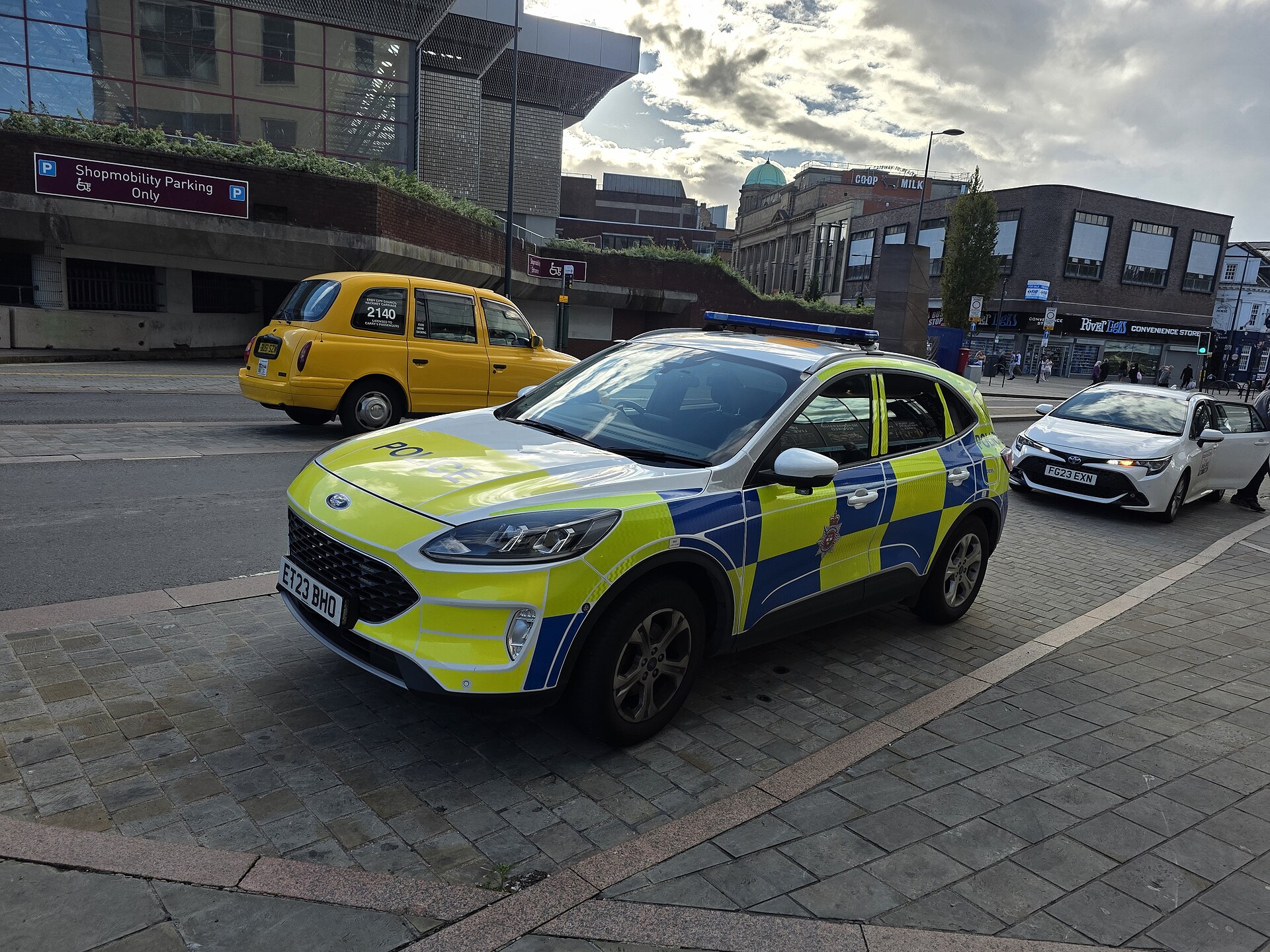
File photo: A police car in Derby. This is not the vehicle from the Chesterfield stop. Photo: HJ Mitchell via Wikimedia Commons (CC BY 4.0)
Derbyshire Constabulary has published an account of a Chesterfield traffic stop that doubles as a tidy lesson in how motor insurance actually works. Officers patrolling Grangewood Road on 1 December clocked a Ford Focus revving excessively, its exhaust snapping out repeated pops. They stopped it. The driver, 29-year-old Luke Hobley of Hollis Lane, smelled strongly of cannabis and then failed a roadside drugs test. Database checks showed no cover for the car. He told officers he had bought temporary insurance. He had, in fact, bought it from the back seat of the police car.
Full marks for initiative. None whatsoever for understanding the product.
Insurance Is a Timestamp, Not a Receipt
Section 143 of the Road Traffic Act 1988 makes it an offence to use a vehicle on a road without at least third-party cover. That verb is doing all the work. Liability attaches to the moment the wheels are turning, not to whatever paperwork exists by the end of the shift. A policy bought at 3:42pm does nothing for a car driven at 3:15pm, and there is no retroactive backdating in British motor insurance, because an insurance contract exists to transfer an unknown future risk. An event that has already happened is not a risk. It is a claim.
Modern data is what ruins the improvisation. Every live UK policy is fed into the Motor Insurance Database, the record that ANPR cameras and roadside checks interrogate and that anyone can query through askMID. That record carries inception and expiry. Short-term products, the one-day and one-week policies sold instantly online, are timed to the minute by design, because they have to be: sell someone 24 hours of cover and you need to know precisely which 24 hours. The very product chosen to paper over the gap is the one that documents the gap most exactly. PC Adam Hardy, who led the investigation, noted that officers “will always check the start and end dates of insurance policies.”
The Roadside Swab Is the Opening Act, Not the Evidence
Roadside kits analyse oral fluid and screen for two substances: cannabis and cocaine. A positive gives grounds for arrest. The prosecution case is then built on a blood sample measured against the specified limits that came into force in 2015 under section 5A. Those numbers are not impairment thresholds, and that distinction is the whole ballgame. The Department for Transport’s published table sets delta-9-THC at 2 micrograms per litre of blood, a zero-tolerance figure pitched low enough to catch deliberate use and high enough to rule out accidental exposure. Cocaine sits at 10, its metabolite benzoylecgonine at 50, ketamine at 20, heroin’s marker at 5. You do not need to be visibly impaired to be guilty. You only need to be over.
Anyone assuming drug-driving law mirrors drink-driving law is in for a shock. Alcohol leaves the bloodstream at a broadly predictable rate, which is why drivers can do rough mental maths the morning after. THC does not behave that way, and the government states flatly that it cannot offer any dosage-to-blood-level guidance because the variables are too numerous. “That was last night” is not a defence. It is frequently the explanation for the reading.
The Fine Is the Cheap Part
At Chesterfield Magistrates’ Court on 28 August, Hobley admitted drug driving and using a vehicle without insurance. He was disqualified for 22 months, ordered to complete 90 hours of unpaid work, and told to pay £1,201.44 in costs plus a £114 victim surcharge. Look closely at the ban. The statutory floor for drug driving is 12 months, so 22 months is nearly double the minimum, which is roughly what happens when a second offence and a clumsy attempt to conceal it arrive in the same file.
The £1,315.44 is the small number. The endorsement is the expensive one. Drug-driving codes such as DG10 sit on a driving record for 11 years from the date of conviction, nearly triple the four years an IN10 no-insurance conviction lingers. That is 11 years of declarable history at every renewal and every quote. A large slice of the mainstream market simply declines the risk outright; the rest hand it to specialist non-standard underwriters whose pricing makes the original temporary policy look like a rounding error. Anyone who drives for a living has the conviction visible on the employer’s licence check, and the government’s own guidance warns it can complicate travel to countries including the United States. If you want the unglamorous mechanics of how underwriters build a premium in the first place, our guide to buying cover without overpaying lays out the levers.
The Exhaust Did the Snitching
Worth sitting with the reason this car was stopped at all. Officers did not describe erratic driving or a swerving line. They described noise: heavy revving and an exhaust popping repeatedly. That sound is almost never a fault. Overrun crackle is manufactured, usually by a calibration that holds the throttle slightly open or keeps injecting on a closed throttle while yanking ignition timing deep into retard, so combustion finishes in the manifold instead of the cylinder. It is a tuning choice, sold as a burble map or crackle map, and it is deliberately audible from three streets away.
It also quietly destroys hardware. Burning fuel downstream of the exhaust valves puts sustained heat exactly where nothing was designed to tolerate it: valve faces and seats, the turbine housing on a boosted engine, and above all the catalytic converter, whose washcoat sinters and loses conversion efficiency under repeated fuel dumping. The end state is a catalyst efficiency fault code, a failed emissions check, and a four-figure repair on a car that was not worth four figures of repairs. Enthusiasts in the United States are getting squeezed from the noise side too, as cities write decibel ordinances with actual enforcement teeth.
There is a subtler insurance trap buried here as well. A non-factory exhaust or an ECU remap is a material fact. Leave it undeclared and the policy you genuinely paid for can be voided or a claim cut back, which drops an otherwise law-abiding owner into the same legal bucket as the man in the back of the patrol car. Declaring a modification costs a phone call. Not declaring it costs the whole claim.
Why Forces Chase a 300-Pound Offence So Hard
Uninsured driving looks like a victimless administrative slip until you read the numbers the Motor Insurers’ Bureau publishes. The MIB, which exists to compensate people hurt by uninsured and hit-and-run drivers, puts roughly 335,000 uninsured vehicles on UK roads on any given day, estimates the practice costs the country about a billion pounds a year, and reckons someone becomes a victim of an uninsured or hit-and-run driver every 20 minutes. Every honest policyholder funds that through a levy quietly baked into their premium, which is why a no-insurance ticket is not a paperwork matter to the people writing it.
The powers reflect that arithmetic. Driving uninsured carries a roadside fixed penalty of 300 pounds and six points, and in court it becomes an unlimited fine plus discretionary disqualification, with six to eight points if no ban is imposed. Officers can also seize the vehicle and, in some cases, have it destroyed. Registered keepers who let cover lapse without filing a SORN get caught by continuous insurance enforcement instead: a 100-pound fine, clamping or crushing, and up to 1,000 pounds if it reaches court. That regime catches collectors and dormant-project owners far more often than criminals, which is exactly how James May ended up in trouble over a classic motorcycle.
The seizure power is not theoretical, either. London’s Metropolitan Police has been using it at industrial scale during summer supercar season, including the operation where 90 cars came off the street in three days. Once a vehicle is in the pound, storage fees accrue daily and the recovery paperwork demands valid insurance before release, which is its own catch-22 for anyone who was uninsured to begin with. The legal gymnastics involved in moving those cars are genuinely interesting, and we have explained how officers can lawfully drive an uninsured car when the owner cannot.
The Owner Takeaways
The useful lessons here are boring and free. Check your own cover on askMID before you move a car you rarely drive, because accidentally uninsured is a real and common category rather than an excuse. Buy short-term cover before the key goes in the ignition, not after, and screenshot the certificate with its start time visible. Declare maps, exhausts and anything else that deviates from the build sheet. Keep a SORN on anything sitting in the garage between projects. And if you are weighing up whether a crackle tune is worth the money, price a replacement catalytic converter first, then decide.
Hobley’s improvisation failed for the most mundane reason available. He was negotiating with a database, and the database already knew what time it was.
About the Author