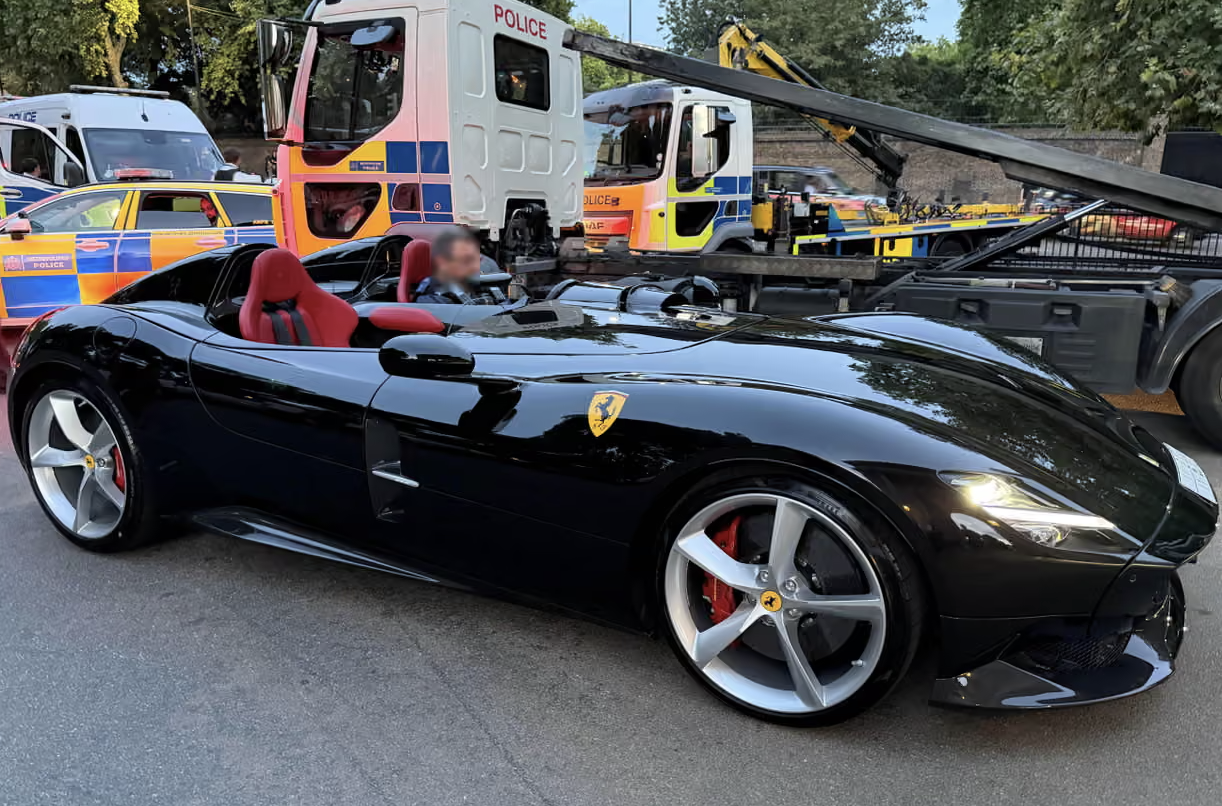
Ninety cars in seventy-two hours. That is what the Metropolitan Police lifted off London’s streets between Friday 7 and Sunday 9 August, and the running total came to more than £8 million — call it $11 million — of metal riding away on flatbeds. It is the largest haul in the five years this operation has run, up from 72 vehicles last summer, and the roster reads like the valet queue outside a Mayfair hotel: a Lamborghini Revuelto, a Ferrari Purosangue, a Ferrari 812, a Porsche 911 GT3, a Rolls-Royce Cullinan, a Rolls-Royce Wraith, a Bentley Continental, assorted McLarens and Aston Martins, plus the car that made the evening news — a £3.7 million Ferrari Monza SP2 driven by a man holding a provisional licence.
Here is what got buried under the photographs. Almost none of this was about driving. Nobody needed to be clocked at triple digits down Park Lane. The Met emptied ninety parking spaces using documents, and the documents are considerably more interesting than the exhaust notes. We already covered how officers legally moved that uninsured Ferrari once it was in their hands. The bigger question is what let them touch it at all.
Two statutes, wildly different workloads
The heavy lifting comes from Section 165A of the Road Traffic Act 1988. A uniformed officer asks for your licence or proof of insurance, you cannot produce it, the officer has reasonable grounds to believe you were driving without either — and the car goes. There is a warning requirement, but it is a warning measured in seconds: produce the paperwork now or watch the truck arrive. No history, no file, no prior contact required.
The other tool is Section 59 of the Police Reform Act 2002, the antisocial-use power that covers the revving, the launches off Sloane Square, the two-in-the-morning theatre outside Wellington Arch. That one is slower. It generally requires that the driver already received a warning, and that warning stays live for twelve months. Officers can skip it in narrow circumstances, but the default is a paper trail.
Which is exactly why only 15 of the 90 seizures came under antisocial behaviour legislation. Section 59 needs a history. Section 165A needs a failed document check. When you have 120 officers — 95 of them from the Special Constabulary and the Vehicle Enforcement Team — working a three-day window across Hyde Park, Kensington and Chelsea, Park Lane and Vauxhall Bridge, you use the power that resolves in ninety seconds at the driver’s window, not the one that requires a twelve-month lookback.
That is the mechanical reality of modern traffic enforcement. An ANPR camera reads the plate, cross-references the Motor Insurance Database, and the constable walking toward the car already knows the answer. The Motor Insurers’ Bureau supported this operation directly with database access. The conversation at the window is a formality.
The provisional licence detail nobody has picked apart
The Monza SP2 is one of 499 cars in Ferrari’s Icona run, split between the single-seat SP1 and the two-seat SP2. It uses a 6.5-litre naturally aspirated V12 derived from the 812 Superfast, with reworked intake fluid dynamics, and it has no windscreen — Ferrari replaced the glass with a shaped air deflector it calls a Virtual Wind Shield, which redirects airflow over the driver’s head at speed. There are no windscreen pillars. It is a 1950s sports-racer silhouette with a modern crash structure underneath.
Now the legal curiosity. In Great Britain a provisional licence holder can drive a startling range of vehicles perfectly legally, provided the car wears L plates and carries a qualified supervisor. There is no exotic-car carve-out. No power ceiling. Nothing in the licensing rules says a learner cannot pilot a V12 barchetta.
So the SP2 — two seats — could in principle be driven lawfully by a learner. The SP1 could not, because there is nowhere for the supervisor to sit. Ferrari accidentally built one car a British learner can legally drive and one it cannot.
The wall is not the licence. The wall is the policy. Finding an underwriter willing to cover a provisional holder in a car worth more than most London terraces is not a matter of paying a high premium; it is a product that essentially does not exist. That is the gap the Met drove a flatbed through.
A £3.7 million Ferrari costs £20 a day in the pound
This is the part that should genuinely annoy anyone who has ever paid for specialist storage. Recovery and retention charges for police seizures are fixed by statute, and they do not scale with value. For a vehicle up to 3.5 tonnes, taken away upright and undamaged, the removal charge is £150. Storage runs £20 per 24-hour period. Disposal is £75.
Those figures were set in 2008 and have not moved since. A Monza SP2 sits in a police compound at the same daily rate as a fifteen-year-old Astra. Meanwhile the recovery operator is expected to move an open-topped, screenless, carbon-bodied hypercar on soft straps without touching a painted surface, then store it somewhere dry and secure, on the same tariff as a shopping car. The economics are brutal for the operator and, frankly, a bargain for the owner. Climate-controlled specialist storage in central London is not a £20-a-day product.
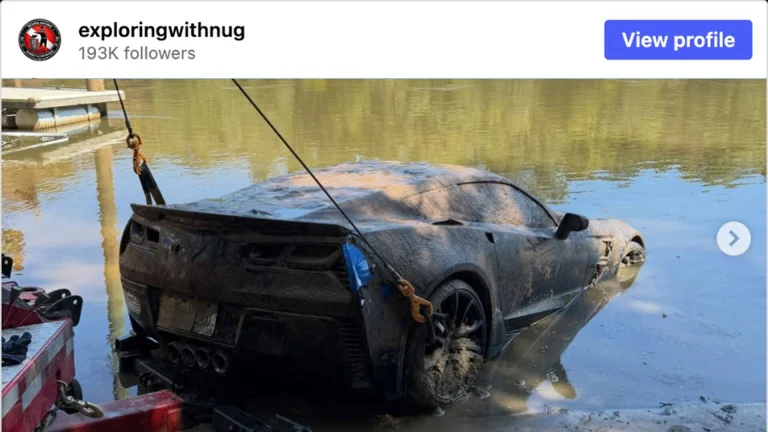
It is a useful reminder that the pound has no idea what it is holding. If you want a sense of how differently forces treat a seized car once the legal dust settles, look at what the DEA did with a confiscated C8 Corvette — the vehicle stops being an asset and becomes a prop.
The fourteen-day clock, and how you actually get it back
Under the 2005 retention and disposal regulations, an authority cannot dispose of a seized vehicle within 14 days of the seizure. After that window closes, and after the date specified in the seizure notice has passed without compliance, the car can be sold or scrapped. If someone formally claims it, disposal is blocked for a further seven working days.
To get the car released you have to walk into the police station named on the seizure notice with two things: a valid certificate of insurance covering your use of that specific vehicle, and a valid licence authorising you to drive it. If you cannot produce both, you can nominate a third party who can — they present their own insurance and licence and collect it on your behalf.
There is one exemption worth memorising. The registered keeper does not pay the charges if they were not driving, did not know the vehicle was being used, did not consent to it, and could not reasonably have prevented it. Note the word “and”. All four conditions, not any one of them. Handing over the keys and later regretting it fails the test on the third condition alone.
The bit that catches owners, not drivers
Section 143(1)(b) of the Road Traffic Act makes it an offence to cause or permit another person to use a vehicle without insurance in force for that person’s use of it. Licensing law carries a parallel provision. Translated: if you let a friend take your car around the block and their cover does not extend to it, you have not witnessed an offence. You have committed one.
The penalties are not symbolic either. An IN10 endorsement — using a vehicle uninsured against third-party risks — carries six to eight penalty points and sits on the driving record for four years, with disqualification available to the court. Anyone who has renewed a policy with an IN10 attached knows the quote does not resemble the old one. The UK is unusually willing to prosecute pure documentation failures, which is roughly the lesson from Ed Sheeran’s conviction over an Aston Martin that had not moved in years.
Foreign plates, summer season, and the insurance trap
August in Knightsbridge means Gulf-registered supercars arriving by air freight, and the rules around them are genuinely permissive. A non-UK resident can bring a foreign-registered vehicle in for up to six months in any twelve, keep home plates, and pay no VAT or customs duty, provided it is registered and taxed at home and used privately. Form C110 covers the relief.
What the temporary import allowance does not do is supply insurance. Section 143 requires cover valid for use in Great Britain, full stop. A home-market policy frequently stops at the border, and the post-Brexit paperwork regime removed a lot of the assumptions drivers used to make. The Met flagged exactly this pattern: policies with the wrong registration typed in, and policies that simply do not extend to the UK.
If the car is not on the Motor Insurance Database and the driver cannot produce a certificate at the roadside, the outcome is not a discussion. It is a recovery truck.
Why an insurance stop is never just an insurance stop
The Motor Insurers’ Bureau puts roughly 335,000 uninsured vehicles on UK roads on any given day, estimates that someone becomes the victim of an uninsured or untraced driver every 20 minutes, and puts the annual cost to honest policyholders at around £1 billion. One in ten people, by the MIB’s reckoning, do not know motor insurance is compulsory at all.
But the enforcement logic runs deeper than premiums. Four people were arrested during the three days: one for handling stolen goods and money laundering after officers found 19 bank cards and more than £2,500 in cash, one for possession with intent to supply Class A, B and C drugs alongside £5,500 in cash, one for a public order offence, and one on an immigration matter. None of those were the reason the cars were stopped.
A missing insurance record is a cheap, legally clean reason to open a conversation with a vehicle that is already behaving strangely. American forces reach the same conclusion by different routes — see what Detroit’s street racing enforcement actually costs drivers and spectators, or the Elk Grove car meet that ended with a tow truck.
Practical takeaways if you drive anything interesting in London
Check your registration on the Motor Insurance Database yourself rather than trusting the certificate. Transposed characters are the single most common reason an insured car reads as uninsured at an ANPR gantry. If you have a personalised plate, confirm the insurer has the current mark and not the one it was bought under.
If you are lending a car, get written confirmation that the borrower’s policy names both them and that vehicle. Driving-other-cars extensions are narrower than most people assume and frequently exclude high-value machinery outright.
If you are visiting with a foreign-plated car, buy UK-valid cover before the car is unloaded, not after. And if the worst happens, remember that the release requirements are personal to whoever collects: bring somebody who can legally drive the thing, or it does not leave the compound.
Five years in, this operation is growing rather than tapering — 90 cars this summer against 72 last. The Met has found the cheapest enforcement lever in British policing: a database lookup that costs nothing to run and produces a photograph of a Ferrari on a flatbed. Expect it every August.
About the Author