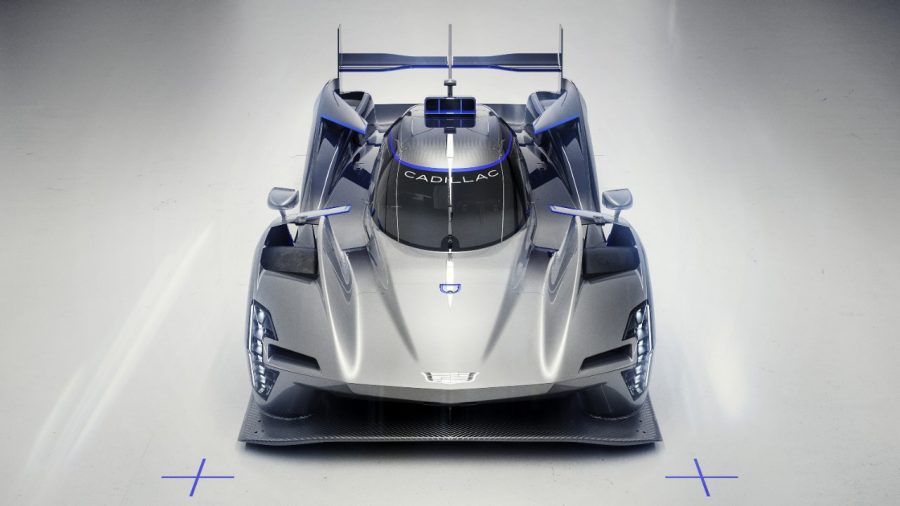
Every race car sold to the public through homologation rules is, by design, less than it could be. Regulators cap horsepower, restrict aerodynamics, and standardize hybrid output so a grid of different manufacturers can theoretically finish within a few tenths of each other. Cadillac just handed over the paperwork on how much sandbagging that actually requires. The V-ONE concept revealed on August 14 shares a chassis, bodywork, and V-8 with the Cadillac V-Series.R that races at Le Mans, Daytona, and everywhere in between — and with the rulebook tossed aside, it makes roughly 830 horsepower, well beyond what the actual race car is allowed to produce on a Sunday.
Underneath, there’s no pretending involved. The V-ONE rides on the same carbon-fiber tub that Italian chassis specialist Dallara builds for the V-Series.R, wrapped in bodywork pulled from the identical molds as the race car. As Cadillac LMDh Propulsion Manager Sean O’Shea puts it, the V-ONE is “about as close to the race car as you can get.” The 5.5-liter naturally aspirated V-8 carries over too, hand-assembled in Pontiac, Michigan by technicians who’ve spent entire careers building race engines, a process that eats up 160 hours per engine before it ever gets bolted into a chassis. That labor bill alone explains why Cadillac has no intention of selling this thing.
The horsepower story is the most interesting engineering wrinkle here. IMSA and WEC competition rules cap the combined output of the V-Series.R’s V-8 and hybrid system to keep prototype entries from different manufacturers competitive with each other, a form of technical parity that’s kept top-tier endurance racing close for years. Strip that ceiling away, as Cadillac did for the V-ONE, and the hybrid motor stops being a compliance tool and becomes a straight-up power adder. Drivers get a push-to-pass-style button that dumps an extra 134 horsepower into the car on demand, the same broad idea behind the boost buttons showing up on hybrid road cars like Audi’s own 987-horsepower supercar, just borrowed from a Le Mans pit lane instead of a marketing deck.
Cadillac is targeting lap times within roughly 10% of the actual V-Series.R’s race pace despite that power advantage, because the V-ONE’s hybrid system is intentionally simplified and its aerodynamic package blends elements from multiple V-Series.R iterations rather than a single homologated spec. This isn’t simply a race car with a bigger power button. It’s a related but distinct aerodynamic and software tune, built around a road-adjacent driving experience rather than a 24-hour fuel and tire strategy.
The visual differences matter more than they might seem. Race cars get vinyl wraps because liveries change constantly and repainting a chassis mid-season isn’t practical. The V-ONE, freed from that logistical reality, is hand-painted in a gradient that runs from silver at the nose to a near-black “Caspia” blue at the tail, a nod to the light-to-dark rhythm of a long endurance race. It also previews two pieces of future Cadillac hardware: a new V-Series logo and a wheel design the brand says will show up on production V-Series models down the line. Cadillac has been aggressive about building out that performance sub-brand lately, including the 685-hp CT5-V Blackwing F1 Collector Series it built to mark its first Formula 1 season, and the V-ONE reads like the halo-est version yet of that same push.
Inside is where Cadillac clearly spent its design budget. The cabin swaps the race car’s tight, function-first seat for a GT3-style bucket that trades a bit of snugness for far better visibility, while the steering wheel went through three dozen design iterations before landing on a shape that still carries over much of the actual race car’s switchgear. Blue ambient accents echo the exterior livery, and here’s the part worth flagging for anyone who assumes concept car means show-car safety: the V-ONE retains the FIA-approved survival cell from the V-Series.R and was validated against the same FIA crash and structural standards as the real race car. That’s a meaningfully higher safety bar than nearly any road-going concept ever needs to clear, and it’s a good example of how expensive it gets to build “just a concept” when the base architecture is a motorsports-homologated tub.
None of this is for sale. Cadillac says so explicitly. So why build an 830-horsepower press vehicle that can’t generate a single sales transaction? Because halo cars have never really been about the car itself; they’re about what a brand wants people to believe about everything else in its lineup. Cadillac is running two strategies at once right now: reintroducing gas-powered versions of the XT6 and CT5 after leaning hard into an EV-first plan that didn’t land the way GM hoped, while simultaneously pouring resources into motorsport-adjacent performance flexes like the V-ONE and its Formula 1 program. A race-car concept that shares its chassis, engine, and now-public design language with a production-bound V-Series wheel is cheap marketing insurance. It tells buyers the brand’s performance credibility is real, even while the showroom lineup is in flux.
Cadillac’s LMDh program has earned pole positions, race wins, and a championship since it returned to prototype racing, exactly the kind of on-track pedigree brands love borrowing for a concept like this. It’s the same instinct that sends manufacturers like Honda into Monterey Car Week with two dozen championship-winning race cars just to remind everyone where their engineering comes from. The V-ONE won’t turn a wrench for anyone’s driveway, but it’s a clean look at what a modern LMDh platform can do once nobody’s worried about beating a rival manufacturer by exactly the right margin, and a pretty good hint at where Cadillac’s next real V-Series street car might borrow its face.
About the Author