Detroit Wrote 53 Tickets in a Parking Lot. The Tickets Are the Cheapest Part.
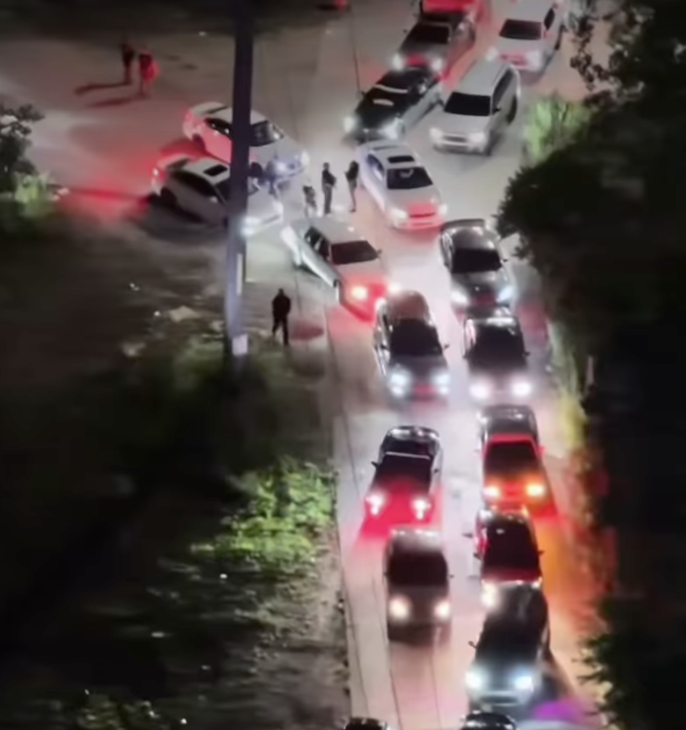
Detroit police broke up a car gathering near the I-75/I-94 interchange late Sunday, July 26, after a 911 call about a large crowd and loud music. By the time it was over, officers say they had looked at 65 vehicles, impounded nine, and issued 53 ordinance violations. They also recovered a firearm and cited one vehicle for fleeing and eluding — the driver ran, and police say they’ve identified the car and are still looking for whoever was behind the wheel.
Read that list again and notice what’s missing: charges. Fifty-three ordinance violations is not fifty-three racing prosecutions. Municipal tickets are the fast tool — cheap to write, no arraignment, no jury, and they clear a lot in about twenty minutes. If you came away thinking the worst-case outcome here is a fine you can pay online, you’ve misread the operation. The nine tow trucks were the point.
The parking lot is not a loophole
The most common misconception in the American street-racing scene is that a private lot puts you outside the traffic code. In Michigan it does not. The drag racing statute, MCL 257.626a, reaches a highway “or any other place open to the general public, including an area designated for the parking of motor vehicles.” Lawmakers closed that door in the 1960s. A strip-mall lot, an industrial apron, a shuttered big-box parking field — all fair game.
Related Articles
- Norway Tested a Chinese Bus Inside a Mountain and Found a Foreign SIM Card Holding the Kill Switch
- Race Weekend Recap: Heim Shocks the Brickyard, Norris Ends His Skid in Hungary, and Kalitta Doubles Up in Seattle (July 24-26)
The same statute contains the sentence that should interest spectators. Subsection (1) prohibits two things: operating in a speed contest, and assisting in one. Not watching. Not filming. Assisting. Whether standing in a circle that forms the walls of an impromptu skidpad counts as assistance is a fact question a district judge gets to decide, and prosecutors in Michigan have been willing to test it.
Subsection (2) is the part that catches people who were never racing at all. Two vehicles accelerating from a common starting point above the limit is prima facie evidence of a drag race. That’s a presumption. You don’t get to start from zero and make the state prove intent; you start behind and have to explain yourself. Pulling away from a green light next to someone with a loud exhaust is a worse legal position than most enthusiasts realize.
What actually lands on your record
Drag racing carries four points under the Michigan Secretary of State’s schedule. Reckless driving — the charge that usually attaches to donuts and drifting, since it doesn’t require a second car — is six, as is fleeing and eluding. Points sit on the record for two years, and twelve inside that window triggers a Secretary of State reexamination that can end with restrictions, suspension, or revocation.
Reckless is also a misdemeanor under MCL 257.626, good for 93 days and $500. If somebody in that crowd gets a body function seriously impaired, it’s a five-year felony. If somebody dies, fifteen.
The insurance consequences are worse than the fine
Here’s where Michigan gets specific in ways most drivers never learn until the renewal notice arrives.
A reckless driving conviction within the preceding three years removes you from the definition of an “eligible person” for auto insurance under MCL 500.2103. Eligibility is the statutory backstop that keeps carriers from turning you away. Lose it and the guaranteed-issue protections stop applying to you for three years. Note the drafting: the list names section 626, reckless driving. It does not name 626a, drag racing. Two offenses that sound like cousins, two very different insurance outcomes.
Separately, MCL 500.2111 requires every carrier to run a merit-rating plan with surcharges based on convictions under Chapter VI of the vehicle code — the chapter that contains both statutes above. The law caps how long a civil infraction can be merit-rated, tying it to the SOS points window. Misdemeanors get no such cap. Your two-year points clock and your surcharge clock are not the same clock.
And one more, aimed squarely at the modified-car crowd: MCL 500.2118 lets an insurer build underwriting rules around “substantial modifications from the vehicle’s original manufactured state for purposes of increasing the speed or acceleration capabilities of the vehicle.” In plain terms, Michigan law expressly permits a carrier to decline or limit coverage because your car makes more power than it left the factory with. That has nothing to do with Sunday night, and everything to do with why you should read your policy before you build.
How Detroit actually takes the car
Impound is a tow bill. Forfeiture is a different animal, and Detroit has been open about preferring it.
The mechanism is nuisance abatement under MCL 600.3801 and the sections that follow. It’s a civil, in rem proceeding — the case is captioned against the car. Two provisions matter to owners. First, MCL 600.3815 states plainly that proof of a defendant’s knowledge of the nuisance is not required. Second — and this is the protection that arrived by amendment and that nobody talks about — when the state seeks forfeiture of a vehicle, it bears the burden of proving by clear and convincing evidence that the vehicle was used for or in furtherance of the conduct. That’s a higher bar than the preponderance standard governing the rest of the chapter. If your car is in a Detroit lot right now, that sentence is the one your attorney should be reading.
If you’re thinking about lending a car to a friend who likes tire smoke, understand what Michigan courts have already decided. In a 2014 Court of Appeals case out of Wayne County, a father lost a Camaro his son had driven in Detroit street races. He testified he thought the kid was driving to his sister’s house. The court affirmed the forfeiture anyway, resting on the statute’s no-knowledge-required language and on Bennis v. Michigan, the 1996 U.S. Supreme Court decision — itself a Detroit case — that rejected an innocent-owner defense in nuisance abatement. The precedent that lets a city take a car from someone who did nothing wrong was made here.
That same opinion is worth reading for what it says about the events themselves: an undercover deputy documented at least twenty races over roughly a year, with crowds running into the hundreds, liquor sold from carts, a civilian killed and a deputy wounded by gunfire, and enough parked cars to block fire trucks and ambulances. That’s the institutional memory Detroit brings to a Sunday night phone call about loud music.
Practical notes
Financing doesn’t insulate you. Under MCL 600.3810, a lienholder with a recorded interest is treated as an owner of the vehicle, which means your lender becomes a named party in a forfeiture action over a car you’re still making payments on. That is a conversation you do not want to have with a credit union.
Related Articles
- Bugatti’s Last Quad-Turbo W16 Roadster Heads to Auction With a $10 Million Estimate
- A Stolen Toyota Highlander Disappeared for Five Years and Crossed Two Borders — Paperwork Finally Caught Up With It
Cars that go all the way through don’t vanish. Detroit runs public vehicle auctions at DPD facilities on Grand River and Grinnell and at a lot on Trombly. If you’re a buyer, understand what feeds that pipeline before you bid on a lightly abused Charger.
And if you want to know where the enforcement push goes next, the Board of Police Commissioners meets Thursday, July 30 at Public Safety Headquarters. DPD’s drifting and drag-racing detail has been a standing item at those meetings, and it’s the venue where the department’s own numbers get put on the record — a better source than any weekend press availability.
The underlying tension hasn’t moved in twenty years. Detroit is the one American city where car culture is the civic identity, and it has never had a sanctioned, insured, permanently sited place to go sideways. Until it does, the enforcement math will keep looking like Sunday: a few dozen tickets, a handful of tow bills, and a small number of people who find out that a $100 ordinance violation was the least expensive thing that happened to them.
Images: Screenshot From Instagram Video Posted by metrodetroitnews
About the Author