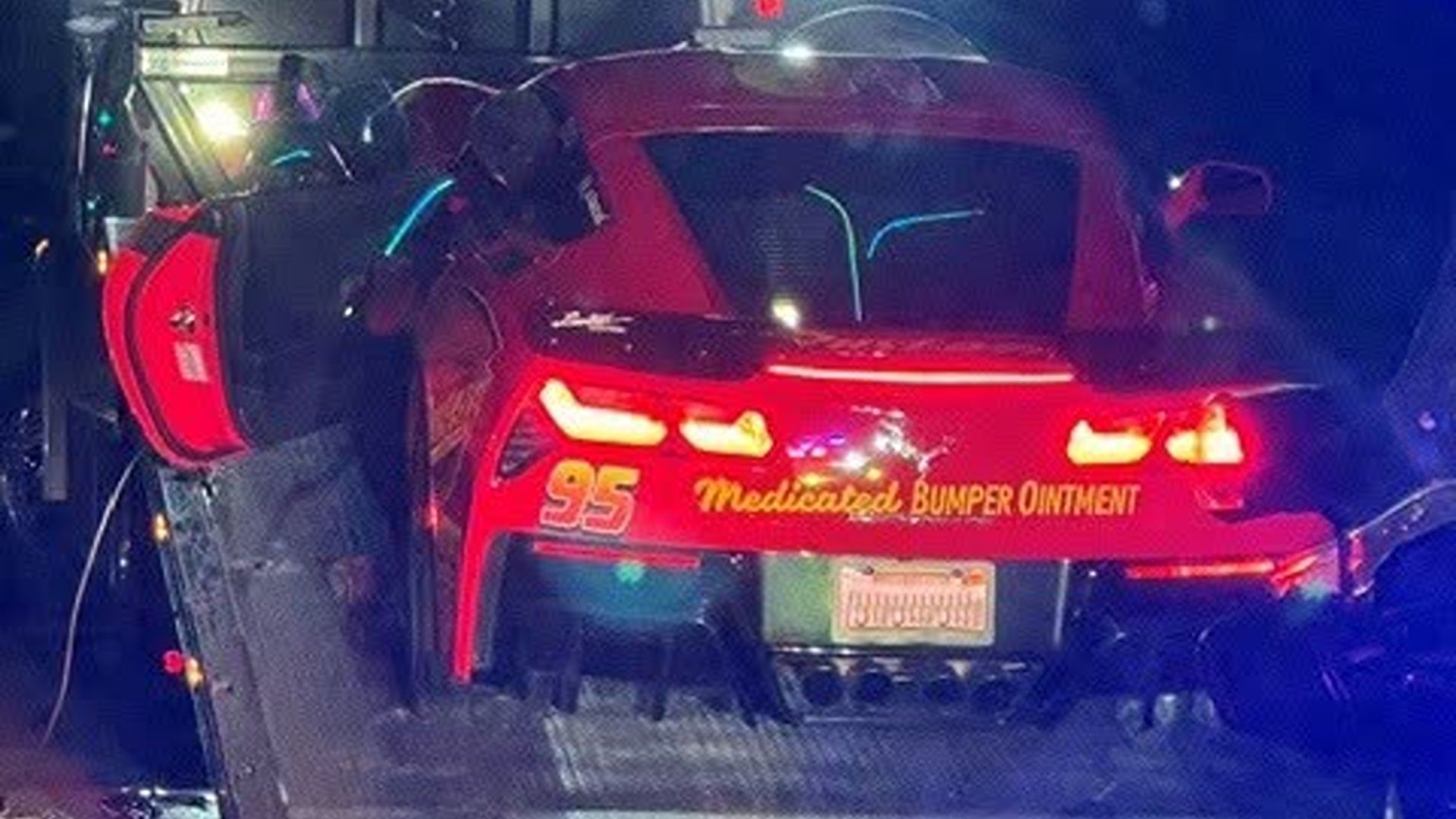
Somewhere in Elk Grove, California, a Chevrolet Corvette wrapped up like Lightning McQueen just learned the hard way that Radiator Springs doesn’t have a shopping center parking lot. The car — red paint, number 95, a “Medicated Bumper Ointment” decal riffing on McQueen’s fictional sponsor Rust-Eze — ended up on a flatbed after its driver decided a packed car meet was the right moment to light up the rear tires for an audience. The Elk Grove Police Department was already staged for exactly that kind of behavior, and towed the car before the night was over.
The meet-up itself didn’t stay quiet for long. Per the department, the gathering filled a shopping center lot, several attendees ended up in a fight, and the disruption forced a couple of nearby businesses to lock their doors while officers cleared the area and restored order. None of it caught police off guard — they had already set up a directed traffic enforcement operation built specifically around the meet-up before things fell apart.
That distinction matters. A directed enforcement operation isn’t a patrol car happening to roll by; it’s a department that knew a gathering was coming, almost certainly from the same social posts that draw the crowd in the first place, and pre-positioned officers to meet it. By the end of the night, Elk Grove PD had logged 121 vehicle stops and issued 105 citations — numbers that only add up if a sizable chunk of the shift showed up expecting exactly this.
Three vehicles were towed, and the Corvette was the one worth photographing. The department captioned the photo “from Ka-Chow to Ka-Ching,” which works because the owner had clearly sunk real money into the McQueen tribute before using it to do the one thing the actual Lightning McQueen spent three movies learning not to do.
The parking lot setting didn’t offer any legal cover. California’s Vehicle Code 23109(c) bans exhibition-of-speed stunts — burnouts, doughnuts, and similar displays — not just on public roads but explicitly “in an offstreet parking facility,” which is exactly where meets like this tend to land once they get pushed off the street. A conviction carries up to 90 days in county jail, a fine of up to $500, or both. (The statute’s formal name, per the code itself, is the Louis Friend Memorial Act.) Starting in 2029, courts will also gain the power to suspend a convicted driver’s license for an exhibition charge tied to a “sideshow” — the law’s specific term for an organized gathering where people block traffic so others can watch stunts, which describes this meet-up about as precisely as a statute can. Right now, that impound-and-suspend hammer is reserved for actual speed contests, where a registered owner’s car can be held at their own expense for one to 30 days on top of daily storage fees. Either way, a citation like this tends to follow a driver into their insurance file for years, and reckless-driving or exhibition convictions routinely bump premiums into a worse bracket than the ticket itself ever will.
Elk Grove isn’t alone in treating these meets as a planning problem instead of a one-night nuisance. California agencies have leaned harder into intelligence-led operations as sideshows hop between parking lots looking for whichever spot hasn’t been staked out yet — the same logic behind the coordinated Bay Bridge Trap that let officers seize nearly 80 bikes from illegal riders in one sweep, and the same reasoning Georgia’s Blood Mountain crackdown used when it promised jail time and towed cars for reckless drivers. Watch the social chatter, pick the choke point, let the citations do the talking.
As for the Corvette, the wrap probably survives; the sense of humor around it might not. Corvette owners have never needed much of an excuse to turn their cars into rolling personalities — see the dealership giveaway stunt that turned heads around the new ZR1 for weeks — but there’s a real difference between building a tribute car and starring in the one scene the original movie would have cut for setting a bad example. Ka-Chow, indeed.
About the Author