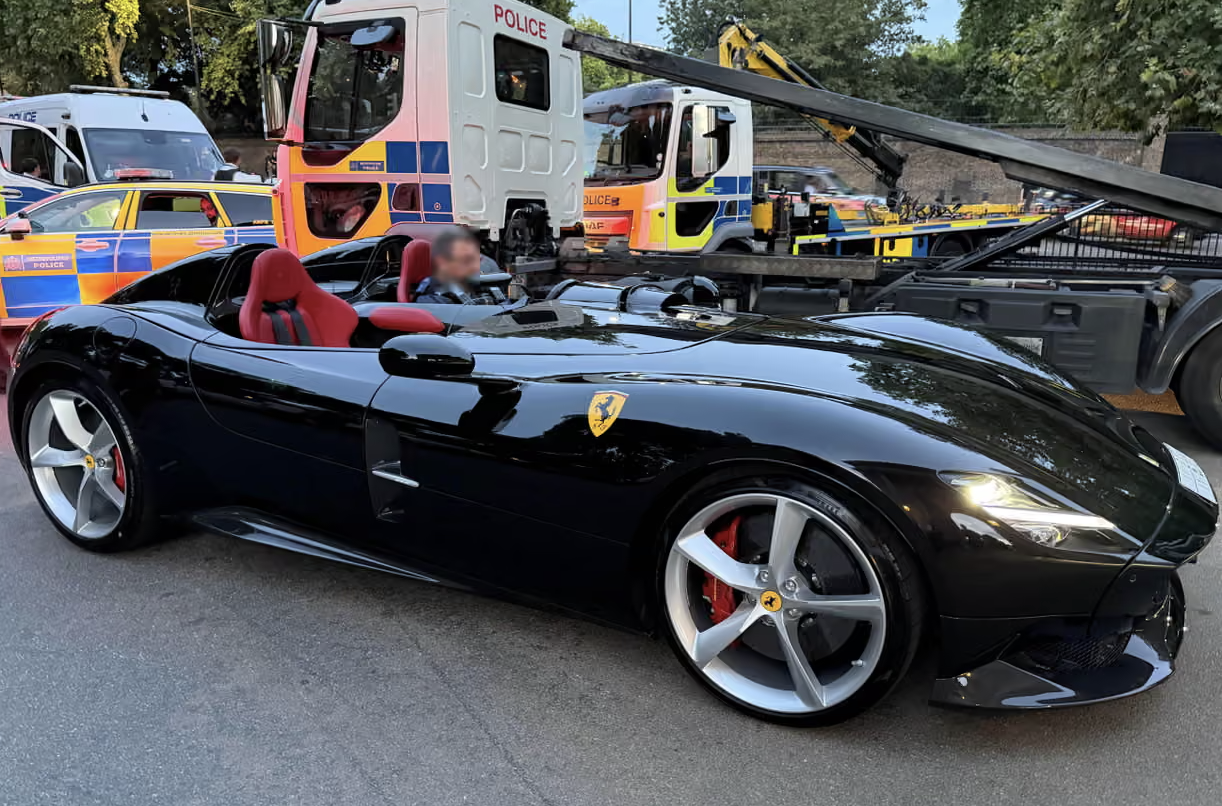
Of the 90 vehicles the Metropolitan Police took off the road over three days in central London, one has done all the travelling since — sideways, through everyone’s phone, with a uniformed officer at the wheel and no roof over his head. The car was a Ferrari Monza SP2. The photographs are the story for most people. The legal plumbing underneath is more interesting, and almost nobody has bothered to look at it.
Start with the obvious question. If the car was seized because it had no insurance, how was it lawful for a constable to drive it through Mayfair?
The exemption nobody knows about
Section 144 of the Road Traffic Act 1988 carves out the situations where the compulsory insurance requirement simply doesn’t apply. One of them covers a vehicle at a time when it is <a href=”https://www.legislation.gov.uk/ukpga/1988/52/section/144/2004-01-11″>”being driven for police purposes by or under the direction of a constable”</a>.
That’s it. The moment a warranted officer took the wheel for a police purpose — moving a seized vehicle into custody — the car stopped being uninsured in any legal sense. Not because a policy sprang into existence, but because the statutory duty to have one falls away. The exemption attaches to the driving, not the vehicle, which is why it works on a car the force doesn’t own and never will.
So the seizure was lawful, the drive was lawful, and the same set of keys went from criminal offence to statutory exemption in the time it took two people to swap seats.
Why you’d drive it rather than winch it
There’s a practical case for it too, and it isn’t showmanship.
Ferrari’s own figures put the Monza SP2 at 1,155 mm tall with a dry weight of 1,520 kg, wrapped in carbon-fibre bodywork over an 812-derived chassis. Recovery operators winch cars onto flatbeds using strap points and a ramp angle that assumes a certain amount of ground clearance and a certain amount of structure willing to take a load. A barchetta with a full carbon shell, a front splitter and a nose that sits about waist-high on an adult gives you neither.
And whoever moves the car owns the consequences. Police forces hold seized vehicles as bailees; damage caused by careless handling is a claim waiting to happen, and on a car the Met itself put at £3.7 million, the excess conversation gets ugly fast. Given the choice between dragging it up a ramp on a strop and driving it three-quarters of a mile at walking pace behind an escort, an experienced officer picks the option with fewer contact points.
The sunglasses, incidentally, are not a pose. Ferrari deleted the windscreen entirely on the Monza and replaced it with a patented “Virtual Wind Shield” — a duct in the fairing ahead of the instrument panel that channels air up and over the driver’s head. There is no glass. Eye protection is equipment, not styling.
Getting it back is embarrassingly cheap
Here’s where people assume the punishment lives, and they’re wrong.
The statutory charges for a vehicle seized under section 165A are set nationally, not by the value of the car. For a private vehicle under 3.5 tonnes, found on the road, upright and not substantially damaged, the removal charge is £192, with storage at £26 for each 24-hour period or part thereof, and £96 if it’s never collected. A Corsa and a Monza cost the same to impound.
The genuinely awkward part is regulation 5 of the 2005 retention rules. To take a seized vehicle out of custody you must satisfy the authorised person that you’re the registered keeper or owner, pay the charges, and produce a valid certificate of insurance covering your use of that vehicle plus a licence authorising you to drive it. Fail the third limb and you nominate someone who can pass it instead.
Which means the person who was driving cannot personally collect it. He would have to hand the retrieval of a seven-figure Ferrari to a third party with the paperwork he doesn’t have.
The sting is on the licence, not the wallet
Using a vehicle uninsured against third-party risks carries six to eight penalty points. Driving otherwise than in accordance with a licence carries three to six. Both stay on the record for four years, and twelve points in three years brings a totting-up disqualification.
Now apply that to a provisional holder. Points collected before you pass carry across to your full licence the day you get it — and under the Road Traffic (New Drivers) Act 1995, six or more inside the two-year probationary period means automatic revocation by DVLA. No hearing, no discretion, and you go back to a provisional and both tests.
An IN10 endorsement on its own clears that threshold. A driver in that position can spend years unable to hold a full licence at all, long after the £192 has been forgotten.
The bit that catches out honest visitors
The Monza had been in the country a day. That’s not itself a problem: gov.uk’s temporary import rules let a visitor use foreign plates for up to six months in twelve, provided the vehicle is registered and taxed at home and they aren’t moving here.
What the six-month allowance never covers is insurance. Section 143 applies to any motor vehicle used on a road in Great Britain, whatever the plate says. The Motor Insurers’ Bureau, which supported the operation with its Navigate database, flagged the two failures it saw repeatedly over the weekend: policies naming the wrong registration or vehicle, and policies that simply didn’t extend to UK driving. Neither of those is a criminal mindset. Both leave you equally uninsured, and both fund the MIB levy that every honest UK premium quietly carries.
The Met also noted 15 of the 90 seizures came under powers that no longer require a warning first — section 8 of the Crime and Policing Act 2026 having repealed the warning provisions in section 59 of the Police Reform Act 2002, as set out in the Home Office’s own circular. Driving in a way that causes alarm, distress or annoyance no longer buys you one free pass. It buys you a flatbed.
What to actually do about it
If you’re shipping a car in for the summer, or lending one to a visiting friend, three checks take five minutes. Confirm the certificate names the exact registration on the car. Confirm it names the person who’ll be driving. Confirm it covers use in Great Britain, not just the country of issue. Then check the vehicle actually appears as insured on the Motor Insurance Database before it turns a wheel.
Getting one of those wrong doesn’t feel like a crime. It reads to an ANPR camera exactly like one.
Images Via: Metropolitan Police/PA
About the Author