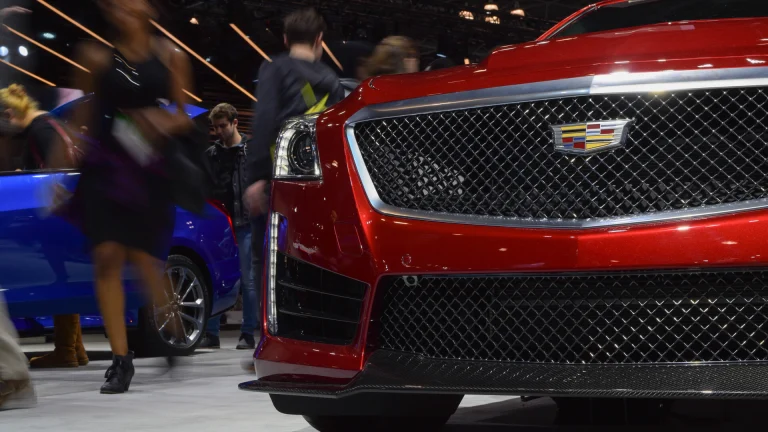

A 2016 Cadillac CTS-V, one of the models named in the case. File photo: Lucas Klappas via Wikimedia Commons, CC BY 2.0.
Jose Otero Nieves, 43, of Baltimore, was sentenced on September 29, 2026, to 96 months in federal prison for interstate transportation of stolen motor vehicles. The U.S. Attorney’s Office for the Middle District of Pennsylvania said Chief U.S. District Judge Matthew W. Brann gave Ian Torres, 26, of Philadelphia, 54 months in the same case. Prosecutors say Otero ran a prominent car meetup group out of Baltimore, and that the stolen muscle cars were shown off and driven hard at meetups and street takeovers. The two were the last of ten defendants to be sentenced.
What the judge cited at sentencing
According to the office’s release, Brann pointed to the number of vehicles, more than two dozen stolen by each of the two men, and to the leadership roles each played in a conspiracy that ran across several states. For Otero, the judge also noted a significant criminal history that includes a second-degree murder conviction. The release does not say where or when that conviction occurred, and it carries no statement from the defendants or their attorneys. Takeovers, burnouts and social media do not appear in its account of the judge’s reasoning.
Torres and Otero were among the co-conspirators the office places at a Selinsgrove, Pennsylvania, dealership on October 3, 2023, where two 2017 Cadillac CTS-Vs, a 2016 CTS-V, two 2019 CTS-Vs, a 2018 Camaro, a 2019 Camaro and a 2019 Corvette were taken. Backfire News covered how that theft worked.
A statute that never mentions a takeover
The charge is 18 U.S.C. § 2312, which punishes anyone who transports a stolen motor vehicle across state lines knowing it was stolen, with a fine, up to 10 years in prison, or both. Prosecutors have to prove two things: the state line and the knowledge. What happens to the car afterward is not an element. The takeovers are in the case because the November 2024 indictment, as the office described it, alleged that taking the vehicles to meetups and takeovers was an object of the conspiracy.
The office said the maximum is five years for the conspiracy count and 10 years for each count of interstate transportation. Those maximums apply count by count, so Otero’s 96 months sits below the 120-month ceiling of a single transportation count. The release does not say how many counts any defendant was convicted of, or whether any of them pleaded guilty.
Nine sentences add up to 366 months
Here is the full list from the office: Jose Otero Nieves, 96 months; Rafael Otero Nieves, of Baltimore County, 84; Nigel Criss, of Philadelphia, 54; Ian Quintana Torres, 54; Jesus Terrero, of Baltimore County, 36; Tyler Hoagland, of Howard County, Maryland, 18; Shamar Morris, of Philadelphia, 12; and Raymond Steward, of Camden County, New Jersey, and Robert Jones, of Prince George’s County, Maryland, six months each. Jumaane Wright, of Montgomery County, Pennsylvania, is listed as deceased.
Backfire News’s tally of the nine sentences is 366 months, or 30 years and six months. Otero’s 96 months is about 26 percent of that. A six-month sentence is one-sixteenth of his. Stolen cars and takeover organizers have also overlapped in a case from Wisconsin: a Milwaukee organizer accused of building a Hellcat 300 from three stolen Mopars.
How leadership moves a federal sentence
Federal judges start from the advisory Sentencing Guidelines, and the office noted that sentences follow consideration of those guidelines and the sentencing statutes. One of them, §3B1.1, adds four offense levels for an organizer or leader of criminal activity involving five or more participants or one that was otherwise extensive, and three levels for a manager or supervisor, according to the U.S. Sentencing Commission’s training primer. The release does not say whether Brann applied that adjustment, so the link to the “leadership roles” he cited is our inference, not a finding in the case.
Where a driver in a similar spot lands depends on the knowledge element and on role. The four lowest sentences here ran from six to 18 months. The release does not say how many cars those defendants moved or what they did.
What the release leaves open
All nine living defendants have now been sentenced. The release says nothing about restitution, forfeiture, appeals, or whether any of the eight Selinsgrove vehicles were recovered. The Pennsylvania State Police Central and Eastern Auto Theft Task Forces and the FBI’s Philadelphia office investigated, and Assistant U.S. Attorney Kyle A. Moreno prosecuted.
When a stolen-car ring is sentenced, should the organizer’s role and prior record count for more than the number of cars each member moved?
About the Author