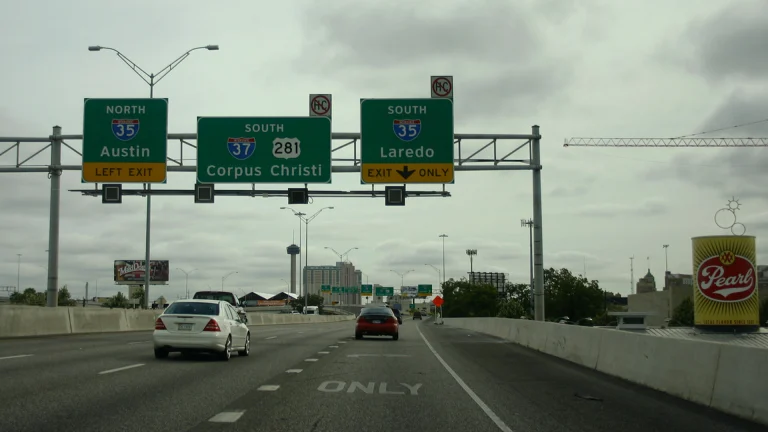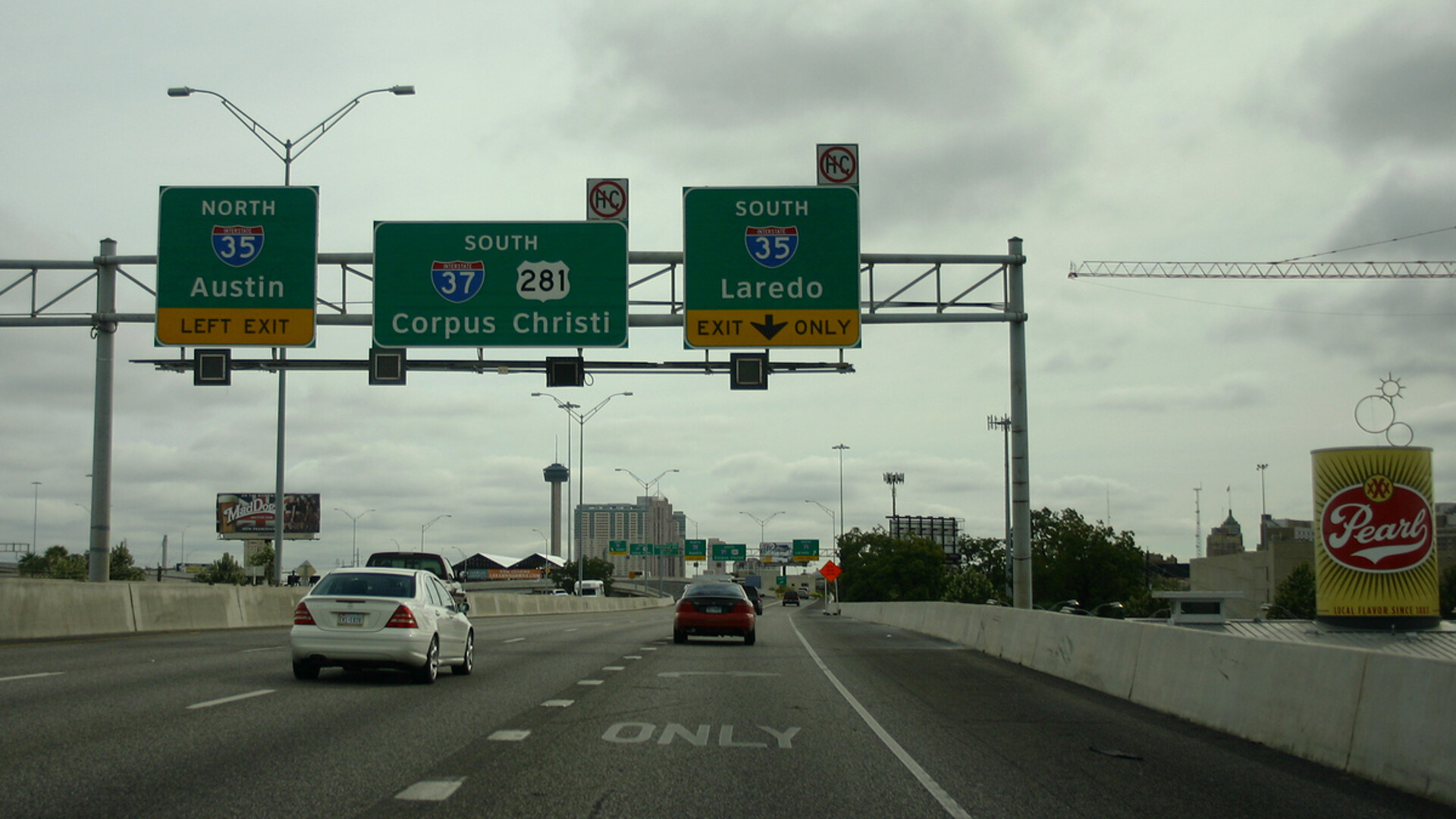
Interstate 35 at the I-37 interchange in San Antonio. Photo: formulanone / Wikimedia Commons (CC BY-SA 2.0)
A Bexar County sheriff’s deputy stopped Alek Schott’s truck on Interstate 35 south of San Antonio at about 11:15 a.m. on March 16, 2022, and told him he had been “drifting over that fog line pretty hard,” according to the complaint Schott filed in federal court. Schott, a Houston-area businessman driving home from a customer meeting near Carrizo Springs, had his own dashcam running, and Texas Public Radio reported that evidence at trial showed he never crossed the line. On Sept. 28, a federal jury in San Antonio found the county liable for violating his Fourth Amendment rights and awarded him $76, KSAT reported, one dollar for each of the 76 minutes he was held.
Photo: formulanone / Wikimedia Commons, CC BY-SA 2.0. Interstate 35 at the I-37 interchange in San Antonio; not the stop location.
What the deputy said on his own camera
The deputy, Joel Babb, worked in the sheriff’s Criminal Interdiction Unit. The complaint quotes him telling Schott it would be a warning, not a ticket, and that the unit looks for “human smuggling, drug smuggling, and all those things like that.” Schott refused a search. About 20 minutes into the stop, the Institute for Justice says, Babb called a drug dog. Deputy Martin Molina, the handler, reported an alert. Three deputies then went through the truck for roughly 40 minutes and found no drugs or other evidence of a crime, according to the complaint. The written warning cited failure to maintain a single lane and carried the notation “No Search.”
The dog scratched the truck, and the complaint says Bexar County paid $7,268.46 for the damage. Schott did not sue over it. KSAT reported that Babb told another deputy the truck was one he had been looking for and had been tracking, and the complaint quotes him on camera saying of stops like this one, “nine times out of ten, this is what happens.” KSAT, citing court records, reported that license plate readers tracked the truck driving south toward the border and back, a pattern deputies flagged as suspicious.
How one stop made the county pay
A county is not liable under federal civil rights law just because its employee did something unconstitutional. Under Monell v. Department of Social Services, a 1978 Supreme Court decision, the plaintiff has to show that a county policy or custom caused the violation. That is why Schott’s complaint did not stop at Babb. Its fourth claim targets the county and Sheriff Javier Salazar for what it calls a policy and custom of using traffic stops to search drivers without suspicion of a crime, and it asks for a declaration and a permanent injunction in addition to damages, including $1 in nominal damages.
Schott told KSAT that evidence at trial showed deputies stopping at least 20 cars a day and searching 10 without cause, with 60 to 70 similar cases in under three months. Those are his figures as reported, not a finding by the court. He also said the county testified that nothing it did was wrong. The verdict reports I found describe the county’s liability; I could not confirm from the docket how the claims against Babb, Molina and Salazar individually were resolved.
The fog line has to be real
Texas gives deputies a narrow hook for a lane stop. Section 545.060 of the Transportation Code requires a driver on a multi-lane road to “drive as nearly as practical entirely within a single lane” and says a driver “may not move from the lane unless that movement can be made safely.” A tire touching a line on an empty highway is not obviously either one. The U.S. Supreme Court, in Whren v. United States, decided June 10, 1996, held unanimously that “Subjective intentions play no role in ordinary, probable cause Fourth Amendment analysis,” so an officer hunting for drugs can lawfully stop any driver who actually commits a violation. The whole interdiction model leans on that rule, and on the violation being there when a judge looks at the video.
The second limit came in Rodriguez v. United States, decided April 21, 2015, by a 6–3 vote. Justice Ginsburg wrote that “a dog sniff is not fairly characterized as part of the officer’s traffic mission,” so a stop cannot be stretched to wait for a dog unless the officer has independent reasonable suspicion. The Court left open whether that suspicion existed in that case. In Schott’s, the complaint says the suspicion on offer was a drive to the border and back for work.
Plate readers and the appeal question
KSAT reported that four sheriff’s vehicles carried plate readers in 2022 and that every patrol car now has one built into its dashcam. A Georgia investigator accused of misusing Flock cameras shows how much those databases can reveal about one driver, though neither the complaint nor the reports I read name a camera vendor in Schott’s stop.
Schott’s lawyers at the Institute for Justice told Texas Public Radio they will ask U.S. District Judge Orlando Garcia to order the sheriff’s office to stop stops built this way, and that they are prepared to sue other agencies for drivers treated the same way. KSAT reported that the county has indicated it may appeal. The sheriff’s office told Texas Public Radio it does not comment on active lawsuits, and it and the district attorney’s office declined comment to KSAT, citing a possible appeal. Until Garcia rules on an injunction, the verdict covers one stop and the practice behind it.
Should a deputy be allowed to use a plate-reader travel pattern to choose which drivers to pull over, or should every stop require a violation the deputy can show independent of the database?
About the Author