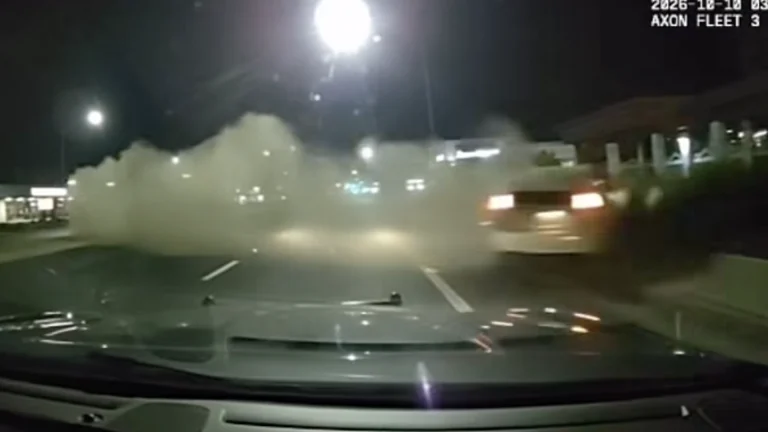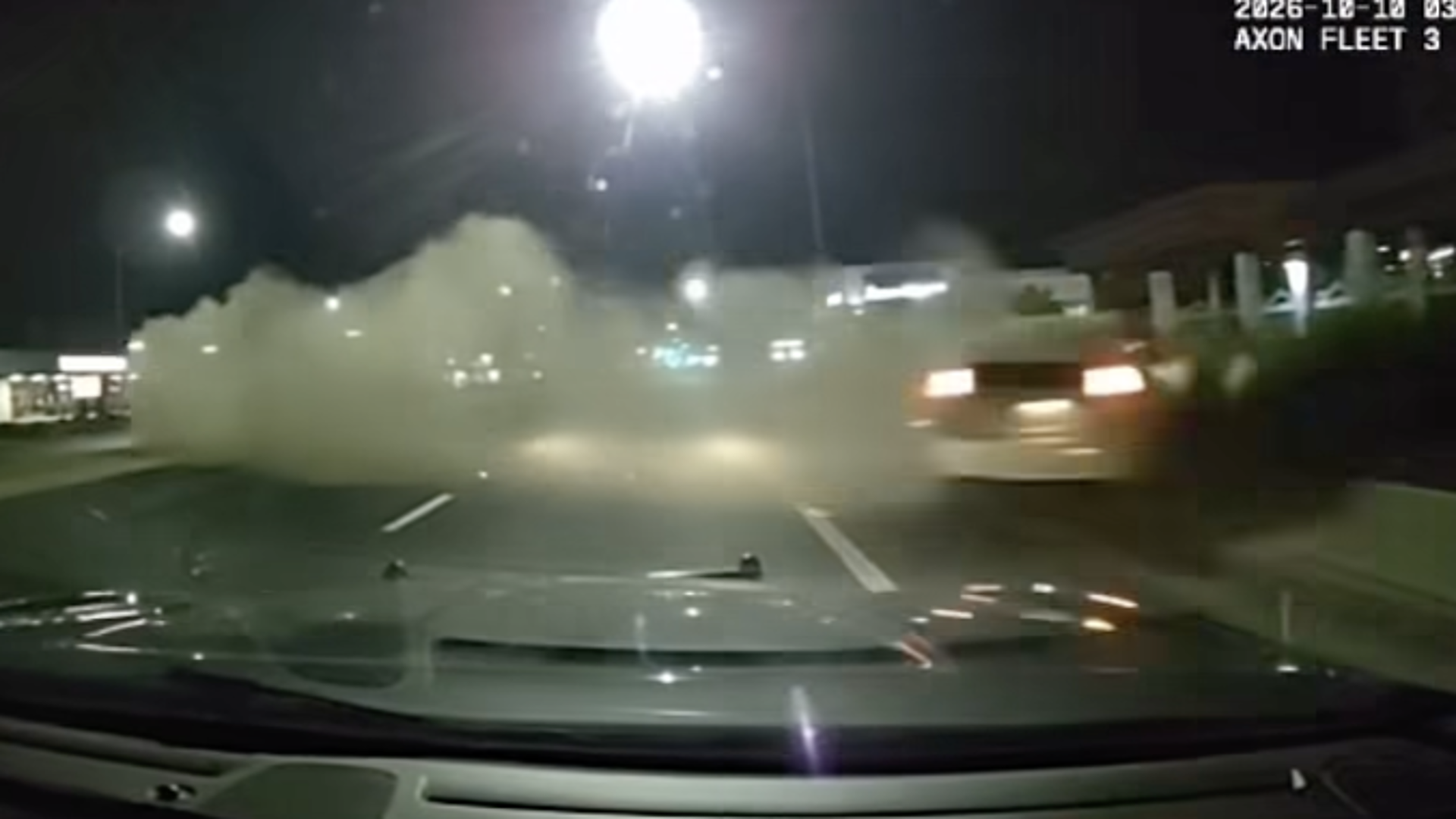
A Visalia police officer on patrol around 3 a.m. had a driver come at him sideways on Mooney Boulevard, the city’s main commercial road in California’s Tulare County. Police say the driver was going more than 80 mph. The Visalia Police Department said the driver lost control, skidded across the median, crossed into oncoming lanes and jumped a curb. The car missed the officer’s vehicle by very little. The driver was arrested for reckless driving. thenationaldesk
The department put out the officer’s dashcam footage on the evening of Monday, Oct. 19. According to police, the car was headed in the opposite direction of the officer. The clip is short. You see headlights, then the side of a car, then a curb. Police have not released the driver’s name, the vehicle, or the date of the crash beyond “around 3 a.m.” Their public statements also don’t say whether impairment is suspected or whether the Tulare County District Attorney has filed charges. Until a prosecutor files and a court rules, reckless driving is an accusation. yourcentralvalley
From the cruiser’s windshield it looks open and shut. California’s reckless driving law asks for more, and the bills start before any judge.
Why 80 mph alone wouldn’t make it a crime in California
Reckless driving in California is a misdemeanor under Vehicle Code section 23103. A driver commits it by driving on a highway in “willful or wanton disregard for the safety of persons or property.” The penalty in subdivision (c) is five to 90 days in county jail, a fine of $145 to $1,000, or both. California then adds state and county penalty assessments on top of the base fine, so the actual bill runs well above the number in the statute.
Related Articles
- Off-Duty ICE Agent Pepper-Sprayed After Road-Rage Stop on Maryland’s Beltway — Now State Police Have Made No Arrests
- Police Say a Montclair, California Driver Hit a 30-Rider Halloween Bike Ride and Fled — Now Prosecutors Have Charged Him With 2 Counts of Murder
What separates a crime from a speeding ticket is the word “wanton.” The Judicial Council’s jury instruction for the offense, CALCRIM No. 2200, requires prosecutors to prove the driver intentionally drove with wanton disregard for the safety of persons or property. It defines that as being aware your actions create a substantial and unjustifiable risk of harm and choosing to ignore it. The instruction tells jurors that driving over the speed limit doesn’t establish wanton disregard by itself. They are to weigh speed along with everything else that happened. The bench notes cite a 2004 appellate ruling, People v. Dibacco, which held that speeding is not a necessarily lesser included offense of reckless driving. In practice, the two charges are separate crimes with separate proof. justiajustia
So the most incriminating thing in the Visalia footage isn’t the speedometer reading. It’s what police say came next: a car out of control, a center median, oncoming lanes and a curb, in the middle of a busy commercial strip. A defense attorney can argue about how the 80-plus figure was measured. Arguing that a car crossing into opposing traffic posed no substantial risk to anyone is much harder, and the officer who nearly got hit is the witness.
The arrest can cost the car before the case costs anything
Most drivers expect consequences after a conviction. California’s Vehicle Code section 23109.2 works earlier. It lets an officer who arrests someone for reckless driving on a highway have the car removed and seized right away. The car can then be impounded for up to 30 days. Tow and storage fees build up the whole time, and a conviction is not required. Visalia police haven’t said whether this car was impounded. The statute allows it on the arrest alone, and the registered owner pays the storage bill even when the owner isn’t the driver.
If the case ends in a conviction, the bigger cost shows up at insurance renewal. Under Vehicle Code section 12810, a reckless driving conviction counts for two points on a driver’s record. An ordinary moving violation counts for one. That difference matters because of Proposition 103. California’s Insurance Code section 1861.025 defines a “good driver” as someone with no more than one violation point in the past three years. Section 1861.02 requires insurers to give good drivers a rate at least 20% below what they’d otherwise pay. One reckless driving conviction is enough to lose that status. A driver with a clean record before 3 a.m. would pay without the discount for three years.
The DMV keeps its own count. Under section 12810.5, a regular Class C licensee who reaches four points in 12 months, six in 24 or eight in 36 is presumed to be a negligent operator and can face suspension. A reckless conviction uses up half the 12-month allowance at once.
Mooney Boulevard and the department’s speeding campaign
The near miss came at a time when Visalia police have been talking publicly about speed. In a July 8 release about its “Slow the Fast Down” campaign, the department cited NHTSA figures: 11,288 people died in speeding-related crashes nationwide in 2024, about 29% of traffic deaths that year, and 1,139 of them were in California. Officer Connor Smythe said in the release, “Speeding is dangerous and puts everyone at risk.”
Mooney has its own record. In March 2025, abc30 reported that a motorcyclist was arrested after investigators said he hit about 113 mph on Mooney Boulevard just after 9 p.m. on a Friday. In May, the station reported that Visalia police had counted four fatal crashes in the city so far this year after a fiery crash that investigators attributed to speeding and reckless driving. By the department’s count, that was the first of the four involving more than one vehicle. The others were vehicles hitting pedestrians. abc30
Related Articles
- Mate Rimac Says a Man Just Walked In and Drove Off in His $3.3 Million Chiron. By Evening, Police Had Arrested a 36-Year-Old
- Billy Joel’s Bikes Are Selling With No Reserve, So Read the Fees and Mods Before You Raise Your Paddle
Few of those cases came with video of a patrol car nearly being hit head-on. If this goes to court, the clip is likely the main exhibit.
What happens next
The next step is up to the Tulare County District Attorney’s office: file reckless driving, file something lesser such as an unsafe-speed infraction, or decline. If the DA files under section 23103, the dashcam footage and the officer’s account will go up against CALCRIM 2200’s two-part test. The defense would most likely concentrate on how the speed was measured and whether the driver knew of a risk and ignored it, as opposed to something like a mechanical failure or a medical problem. In California, prosecutors who can’t prove wanton disregard sometimes reduce reckless driving cases to speeding or unsafe-speed infractions. Those carry one point, which leaves the driver’s Good Driver status intact.
California can hold your car for up to 30 days on an arrest alone, and you pay the storage lot. If a jury later says not guilty, who covers that bill?
Images Via: Visalia Police Department
About the Author