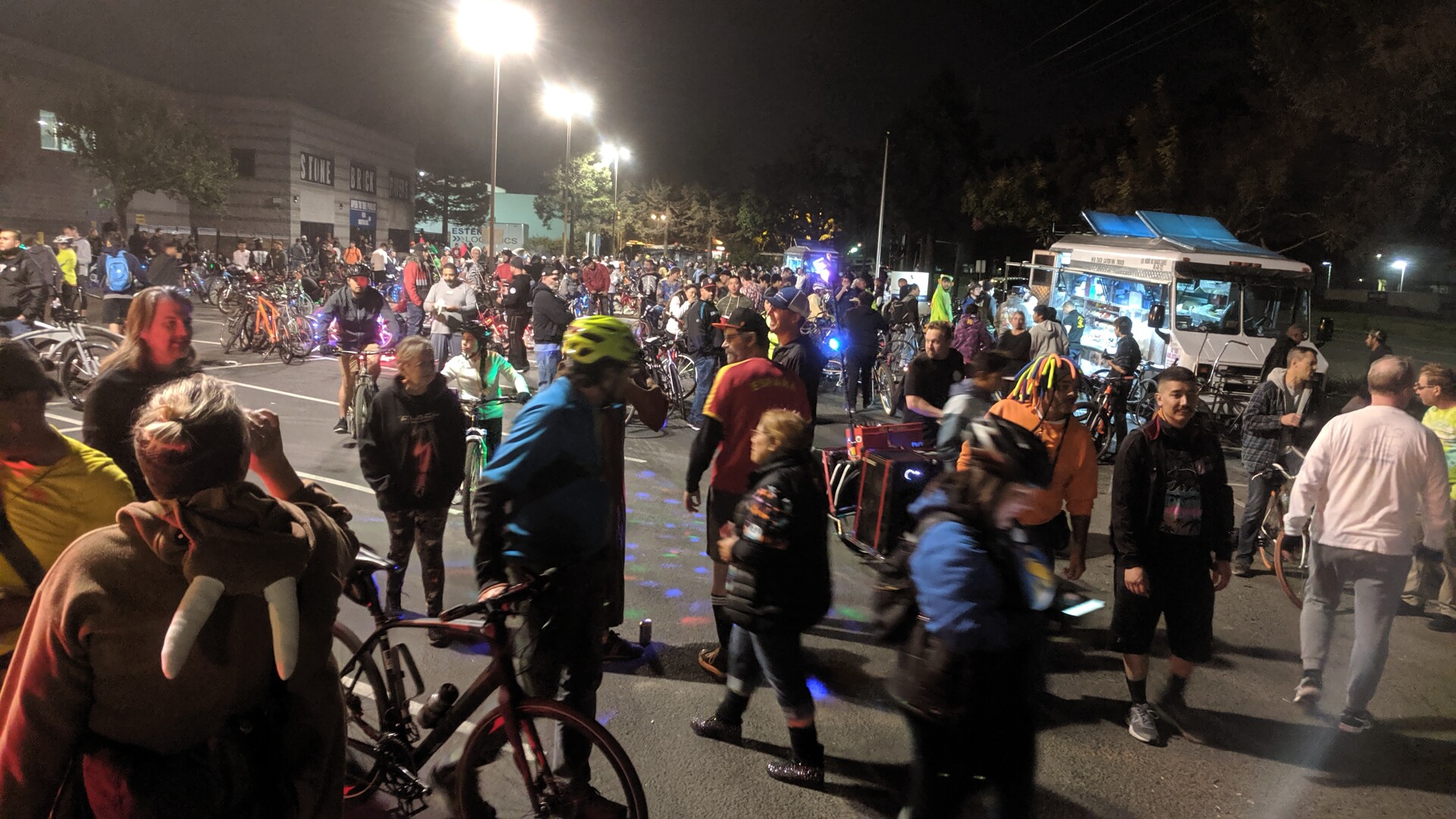
File photo of a different Halloween-themed group ride, San Jose Bike Party in Santa Clara, October 18, 2019. It is not from the Montclair ride. Photo: Ian Kluft / Wikimedia Commons, CC BY-SA 4.0
Montclair, California, police say a driver struck a group of about 30 cyclists on a Halloween ride near Kingsley Street and Tudor Avenue at about 10:39 p.m. on October 24 and did not stop. Three days later the San Bernardino County District Attorney’s Office charged Valentin Alberto Rodriguez, 38, with two counts of second-degree murder, a step past the vehicular manslaughter charge he was booked on.
The riders were on a self-coordinated ride heading east on Kingsley, CBS Los Angeles reported, citing the Montclair Police Department. One rider, 25, was pronounced dead at the scene, according to police. A second, a 30-year-old woman, died at a hospital, according to friends quoted by CBS. Police said one other rider was hospitalized with major injuries and was in stable condition, and another had minor injuries and declined treatment.
Police said they arrested Rodriguez at his home, about a mile from the scene, at about 2:40 a.m. on October 25, and booked him into West Valley Detention Center on suspicion of DUI causing injury or death, felony hit-and-run and gross vehicular manslaughter while intoxicated. Those were suspicions. The charges came with the District Attorney’s complaint, and Rodriguez has not been convicted of anything. I found no public statement from him or an attorney in the filing, the DA’s release or the coverage I reviewed.
Seven counts, with murder at the top
The complaint, filed October 27 in San Bernardino County Superior Court’s Rancho Cucamonga District (case FWV26003702), lists seven counts. Two are second-degree murder under Penal Code section 187(a). Two are gross vehicular manslaughter while intoxicated under section 191.5(a), each with an allegation that he fled the scene. Two are DUI causing injury under Vehicle Code section 23153(a), each with a great-bodily-injury allegation. The seventh is felony hit-and-run resulting in death or serious injury under Vehicle Code section 20001(b)(2). The complaint alleges no prior convictions.
District Attorney Jason Anderson said in the office’s release that the deaths were avoidable and that the driver had other ways to get home. The release lists the arraignment date as pending.
What separates murder from manslaughter on the same night
The statutes put the gap in numbers. Gross vehicular manslaughter while intoxicated carries 4, 6 or 10 years in state prison per death. Second-degree murder carries 15 years to life. A flight allegation under Vehicle Code section 20001(c) adds a consecutive five years to a manslaughter conviction, and the court cannot strike it. Backfire News’s arithmetic: the most the manslaughter route yields per death is 10 plus 5, or 15 years, which is where the murder sentence starts.
The difference is the defendant’s state of mind. Manslaughter requires gross negligence. Murder requires what California calls implied malice: that the driver knew the conduct endangered human life and acted with conscious disregard for it. The California Supreme Court allowed that theory for drunk driving in People v. Watson, decided November 30, 1981, reversing the dismissal of murder counts against a driver who had a .23 blood-alcohol level, was estimated at about 84 mph in a 35 zone, ran a red light and sped off. The court said murder was available when the facts show implied malice, and that it should not be routine. The Rodriguez complaint cites Watson on its two DUI-injury counts.
Courts also have a built-in way to establish that knowledge for repeat offenders. Under Vehicle Code section 23593, a judge must advise anyone convicted of DUI that if they keep driving impaired and someone is killed, they can be charged with murder. Because the complaint alleges no prior convictions, nothing in it points to an earlier advisement, so a jury on the murder counts would be asked to infer that awareness from the night itself.
The impairment charge does not depend on a number
The two DUI counts cite subdivision (a) of section 23153, the provision for driving under the influence of alcohol and causing injury. The separate 0.08 percent provision is subdivision (b). I found no blood-alcohol result in the DA’s release or in the police account CBS relayed, and a figure on a test can be challenged in court, as a recent Georgia case over a 0.139 roadside reading showed.
NHTSA counted 11,904 deaths in alcohol-impaired-driving crashes in 2024, meaning a driver at 0.08 or higher: 30 percent of all traffic deaths and 3.9 percent fewer than the 12,382 in 2023. California’s share was 1,311.
What comes next in Rancho Cucamonga
The next event is the arraignment, where Rodriguez will be formally advised of the charges and enter a plea. After that the fight is over implied malice: whether this is argued as murder, or as manslaughter plus a flight enhancement. The Superior Court’s online case search will show the filings under FWV26003702.
Prosecutors have charged this as murder, not manslaughter. Where do you draw the line between a drunk-driving tragedy and murder?
About the Author