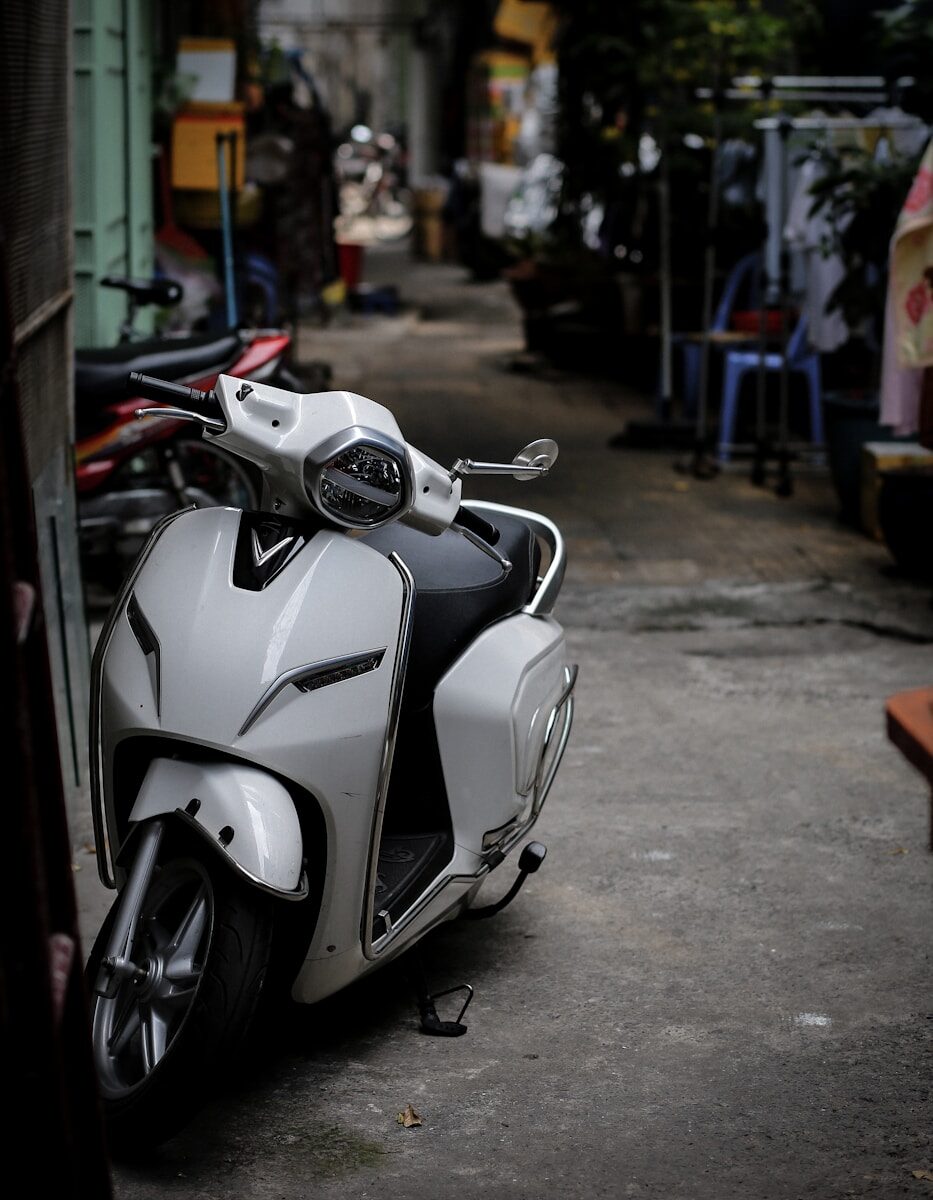
A design matching the VinFast Rasad — the maxi-scooter the Vietnamese company revealed at the end of January — has surfaced on India’s Register of Designs. VinFast hasn’t announced anything about bringing it to India. It doesn’t have to. Under the Designs Act, registering a design is a cheap, quiet, non-committal act, and companies do it constantly for products that never arrive.
So before anyone starts building a launch calendar: what got filed is a picture. Section 2(d) of that Act protects shape, configuration, pattern and ornament — the stuff judged by the eye. Not the motor. Not the battery. Not the frame. The registration runs ten years from the date of registration, extendable once by five, and confers the exclusive right to apply that appearance to an article in the class it’s registered under. It is a fence around a silhouette, nothing more.
What makes this particular fence worth a second look isn’t the drawing. It’s what VinFast has already said, on its own website, about the machine inside it.
The center-motor detail nobody’s chewing on
When VinFast published its plan for three e-two-wheeler tiers on January 30, it described the Rasad as a maxi-scooter with a centrally mounted motor making up to 7,100 W and a top speed of 100 km/h. Its premium siblings, Sadie and Saxil, get 4,500 W center motors and 80 km/h.
Compare that to what VinFast actually builds today. The Viper and Feliz II run 3,000 W BLDC in-hub motors. The Evo runs 2,450 W. All three top out around 70 km/h, per the company’s January product launch.
Related Articles
- Kim Kardashian’s Hidden Hills Mansion Was Burglarized, and the Getaway Car Was Hers
- xAI Sues Its Contractor for $800 Million, Says He Secretly Bankrolled a Drag Strip With the Money
Moving the motor out of the rear wheel hub and into the chassis is not a spec-sheet flourish. It’s a different vehicle.
Hub motors are cheap, sealed, and mechanically dumb — no belt, no reduction gearbox, nothing to tension or replace. The cost is unsprung mass. Bolting six or seven kilos of copper and steel to the end of a swingarm makes the rear wheel slow to react, and on broken pavement the tyre spends more time skipping than gripping. Anyone who has ridden a heavy hub-motor scooter over a poorly patched road knows the sensation: the back end hops, the damper never catches up.
A mid-drive fixes that. It also fixes something Indian owners will appreciate far more than ride quality — puncture repair. Pulling a wheel off a hub-motor scooter means dealing with the motor’s phase wires and hall-sensor loom. On a mid-drive, the rear wheel is just a wheel. Roadside tyre repair goes from a dealer visit to a twenty-minute job at any puncture-wallah.
The trade is a new set of wear items. Belt or chain, reduction gears, and a drivetrain that needs a parts pipeline and technicians who know it. For a brand with no two-wheeler service history in India, that’s not a footnote.
The battery math doesn’t obviously work
Here’s the tension. VinFast’s entire scooter strategy runs on swappable 1.5 kWh LFP packs — two under the seat, ₹9,000 VND per pack per swap, rental from VND 175,000 a month. Its global e-scooter plan, which names India among five launch markets, is explicitly a battery-swapping portfolio: Flazz, Evo, Feliz II, Viper.
Three kilowatt-hours is fine for a 3 kW hub motor doing 70 km/h in traffic. Ask that same pack to feed a 7,100 W motor at a sustained 100 km/h and the arithmetic turns hostile — you’re pulling well over 2C from a chemistry chosen for cycle life and thermal safety, and highway-speed aerodynamic drag eats energy at a rate that makes a claimed range figure collapse. Either the Rasad carries considerably more energy than the current swap packs provide, or it doesn’t sit inside the swap network at all. The design filing can’t tell you which, and that ambiguity is the single most important unknown about this machine.
The Indian context is less friendly than the timing suggests
VinFast’s own plan puts commercial Rasad units in showrooms in Q4 2026, with the sport models following in Q2 2027 — a Vietnam timeline, not an Indian one. Meanwhile the company has been laying real groundwork here: a December 2025 MOU with Tamil Nadu allocating roughly 500 additional acres at Thoothukudi and a USD 500 million second phase covering e-buses and e-scooters, and a retail network that hit 60 dealerships in early August, targeting 75 by year-end.
Related Articles
- Lincoln Corsair’s Flat-Tow Feature Is Getting Deleted, and Owners Are Suing Ford Over It
- Honda’s Bringing 20-Plus Championship-Winning Race Machines to Monterey, and the Garage List Reads Like a Motorsports History Class
But a 100 km/h maxi-scooter lands in an awkward spot. The demand incentive under PM E-DRIVE for registered electric two-wheelers has lapsed; the Ministry of Heavy Industries extended the scheme’s overall tenure to March 2028 but kept two-wheelers on a separate, earlier clock. A premium maxi-scooter would have blown past the ex-factory price ceiling anyway, so functionally nothing changes — it was never subsidy bait.
Insurance is a quieter cost. Third-party premiums for electric two-wheelers are banded by kilowatt output, and the published bands step at 3 kW, 7 kW and 16 kW. At 7,100 W, the Rasad clears the 7 kW threshold by a hundred watts and lands in a band where the mandated premium is meaningfully higher than the one every Ather, iQube and Chetak sits in. A hundred watts of marketing headroom, paid for annually.
Then there’s the market itself. SIAM’s monthly figures put domestic two-wheeler sales around 19 lakh units in a single month — enormous, and overwhelmingly commuter. India’s maxi-scooter segment, electric or otherwise, is a rounding error.
What an owner should take from this
A registered design is evidence of intent to protect, not intent to sell. If the Rasad does arrive, judge it on two things the drawing won’t show you: what the drivetrain costs to service, and whether the battery architecture is the swap system VinFast has built its ecosystem around or something bespoke. The first determines your ownership costs. The second determines whether the brand’s biggest structural advantage applies to this bike at all.
About the Author