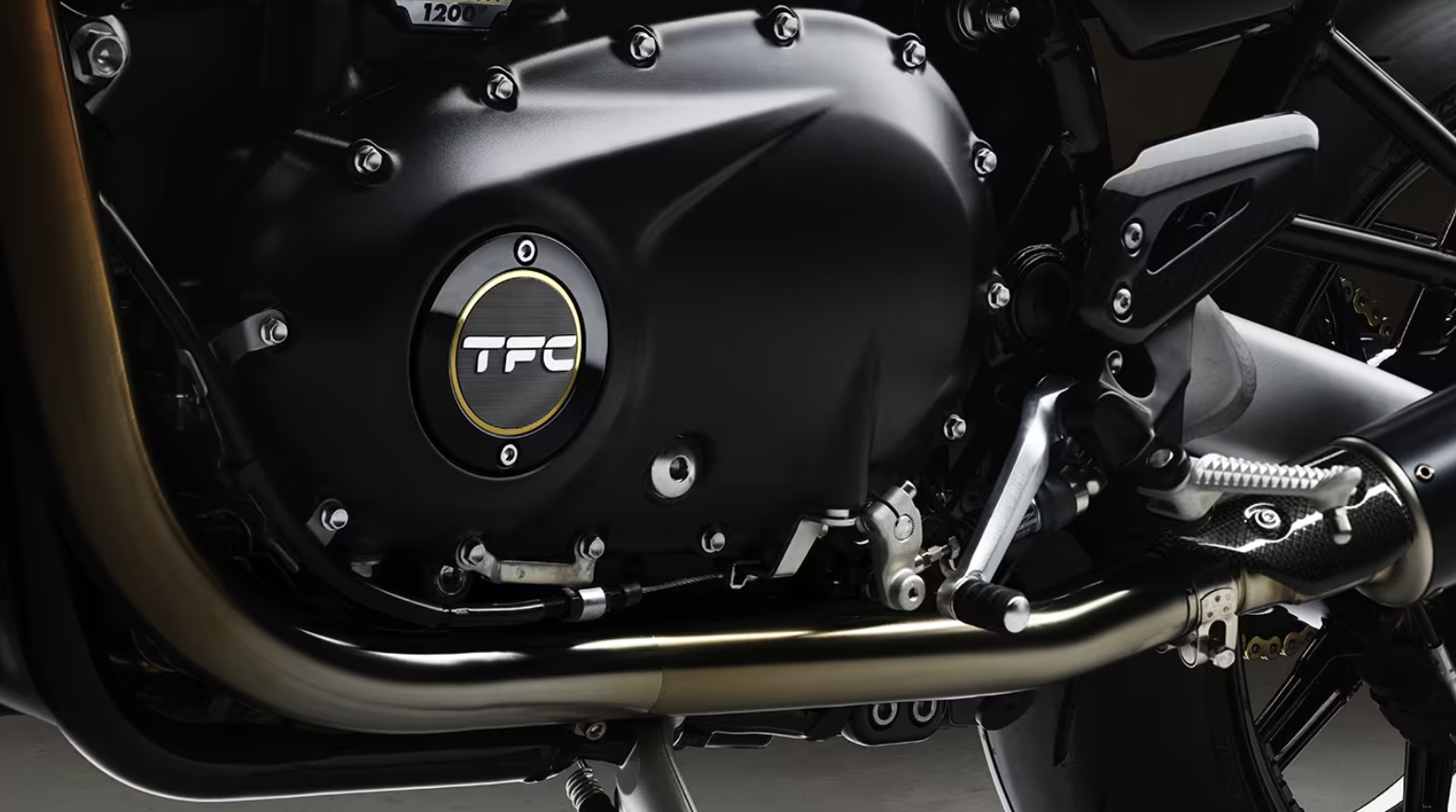
Limited editions usually work like this: same bike, different paint, wildly different invoice. So when Triumph announced the Speed Twin 1200 TFC on July 14 — the fifth Triumph Factory Custom in seven years, capped at 750 units worldwide with 180 earmarked for the United States and 30 for Canada — the reflex is to assume you’re buying a numbered plaque with a motorcycle attached.
Do the arithmetic and it’s more interesting than that.
Triumph lists the TFC from $21,995. The Speed Twin 1200 RS it’s built on starts at $17,195. That’s a $4,800 walk. For that you get an Öhlins front end, Akrapovič titanium silencers, carbon fiber bodywork, clip-on handlebars, machined bar-end mirrors, a leather-and-suede bench seat, gold chain and fork lowers, Obsidian Gold paint, and a numbered build with a Certificate of Authenticity. Price out an Öhlins fork and a titanium exhaust from a catalog and you’ve spent most of that before anyone hands you carbon or a certificate.
That’s a rare thing in the limited-edition business. It doesn’t mean you should buy one. It means the pitch survives contact with a calculator, which is more than most special editions manage.
Read what Triumph didn’t say
The announcement talks about handling, detailing, ergonomics and exhaust note. What it never does is quote a horsepower figure or claim one.
Related Articles
- Brembo Is Bringing Its A-Game Brakes to a Brutal WorldSBK Weekend at Donington
- This Ferrari-Built Maserati Just Doubled in Value, and a 2,000-Km Example Wants a New Home
Triumph’s own spec for the Speed Twin 1200 family puts the Bonneville twin at 103.5 HP (105 PS) at 7,750 rpm. Nothing in the TFA material suggests that changes. The titanium cans are there for mass and sound, not for a dyno number — which is the honest way to do it, and also why nobody should walk into a dealership expecting a faster motorcycle.
The second thing worth noticing is which suspension actually changed. The RS already runs twin fully adjustable Öhlins piggyback shocks at the rear with fully adjustable 43mm Marzocchi forks up front. The TFC’s headline “fully adjustable Öhlins front and rear” therefore represents one genuine hardware upgrade — the fork — not two. That’s not a knock. A proper Öhlins front end is the single most transformative chassis change you can make to a bike like this, because on a torquey twin with a stiff frame, the front is where confidence lives or dies. But if a salesperson tells you the TFC “adds Öhlins,” the accurate version is that it finishes the job the RS started.
The clip-ons are the decision, not the paint
Here’s the part buyers routinely underestimate. Going from the RS’s repositioned tubular bars to clip-ons mounted below a billet top yoke isn’t a styling choice with a side effect. It’s a fundamental change to how the motorcycle behaves at both ends of the speed range.
Two things happen. First, weight transfers onto your wrists, which is fine at 70 mph with wind support and unpleasant at 25 mph in traffic. Second — and this is the one nobody warns you about — clip-ons are narrower than bars, so you lose steering leverage. Low-speed maneuvering, U-turns, backing out of a parking spot, filtering through a lot: all of it takes more effort. On a bike this size that’s a manageable trade. It is still a trade, and it’s one you make permanently, because reversing it means sourcing a different top yoke and defeating the point of the bike.
If you’ve never ridden a modern classic with clip-ons for more than fifteen minutes, ride one for an hour before you sign anything. Your wrists will tell you the answer faster than any spec sheet.
What it costs to live with
Öhlins hardware is superb and it is not maintenance-free. Cartridge forks and reservoir shocks have service intervals for oil, seals and nitrogen charge, and rebuilds generally mean a specialist rather than the guy who does your tire changes. Budget for that, and understand it’s a real running-cost difference versus the Marzocchi-forked RS, not a rounding error.
Carbon bodywork changes the math on tip-overs. A scuffed painted mudguard is a cosmetic annoyance. A cracked carbon one on a 750-unit run is a parts availability question you’ll be asking a dealer in 2033. Same logic applies to the numbered top yoke — the piece carrying the build number is a structural component, and damaging it is a different conversation than damaging a badge.
Related Articles
- Chase Briscoe Says NASCAR Turns Drivers Into Liars About Payback Wrecks – And the Penalty Reports Prove It
- Toyota’s 2027 Dakar Hilux Skips Combustion Entirely for a Hydrogen Fuel Cell
Insurance deserves a moment too. A standard actual-cash-value policy values a motorcycle by depreciation schedule, which does not know or care that 749 other people got the same bike and nobody else did. If you buy one of these, ask specifically about an agreed-value policy and expect to document the purchase. Sorting this out before there’s a claim is the entire game.
One regulatory note worth knowing
There’s a genuine advantage to getting an Akrapovič system from the factory rather than the aftermarket, and it isn’t just fitment.
A factory-fitted exhaust is part of the configuration the manufacturer certified. Swap cans yourself and you’re in the territory covered by the EPA’s tampering policy, which explicitly applies to highway motorcycles and prohibits removing or rendering inoperative emissions control elements installed to meet Clean Air Act requirements. Buyers rarely think about this until a state inspection or a resale gets awkward. Titanium and carbon end caps that arrived on the certification paperwork are the clean way to get the sound.
The badge is scarce on purpose
Triumph’s own history of the program is instructive: TFC launched in 2019, and the roster runs Thruxton in 2019, Rocket 3 in 2020, Bobber in 2020 and again in 2024, with 750 examples of each. Five bikes in seven years is a deliberate cadence. Plenty of manufacturers push out an “anniversary” or “special” every single year until the word means nothing. Triumph has spent seven years not doing that, and the restraint is arguably the most valuable component on the bike.
Practical reality check, though: 180 units spread across the entire United States works out to roughly one or two motorcycles per major metro market. If you want one, the mechanism is an order inquiry through a dealer, not a waiting list you can casually join in six months. And 750 globally is scarce enough to be interesting without being scarce enough to justify buying one as an investment. The previous four TFCs have been trading on the open market for years — that record is public, and it’s a far better guide to what this bike will be worth than anything a press release will tell you.
Images Via: Triumph
About the Author