Every so often a car spends two decades being quietly underrated, then decides to make up for lost time all at once. That’s the Maserati MC12 in 2026. And right on cue, RM Sotheby’s has a barely-driven example crossing its digital block with an estimate coy enough to be listed only “upon request” — which, in auction-speak, generally means “sit down before you ask.”
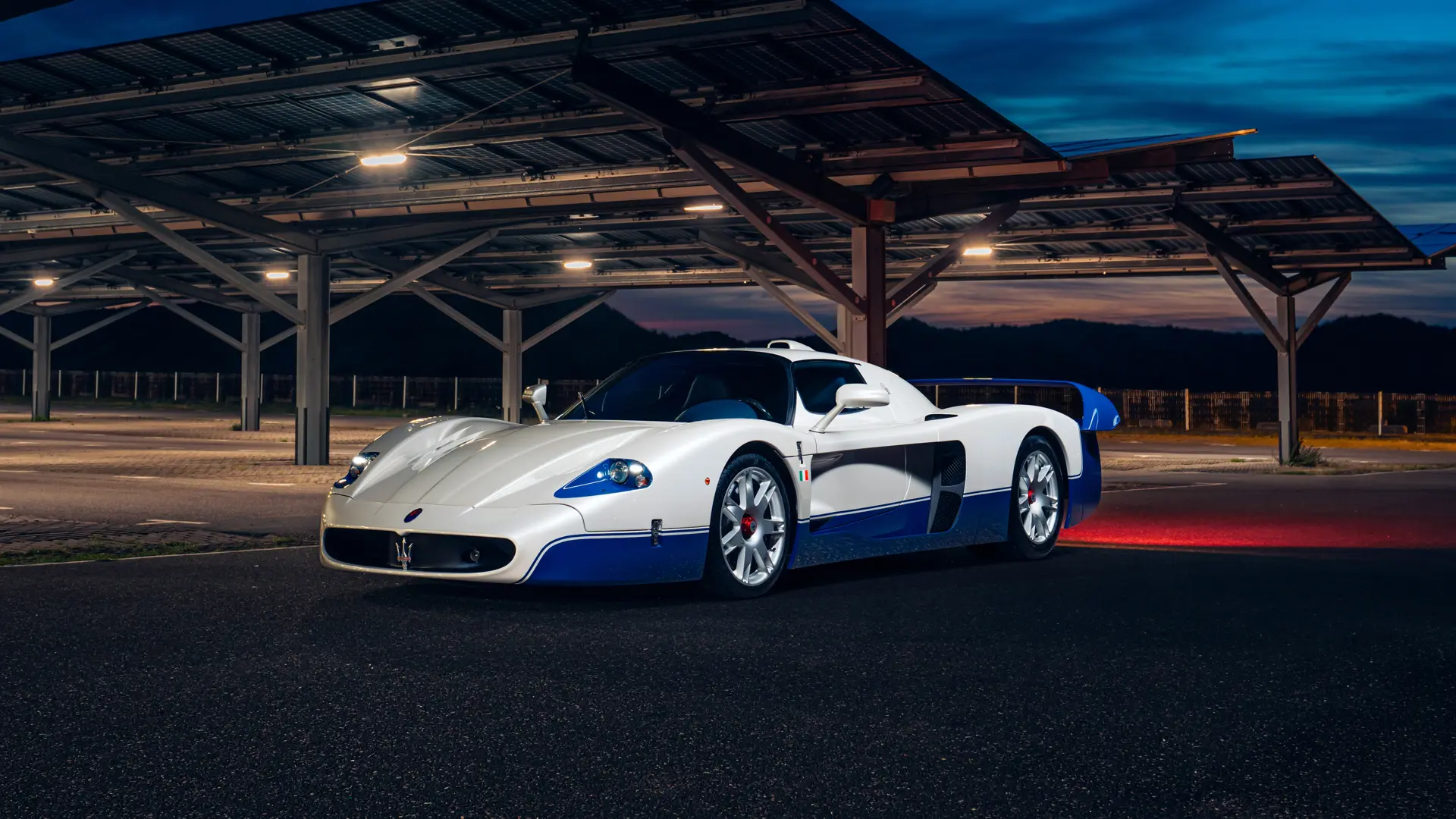
This particular MC12 is chassis 17558, referenced as car number 41 on its certificate of origin, and it comes from the second batch built for the 2005 model year, among the last of the breed. It shows just 2,024 kilometers — about 1,260 miles — and here’s the wild part: the invoices say it had already covered 1,375 km by March 2006. So in the roughly nineteen years since, its original Hong Kong owner added fewer than 700 kilometers. That’s not a car that was driven. That’s a car that was visited.
Related Articles
- This Machine Could Pull $6 Million in Bids — and It Might Be a Bargain
- A Rare 1985 Ferrari 288 GTO Just Became Bring a Trailer’s 250,000th Auction Lot
Delivered new through Maserati France before being shipped straight to Hong Kong, it stayed with that first owner until 2024, when it was imported and registered in Germany. It picked up a service at an official Ferrari center near Böblingen in 2025 and a fresh clutch in the Netherlands in 2026. Hold that clutch detail — it matters more than the catalog lets on.
What you’re actually buying
Strip away the Modena badging and the MC12 is an Enzo wearing a very expensive tailored suit. Both cars share the same fundamental architecture and the same naturally aspirated 6.0-liter (5,998cc) V12, here making roughly 630 horsepower routed through a six-speed Cambiocorsa automated manual with paddles. Top speed sits north of 205 mph. Frank Stephenson drew entirely new bodywork over the Enzo’s bones — longer, wider, slipperier, and crowned with a rear wing you could serve dinner on — which is why the MC12 makes more downforce than its Maranello cousin despite sharing so much underneath.
The engineering diverges in ways enthusiasts appreciate and appraisers price in: gear-driven camshafts instead of the Enzo’s chain drive, conventional dampers rather than the Enzo’s electronically managed setup, and its own engine mapping. Maserati was also politely instructed not to let the MC12 embarrass the Enzo, so its acceleration and top speed were reined in. The trade-off buyers actually cared about was the removable hardtop, a targa arrangement that turns the thing into a spider and lets that V12 sing straight into the cabin — a trick borrowed from the Ferrari F50 playbook. One catch worth knowing: the roof panel doesn’t stow onboard, so open-top motoring is a commitment you make in the garage, not on a whim at a stoplight.
Related Articles
- Rezvani Built an 850-HP Tactical Luxury Truck, and Only 100 People Will Ever Own One
- How a Turbocharger Actually Works — No Engineering Degree Required
Only 50 road cars were built, 25 in 2004 and 25 in 2005, all finished in the same white-over-blue livery nodding to Maserati’s old Camoradi racing colors. For context, Ferrari built around 400 Enzos (including the one made for Pope John Paul II and later auctioned for charity). That makes the MC12 roughly eight times rarer than the car it’s based on — a fact the market has only recently gotten religious about.
The clutch, the paint, and other things buyers should read twice
Two lines in the history file deserve a hard look. First, that 2026 clutch replacement. The Cambiocorsa is a single-clutch automated manual, and these systems are notorious for chewing through clutches, especially in the low-speed crawling that a pampered collector car actually does. On an MC12, replacing one is an engine-out affair, and the bills run into serious money — earlier MC12s have surfaced with $70,000 recommissioning invoices where a clutch was the headline item. A car that just had that work done is a car whose next owner dodged a very expensive appointment.
Second, the honesty flag: the front bumper and bonnet were repainted in January 2020. On a seven-figure car, originality is currency, and a resprayed nose — almost certainly the result of stone chips from what little driving it saw — is the kind of thing that separates a strong result from a record one. It’s minor and disclosed, which is exactly how you want it, but it’s not nothing.
The import math nobody mentions until the wire transfer clears
For American buyers eyeing this one, the MC12 was never federalized for U.S. sale, but it does sit on NHTSA’s Show or Display list, meaning it can be imported now — with a catch. Cars admitted that way are capped at 2,500 miles per year, which, frankly, an MC12 owner is unlikely to trouble. The cleaner path is patience: under the 25-year rule, the car earns a full exemption from federal safety standards in 2030, mileage cap and all.
There’s a European wrinkle too, and it’s a genuinely counterintuitive one. Because this car has covered under 6,000 kilometers, EU rules classify it as a “new means of transport” for VAT purposes — age be damned. A 21-year-old supercar is legally “new” the moment the odometer reads below 6,000 km, which flips the VAT liability to the destination country on an intra-EU sale. It’s why the listing’s fine print talks about VAT deposits and margin-scheme eligibility. Buy it, drive it past 6,000 km, and it quietly becomes “used” in the taxman’s eyes. Few six-figure decisions hinge on a rounding error in kilometers, but this is one.
Related Articles
- Touch a Flock Camera in Georgia and This Sheriff’s Office Will Hit You With a Felony
- NASCAR’s Richest Drivers Ever: A List That Refuses to Change
Here’s the backdrop that makes the estimate-on-request coyness feel earned. In August 2025, Maserati proudly announced that an MC12 had sold for $5.2 million in Monterey — the most expensive modern Maserati ever, by the brand’s own reckoning. That record lasted about nine months. In May 2026, a 515-kilometer example crossed the block at Mecum’s Indianapolis sale and brought $9,460,000 — a new high for the model and, remarkably, a new record for the entire Maserati marque, eclipsing prices that vintage racing Maseratis had held for over a decade.
That’s a near-doubling of the ceiling in under a year, and it’s part of a broader stampede toward analog, mid-2000s hypercars with real motorsport DNA — the same wave lifting the Enzo, the Carrera GT, and the F50. The MC12 is riding it for a simple reason: it delivers Enzo mechanicals and a genuine championship pedigree at a fraction of the supply.
Where this 2,024-km car lands depends on how bidders weigh its longer legs against that Mecum car’s near-delivery mileage and its resprayed nose against its unusually tidy single-owner history. But if you’ve been telling yourself the MC12 is the sensible, affordable way into Enzo-adjacent hypercar ownership, this is your reminder that the window on “affordable” slammed shut sometime last spring.
Images Via: RM Sotheby’s
About the Author