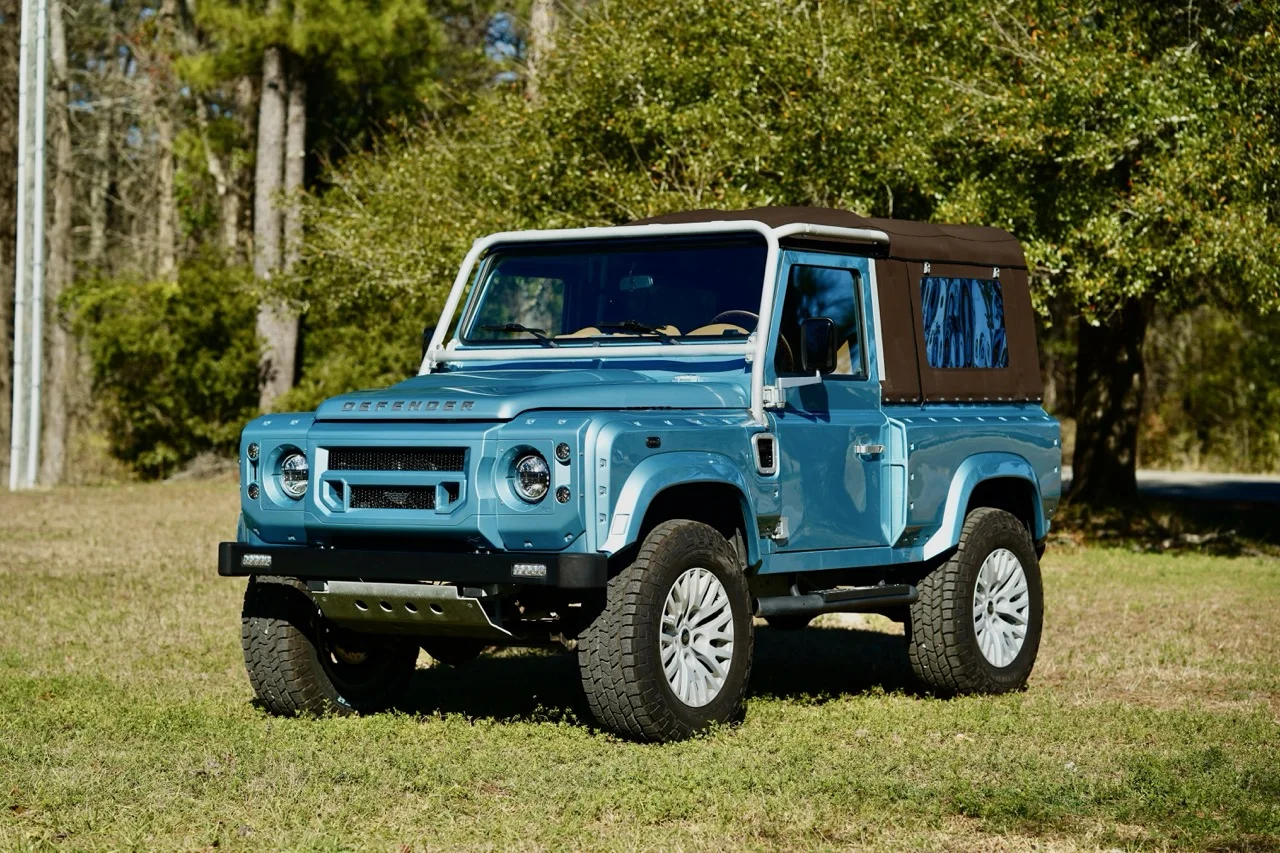
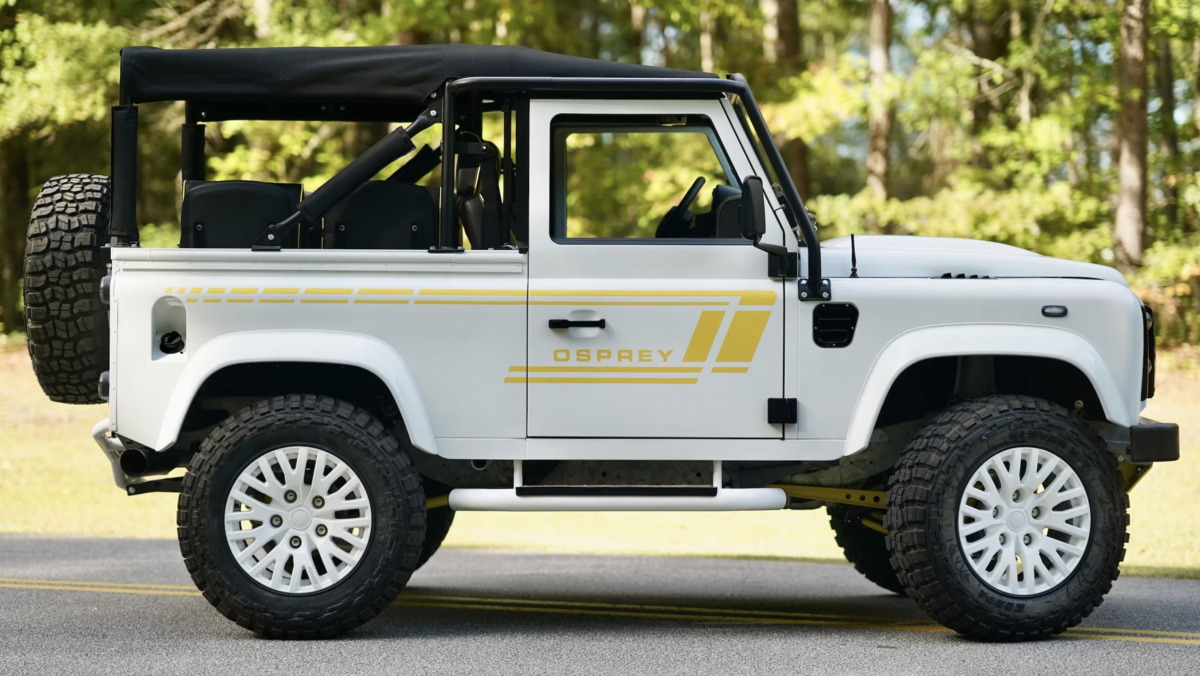
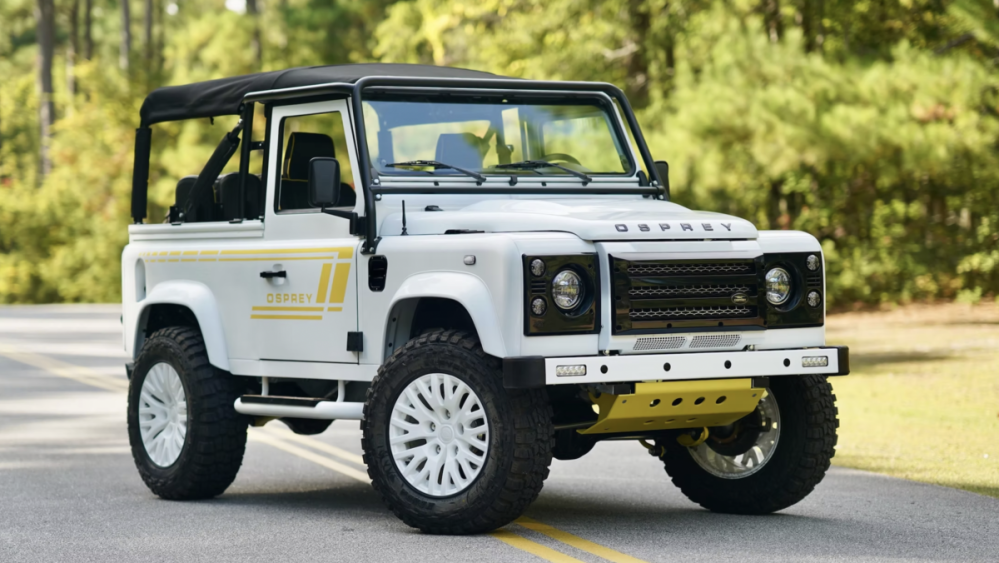
There is a 2022 Land Rover Defender 90 listed in Wilmington, North Carolina for $209,950. It has 2,300 miles, a Viking Blue body, a chocolate soft top, and a 6.2-liter Corvette V8 where the tractor engine used to live. It is a very good looking truck. It is also not a Land Rover, and you do not need to take anyone’s word for that, because the federal government already wrote it down.
Run the VIN — 4S9111E29NC520064 — through NHTSA’s public vehicle decoder and the answer comes back clean, check digit and all. Make: Osprey Custom 4×4. Model: OC90. Trim: Soft Top. Manufacturer: Signature Autosport, LLC. Plant city: Castle Hayne, North Carolina. Body class: SUV/MPV. GVWR: 5,523 pounds. Nowhere in that record does the word “Rover” appear.
The listing itself gives the game away if you read past the headline. The spec table says Land Rover, Defender 90. The description directly beneath it says Osprey Custom 4×4, OC90 Soft Top, 2022. Both are on the same page. Only one of them matches the title you would be signing.
A VIN That Starts With 4S9 Is Telling You Something
This matters more than trivia. A vehicle wearing a Land Rover VIN is a Land Rover — titled as one, insured as one, serviced under Land Rover’s parts catalog, and tracked under Land Rover’s recall obligations. A vehicle wearing its own manufacturer’s VIN is a new vehicle from a company most people have never heard of, and every one of those downstream relationships changes.
Signature Autosport is registered with NHTSA as manufacturer ID 19307, out of Castle Hayne, with Aaron J. Richardet listed as president. The registry records two classifications next to that name: Completed Vehicle Manufacturer and Replica Vehicle Manufacturer. Those are not synonyms, and the difference is worth roughly everything to a buyer.
The replica classification exists because of a 2015 law that finally gave small builders a legal path to selling turnkey cars. Under 49 U.S.C. 30114(b) and the rule NHTSA wrote to implement it, a manufacturer producing no more than 5,000 vehicles worldwide per year can sell up to 325 replica vehicles annually that are exempt from the Federal Motor Vehicle Safety Standards that apply to vehicles. There are strings. The body has to resemble something “manufactured not less than 25 years before.” The vehicle has to be built in a single manufacturing stage. The builder has to hold a license from the original manufacturer or own the intellectual property outright. Registration runs through NHTSA’s own database, and annual reports listing every VIN produced are due by March 1.
And there is a label. The rule requires a permanent dashboard placard — yellow header, white message area, minimum 30 square centimeters — stating in plain language that the vehicle is exempt from current federal safety standards and theft prevention standards. If you are looking at a replica-exempt vehicle, that label is legally required to be staring at you from the dash.
Here is the tension. Osprey’s own website carries a disclaimer that the company is “not affiliated with, sponsored by, authorized by, endorsed by, or officially connected with Jaguar Land Rover Limited,” and describes itself as a “boutique restoration atelier” rather than a manufacturer. The replica pathway specifically requires that licensing relationship. So the practical buyer question is not academic: which classification does my specific VIN fall under, and can you show me the paperwork? A completed-vehicle build and a replica-exempt build are two different cars with two different safety-standard obligations, and the only person who can tell you which one is in your driveway is the builder. Ask before the wire transfer, not after.
This is the same conversation the licensed Eleanor Mustang forced into the open, and the same one that follows every Corvette-based replica onto the market. Licensing is the entire ballgame in low-volume manufacturing.
The Engine Is Real, But The Number Is Optimistic
The listing claims “approximately 435 horsepower” from the 6.2-liter LS3, and NHTSA’s record for the VIN carries 435 as well. Chevrolet Performance rates the LS3 crate engine at 430 horsepower at 5,900 rpm and 425 lb-ft at 4,600 rpm, from 376 cubic inches, on a 10.7:1 compression ratio, with a cast aluminum block using six-bolt cross-bolted main caps and as-cast L92-style heads with 68cc chambers. The 436-horsepower figure people remember belongs to the C6 Corvette fitted with the dual-mode exhaust option, not to a crate motor breathing through a Defender’s plumbing.
Five horsepower is nothing. The reason to care is that it tells you how the spec sheet was assembled — rounded up from memory rather than pulled from a dyno sheet. Ask for the dyno sheet.
The Transfer Case Is The Smartest Thing On The Window Sticker
Behind the LS3 sits a 6L80E six-speed automatic and, per the listing, an LT230 transfer case with center differential lock. That is the Land Rover unit: gear-driven, two-speed, with a lockable center diff and a genuine low range. It is the part of the old Defender that actually earned the reputation.
Worth noting for anyone cross-shopping Osprey’s current inventory: the company’s newer OC90 builds are specified with an NP149 instead. That is a GM full-time all-wheel-drive case — single speed, chain driven, no low range. On pavement it is smoother and quieter. On a rock ledge or a steep wet launch ramp, a 2:1 low range is not a luxury item. If crawling matters to you, the older LT230 car is the one you want, which is a genuinely unusual situation where the used example has the better hardware.
The rest of the build reads like a well-sorted parts list: Terrafirma springs and shocks, a Project Kahn widebody kit, 18-inch Iconisus alloys wrapped in Cooper Discoverer AT3 XLT tires, saddle tan leather, heated fronts, an Atoto touchscreen running wireless CarPlay, and Rockford Fosgate and Memphis audio with a powered subwoofer. None of it is exotic. All of it is serviceable by a competent independent shop, which is a real advantage over the more ambitious LT4-swapped Defenders floating around.
What A Galvanized Chassis Does And Doesn’t Buy You
The new hot-dipped galvanized frame is the single most valuable line in the description, and it is the one nobody photographs. Defender chassis rot from the inside out, usually at the rear crossmember and the spring seats, and by the time it shows on the outside the repair is a frame-off job. A new galvanized chassis removes that entire failure mode from the ownership equation.
What it does not fix is everything bolted to it. The bulkhead — the firewall structure the doors and dash hang off — is the other classic Defender corrosion point, and a galvanized frame says nothing about it. Door frames, footwells, and the seams under the wing tops are the next three. If you are spending north of two hundred grand, the questions are simple: is the bulkhead new or refurbished, and can I see it on a lift.
The Money Math Is The Strangest Part
This 2022 with 2,300 miles is asking $209,950. Signature Autosports — the same company that built it and holds the manufacturer registration — currently lists a 2024 OC90 Soft Top with delivery-only mileage at $189,950 on its own website. That newer car carries a 12.3-inch digital cluster, Method MR318 wheels, Maxxis Razr MT tires, and Exmoor Trim leather.
So the used one, from the same builder, is asking twenty thousand dollars more than the newer one. Unless you specifically want the LT230 and the Kahn widebody, that is a difficult sentence to justify. The financing estimate attached to the listing works out to roughly $3,618 a month, which is a useful reminder that a bespoke SUV payment is a mortgage on a second house.
The broader restomod Defender market has absorbed a lot of capital in the last few years — the $350,000 builds with three-year waiting lists set the ceiling everyone else prices against. But that ceiling belongs to a handful of names with auction records behind them. A first-generation VIN from a builder without a public resale history is a different asset class entirely, and the exit is thinner than the entry.
Insure It Before You Buy It
A vehicle with a non-OEM VIN and no book value does not fit a standard auto policy, because there is no standard auto policy value to total it against. The coverage you want is an agreed-value policy written by a specialty carrier, with the number agreed in writing before delivery and revisited as the market moves. Get that quote in hand first. A carrier that will not write agreed value on an Osprey is telling you something about how the market sees the VIN, and that is free market research. Our guide to getting real coverage without overpaying covers the mechanics.
Body repair is the other cost nobody models. A widebody panel on a low-volume build does not exist in a collision shop’s parts system. It comes from the builder, on the builder’s schedule, at the builder’s price. Budget accordingly, and confirm the company will still sell you panels for a car it built four years ago.
So What Is It, Actually?
It is a well-executed American-built small-volume SUV in a British costume, with a durable pushrod V8, a fresh frame that solves the platform’s worst structural habit, and a transfer case that outperforms the one its own builder specifies today. That is a legitimately appealing package, and calling it a “fake Defender” misses the point — it was never trying to be a restored Defender. It is a new vehicle. That is exactly what the VIN says.
The problem is that it is being marketed as the thing it is not. When the search results say “2022 Land Rover Defender 90” and the federal record says “2022 Osprey Custom 4×4 OC90,” the buyer who does not check is going to learn the difference at the DMV counter, at the insurance renewal, or at trade-in. If you want the truck, buy the truck. Just buy it knowing what is on the title, and read the dashboard before you read the brochure.
Still fuzzy on where the line sits between a restoration and a new vehicle? Start with our breakdown of what “restomod” actually means, then see why restomods are quietly taking over the classic car world. And if you like the Defender idea but not the VIN gymnastics, there is a supercharged factory Defender 110 nobody talks about that costs a lot less and titles itself.
Your Turn: Would a VIN mismatch be a dealbreaker for you, or does the build quality matter more? Tell us in the comments.
About the Author