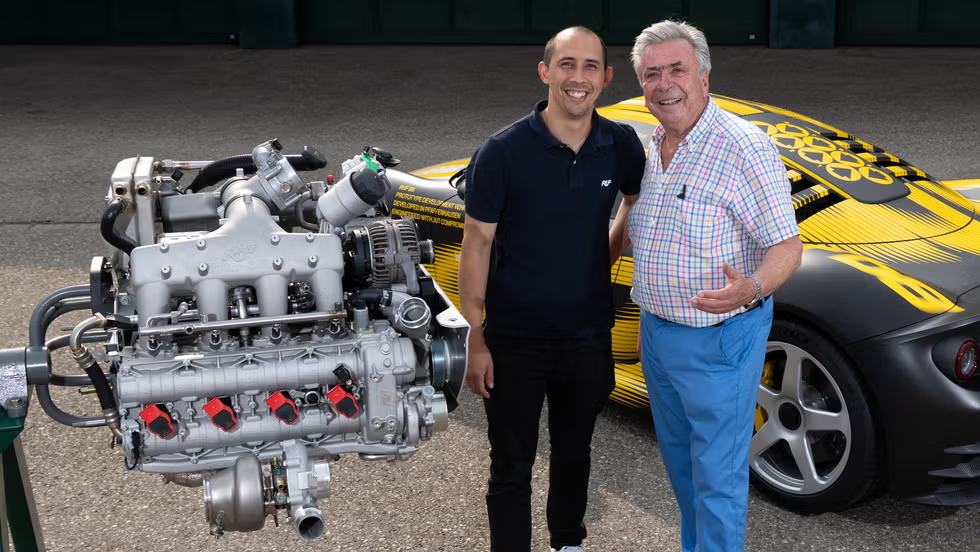
At the 2026 Goodwood Festival of Speed, RUF sent a heavily disguised CTR3 up the hill wearing a screaming yellow livery with “BOXER 8 ERPROBER” stenciled across the doors. The paint job isn’t the story. What’s bolted between the axles is: a clean-sheet, 4.8-liter twin-turbocharged flat-eight producing more than 1,000 horsepower and 1,000 Nm (738 lb-ft) of torque. RUF calls it the B8, and it’s the first boxer-eight the German manufacturer, or really anyone building a road-relevant engine, has attempted in this exact configuration.
Garage-worthy EDC gear, on sale this week.
A flat, or boxer, engine lays its cylinders down in opposing horizontal banks so each piston’s motion cancels its mirror image, which is why Porsche’s flat-sixes and Subaru’s flat-fours run so smoothly at idle. Doubling that layout to eight cylinders sounds like simple arithmetic, but it isn’t. Porsche learned that the hard way in the 1960s, when its 908 prototype racer needed multiple crankshaft and firing-order redesigns just to keep the engine from shaking itself apart, and that was a purpose-built race motor with none of the daily-use durability targets a road-relevant flat-eight would need. Wrapping that layout around two turbochargers and a bespoke, gravity-cast aluminum case, decades later, is a genuinely different engineering problem than simply stretching an existing flat-six.
RUF is also handling this reveal differently than usual. The company has spent more than eight decades in Pfaffenhausen, Germany, finishing cars mostly out of public view until they’re done. By RUF’s own account, this is the first time it’s let outsiders watch a car mid-development rather than only unveiling a finished product. The stretched CTR3 body here is functioning purely as a rolling test bed for the B8’s engine and drivetrain, not a preview of any future model’s styling.
Check This Out: Best Dash Cams of 2026: How to Choose the Right One for Your Vehicle
It’s worth remembering RUF isn’t a tuning shop bolting a bigger turbo onto a Porsche and calling it a day. RUF Automobile GmbH has held independent manufacturer status under German type approval since 1981, meaning cars like the CTR “Yellowbird” and CTR3 carry their own VINs and homologation, even when built around 911-derived architecture. That distinction matters if the B8 ever reaches a customer: pricing, warranty coverage, and even collision repair would run through RUF’s own small network rather than a Porsche dealership. Porsche has leaned hard into factory-level, from-scratch rebuilds of its own older models in recent years, but RUF has built that same philosophy into its identity since 1939, treating every car leaving Pfaffenhausen as a complete build rather than a modification.
The B8 also pairs its turbo-eight with a six-speed manual, by RUF’s own description of the car. That’s a deliberate stance in a market where nearly every flagship this powerful ships exclusively with a dual-clutch gearbox for shift speed and launch-control consistency. Running a manual behind this much torque means the clutch and flywheel have to survive turbo boost spikes without slipping or cooking themselves, a durability problem serious enough that automakers still willing to build three-pedal hypercars, like Pagani with its manual Zonda revival, treat it as a genuine selling point precisely because so few companies still attempt it.
RUF let racing and stunt driver Tanner Foust pilot the B8 up the Goodwood hillclimb for its public debut, running on Optima batteries and lubricated by Motul. Company founder Alois Ruf framed the engine as a milestone rather than a spec-sheet exercise, noting that a boxer-eight has never been part of RUF’s story, or anyone else’s in this exact form, before adding that the team was ready to “let the engine speak for itself at Goodwood.”
Read Next: The 10 Best Outdoor Knives of 2026: Top-Rated Picks for Hunting, Camping, and Survival
None of this confirms a production car yet. The CTR3 body here is purely a mule, and RUF hasn’t attached the B8 to any announced model, price, or timeline. But the company’s track record suggests today’s engineering exercise tends to become tomorrow’s limited-run customer car. The original CTR3’s twin-turbo flat-six eventually underpinned a series of seven-figure specials built in numbers small enough that most buyers knew about their allocation before the car was ever photographed publicly. If the B8 follows that pattern, expect a similarly tiny production run, bespoke pricing, and an ownership experience where major service work means shipping the car to Bavaria rather than driving it to the nearest dealer.
It’s also a useful reminder of how diluted big horsepower numbers have become lately. A production Corvette is already flirting with 1,000-plus horsepower from the factory, and drag-strip specials built out of decades-old muscle-car platforms are matching supercar output for a fraction of the price. What makes the B8 interesting isn’t the horsepower figure, it’s that RUF chose one of the hardest possible ways to get there, reviving a cylinder layout almost nobody has seriously attempted since Porsche shelved its own flat-eight racing experiments more than half a century ago. That’s a rarer kind of engineering swing to see at an event like Goodwood, where most reveals are about polish rather than genuine risk.
About the Author