Porsche’s New Entry-Level Race Car Costs More Than the Road Car It’s Built From
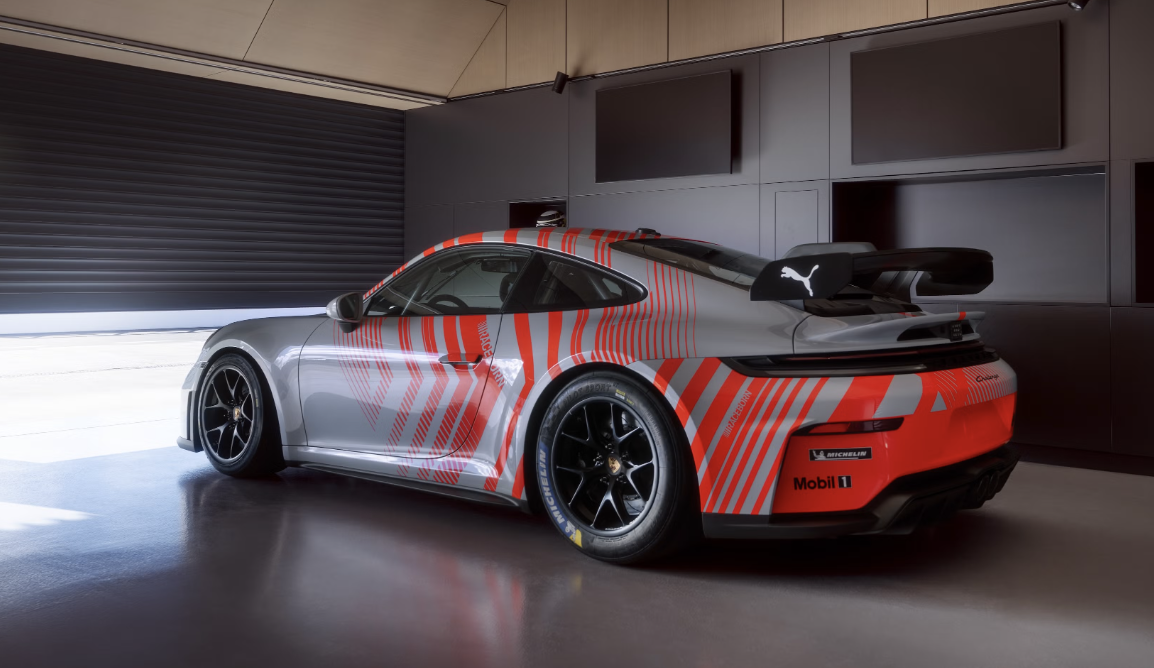
Porsche Motorsport North America has put a number on the 911 Challenge: $275,000, including import and delivery, offered first to 2027 one-make entrants. Sit with that for a second. The road-going 911 GT3 this thing is built from launched at an MSRP of $222,500 plus $1,995 for delivery, processing and handling. So the race car asks roughly fifty grand more than the street car, and it can’t be registered.
That sounds absurd until you price out doing it yourself. A welded-in cage in an aluminum-intensive 992 shell, an FIA FT3 bladder, plumbed fire suppression, a proper seat and six-point mounting, an air-jack installation, and the wiring and fabrication labor behind all of it will comfortably eat six figures at a competent race shop. You’d also be gutting a $220,000 road car’s resale to get there, and you’d still have a converted street car rather than a homologated one-make entry with factory spares support. The math on the Challenge isn’t crazy. It’s just uncomfortable to look at directly.
The name change is a taxonomy thing, not a marketing thing
Nobody called this a Clubsport, and that’s deliberate. When Porsche introduced the 911 Cup last August, it explained that it was standardizing its racing nomenclature: from that point on, only cars built for open-brand series or specific categories carry a “GT” suffix with a number. One-make cars get plain names. That’s why the 911 Cup dropped “GT3” from its badge and why this one is a Challenge, named for the series it’s meant to run in.
Related Articles
- Ford’s Bronco Family Is About to Get a Truck Bed, and the Timing Is No Accident
- Rivian’s E-Bike Spinout Just Raised $150 Million to Chase Driverless Delivery
It also means the Cayman is fully gone from Porsche’s racing ladder. Every current Porsche GT race car is now a 911: Challenge, Cup, GT4 R, GT3 R. The Challenge is the direct replacement for the original Cayman GT4 Clubsport and the 718 Cayman GT4 RS Clubsport that followed it.
Where the extra six horsepower comes from, and why it matters
The Challenge’s 4.0-liter flat-six makes 508 hp at 8,500 rpm and shares the 9,000 rpm cutout with the road car’s 502 hp unit. Six horsepower is nothing. The reason for it is everything.
Porsche says the racing exhaust uses a modified muffler that still carries a catalytic converter but doesn’t require a particulate filter. The road-going 992.2 GT3 runs two gasoline particulate filters and four catalytic converters to clear current emissions limits, and Porsche had to work the camshaft profiles, cylinder heads, throttle butterflies and oil coolers just to hold 502 hp against that backpressure.
Delete the GPFs and you get the difference back. You also permanently forfeit any path to street legality, which is why Porsche’s “not street legal” line isn’t boilerplate liability language. It’s a hardware statement. This car cannot be federalized, cannot be titled, and will spend its entire life arriving at circuits on a trailer.
The PDK is the interesting engineering decision
Every other rung on this ladder uses a sequential six-speed dog gearbox. The Cup runs one behind a four-disc sintered metal racing clutch. The GT4 R runs one too. The Challenge keeps the production seven-speed PDK, with both automatic and manual paddle modes intact, exactly as in the road car.
For a novice, that’s enormous. A dog box demands a specific technique and punishes sloppy inputs by chewing dog rings, and a sintered clutch is an on-off switch that makes standing starts a skill unto themselves. PDK removes both. It also removes two recurring consumable lines from a club team’s budget, which is very likely the actual point given Porsche’s stated goal of holding operating and spare parts costs down.
The trade-offs are real, though. A wet dual-clutch is heavier than a dog box, it carries its own cooling burden during long stints, and PDK service is a specialist job rather than a between-sessions clutch pack swap. If you’re evaluating one of these, the gearbox service interval and cost is the first question worth asking, right alongside engine overhaul hours. Porsche publishes a 100-hour overhaul figure for the Cup engine; it hasn’t published one for the Challenge.
Chassis choices that quietly cut running costs
The Challenge rides on 18-inch wheels with a conventional five-bolt pattern, following the 911 GT4 R rather than the Cup’s center-lock setup. Five-bolt costs you a few seconds on a tire change, but it also means no center-lock hardware, no dedicated sockets, no torque guns calibrated for a single nut, and cheaper hub assemblies when someone finds a wall. For a two-car club operation, that’s not a rounding error.
Eighteen-inch is the smart size, too. It’s the volume slick diameter across most series, it’s cheaper per set than 19s or 20s, and the extra sidewall is more forgiving of the aggressive curb use that separates fast club racers from expensive club racers.
Brakes are steel, 380 mm front and rear, shared with the GT4 R and Cup. Steel discs and race pads are dramatically cheaper to feed than the carbon-ceramic rotors a track-day GT3 owner is currently incinerating. Dampers get a motorsport-specific valving curve, the anti-roll bar is adjustable across three positions, and the rear wing has four mechanical settings — a deliberately narrow adjustment window that keeps one-make fields close and stops the team with the biggest engineering budget from running away with it.
What’s actually in the cabin
Sound deadening, carpet and trim are gone. In goes a welded roll cage, an adjustable racing bucket with a six-point harness, a fire-extinguishing system and a 29-gallon (110-liter) FIA FT3 fuel cell — endurance-stint capacity, and in the same ballpark as the 115-liter cell in the outgoing 718 Clubsport.
What stays is the tell. ABS, traction control, full ESC, multi-stage PTV+, the GT3 RS steering wheel with racing functions, and air conditioning. A race car with stability control fitted as standard is not a car built for professionals who want the electronics unplugged. It’s built for a GT3 owner who has done thirty track days, wants to try a real grid, and would prefer the car not spit them into a tire wall while they learn.
Body dimensions and key panels match the GT3. Three air jacks are standard, the hood opens on quick-release fasteners, and there’s an FIA-spec rain light at the rear.
Where it sits, and what buyers should watch
Against the rest of the family, the Challenge undercuts the GT4 R by $100,500 — that car lists at $375,500 with import and delivery — and sits $46,000 above what the 718 Cayman GT4 RS Clubsport asked back in 2021. Some of that gap is five years of inflation and tariffs on a German-built car; the rest is the jump from a Cayman shell to a 911.
Related Articles
- Polestar Hand-Built 34 Prototypes Just to Learn How to Build One Car
- FLEX Automotive Will Now Ship a Genuine JDM Land Cruiser Straight to Your Driveway
For 2027 in the U.S., the Challenge is eligible for the Porsche Sprint and Endurance Challenge North America by Yokohama, the Porsche Sprint Trophy Porsche Club of America by Yokohama, and the new Porsche Sprint Trophy Porsche Owners Club. Full-season entrants in those series get priority on allocation. If you just want a very expensive toy for track days and driver development, Porsche says that availability comes later in 2027, meaning you’re standing behind everyone who committed to a season.
Two practical notes for anyone seriously considering one. First, insurance: this is not a titled vehicle, so it lives on an agreed-value race-car physical damage policy plus event liability, and coverage during on-track incidents is where those policies differ wildly. Read the on-track exclusion before you write the deposit check, not after your first contact.
Second, the consolidation onto one platform is the real cost story. A shop running a Challenge, a Cup and a GT4 R is now stocking one family of 992-based parts instead of three unrelated ones. Over a season, that shared-inventory effect will save more money than any single line item on the spec sheet.
Images Via: Porsche
About the Author