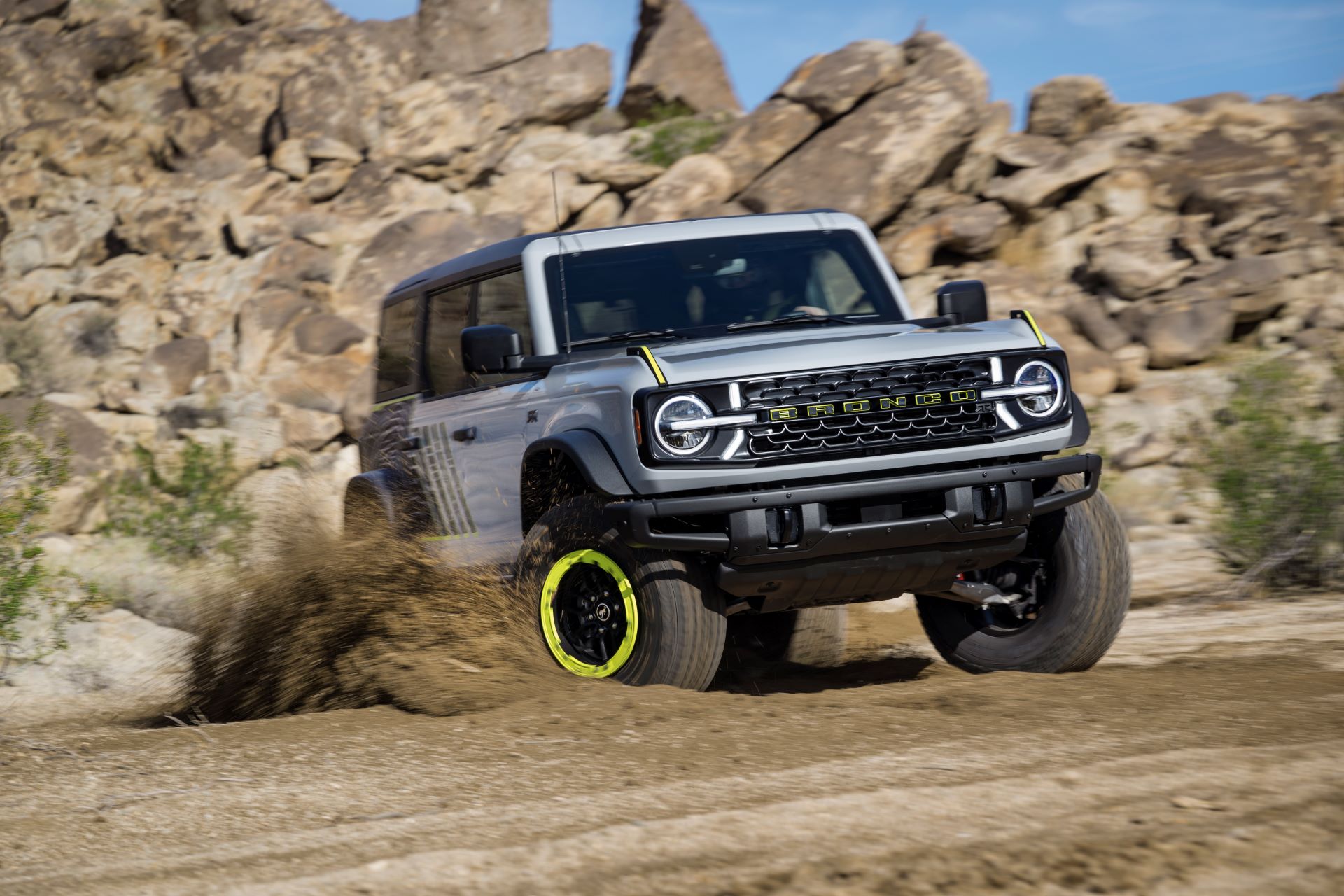
Ford has spent the better part of six years teasing a pickup version of the Bronco, and industry sourcing now suggests the project has finally moved from mood board to product plan. People familiar with Ford’s thinking describe a Bronco-badged truck aimed squarely at the Jeep Gladiator, expected to be built at the Michigan Assembly Plant in Wayne, the same factory currently splitting output between the Bronco SUV and the Ranger. None of this has been confirmed by Ford itself, so treat the specifics as a strong, well-sourced rumor rather than a finalized spec sheet. Still, the pieces fit together neatly, and Ford’s own paperwork this month backs up the broader strategy sitting underneath it.
The Hard Part Is Already Solved
Whatever underpins a production Bronco pickup, it won’t require a clean-sheet engineering program. The current Ranger and Bronco SUV already share Ford’s T6 midsize truck architecture, the body-on-frame platform Ford also builds trucks on for markets overseas. Bolting a pickup bed onto that same frame is a packaging exercise more than an all-new vehicle program, which is exactly why a Bronco pickup has been technically plausible since the current Bronco launched back in 2021. If Ford carries over the SUV’s engines, expect the 300-horsepower 2.3-liter EcoBoost four-cylinder as the base offering and a 330-horsepower 2.7-liter EcoBoost V6 as the step-up option, matching what Ford currently publishes for the 2026 Bronco SUV lineup. A hybrid variant is plausible too, since industry reporting has pointed to a Bronco hybrid arriving as soon as 2027.
Where It Would Have to Land Against the Gladiator
Jeep isn’t standing still while Ford sorts this out. The 2026 Gladiator Sport starts at $39,820 before a destination charge, runs a 285-horsepower 3.6-liter Pentastar V6, and tops out in Rubicon trim around $53,000 with a 7,000-pound max tow rating and a 1,200-pound payload ceiling, per Jeep’s own configurator. That’s the number Ford has to beat. A Bronco pickup carrying over the SUV’s optional 330-horsepower V6 would out-power the Gladiator’s V6 on paper, and the Bronco’s existing Sasquatch off-road package, with 35-inch tires, locking differentials, and bead-lock-capable wheels, already gives it credentials that would carry straight over to a truck body. Jeep’s trump card has always been the Gladiator’s Wrangler-based drop-top versatility, a party trick that’s tough to engineer into anything wearing a fixed pickup cab.
A Factory Rewritten Around One Name, and What It Means for Ranger
The more interesting wrinkle is what happens to Michigan Assembly Plant, and by extension the Ranger. That factory currently splits production between the Ranger and the Bronco SUV, and industry sourcing suggests Ford could eventually hand the entire plant over to the Bronco family: SUV, pickup, and a rumored Lincoln-badged off-roader down the line. If that happens, the Ranger doesn’t have to disappear, but it would need a new home or a new identity, perhaps repositioned as a plainer work truck while the Bronco pickup chases buyers willing to pay more for adventure branding. That wouldn’t be unprecedented for a company that already stacks nameplates at very different price points within its own F-150 lineup and beyond. Anyone shopping a current Ranger shouldn’t panic; nameplates rarely vanish the moment a factory’s assignment changes, and it’s worth asking a dealer directly about incentives if this generation is nearing the end of its run.
The Real News Ford Already Confirmed
While the Bronco pickup remains unofficial, Ford did put something concrete into writing this month that explains why the timing lines up. On August 12, Ford announced it will grow Lincoln production in the United States starting in 2030 and phase out importing Lincoln vehicles from China for the U.S. market. Lincoln’s current U.S. output includes the Navigator, built at Kentucky Truck Plant in Louisville, and the Aviator, assembled at Chicago Assembly Plant, and Ford says this expansion builds on that existing American manufacturing footprint. CEO Jim Farley framed the move simply, saying Ford builds in America “because we believe in America.” The company says it led the industry in U.S. vehicle assembly, U.S. exports, and hourly manufacturing employment in 2025, assembling more than 2 million vehicles domestically and employing roughly 56,300 hourly manufacturing workers. Set next to that announcement, a Bronco pickup built in Michigan looks less like an isolated product bet and more like one piece of a broader push to reshore nameplates at a moment when buyers and regulators are both paying closer attention to where vehicles actually get built.
What to Actually Do With This Information
If you’re cross-shopping a Gladiator right now, don’t wait around for a Bronco pickup to show up on a dealer lot this year. Nothing Ford has said publicly points to an imminent launch, and a plant realignment this size typically takes a few model years to execute. If you already own a Bronco SUV, the parts and service outlook likely improves over time rather than shrinking, since a pickup sibling built on shared components tends to widen a dealer’s parts inventory instead of splitting it. And if insurance cost factors into your decision, expect a Bronco pickup to price out closer to the SUV’s off-road trims than to a stripped-down work truck. Locking differentials, oversized off-road tires, and winch-ready bumpers are exactly the components adjusters flag as expensive to replace, and the kind of hardware that turns a minor mishap into a costly repair bill. Bronco owners already know that outcomes on the road depend on more than badge or drivetrain, as the crash report behind ESPN analyst Matt Miller’s own Bronco wreck made painfully clear.
About the Author