Most “overland packages” are a purchase order with a badge on it. Somebody buys a lift, a rack, a set of tires and a light bar from four different catalogs, bolts them to a truck that was never engineered to carry any of it, and charges you a markup for the privilege of doing your own shopping. The result usually rides worse, steers worse, and eats CV boots.
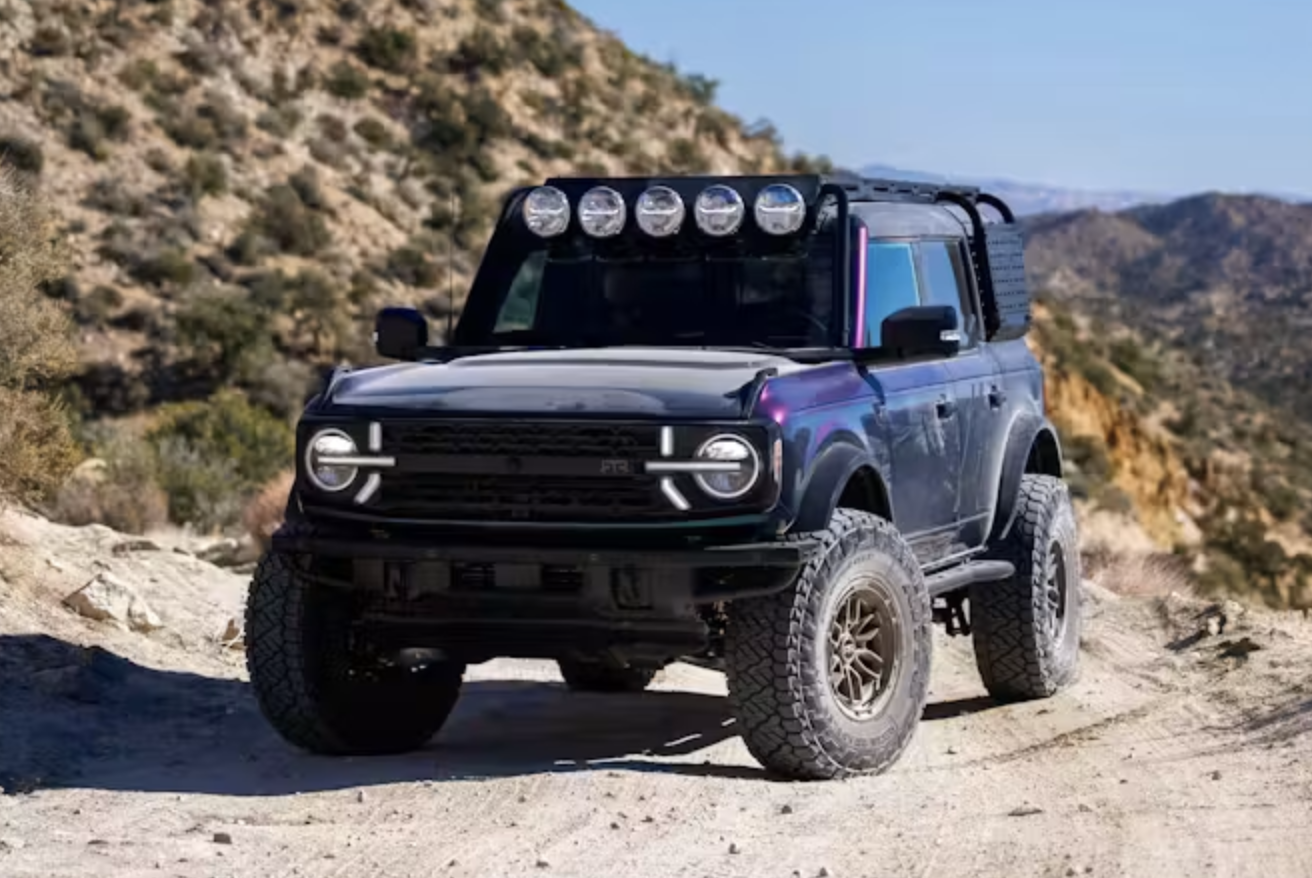
RTR’s Bronco ROVR is a more interesting animal, mostly because of what it leaves alone.
The package starts at $26,595 — parts and labor, base vehicle not included — which puts it roughly $8,400 above the standard Bronco RTR treatment. Buyers can order it through RTR’s authorized Ford dealer network or have RTR build it in-house. The people signing off on it aren’t marketing hires: RTR’s off-road roster is Vaughn Gittin Jr. (three Ultra4 titles, two King of the Hammers stock class wins), Loren Healy (two KOH Unlimited championships, five Ultra4 titles), and Bailey Campbell.
The tire swap is the smartest part, and nobody talks about it
Ford’s Sasquatch package already gives you a 4.7 final drive, electronic lockers front and rear, high-clearance suspension, position-sensitive Bilstein dampers and LT315/70R17 rugged-terrain tires, per Ford’s 2025 order guide. That’s a truck already geared for 35s from the factory.
So what does RTR do? It fits a 35×12.50R17 Nitto Recon Grappler on a 17×9 wheel. Check Nitto’s own spec table and the elegance shows up: the LT315/70R17 measures 34.41 inches inflated, while the 35×12.50R17 measures 34.53. That’s a tenth of an inch. Your speedometer doesn’t lie to you, your ABS and stability control keep seeing the wheel speeds they expect, and nobody needs to re-gear a differential.
Related articles
- Backfire News Readers Get More Entries to Win the Super Chevy Dream Giveaway — Ends 8/4
- Weekend Racing Guide: Every Motorsports Event Happening August 1-2, 2026
What actually changes is construction. The 35×12.50R17 Recon Grappler is a Load Range E tire — a 10-ply rating by Nitto’s own definition — good for 3,640 pounds at 65 psi, with 16.9/32nds of tread, and it weighs 67.24 pounds. That’s the trade: you’re buying sidewall and carcass strength for a truck that’s about to gain a steel roof rack and a spare hanging off the tailgate. The cost is unsprung mass, which no amount of damping tuning fully hides.
The lift is where non-Sasquatch buyers should pay attention
If your Bronco isn’t Sasquatch-equipped, RTR installs a billet spacer lift that raises ride height by two inches and moves you to a +30 offset wheel instead of the Sasquatch-spec +0. Sasquatch trucks skip the lift entirely.
Understand what a spacer does on an independent front end: it does not add suspension travel. It relocates the static ride height, which means you trade droop for lift, steepen the CV angles, and change the geometry the factory alignment was validated against. Budget for an alignment afterward, inspect CV boots more often than you would stock, and don’t be shocked if front wheel bearings and ball joints ask for attention earlier than a stock truck’s would. RTR also notes the wheels require tuner-style lug nuts and that OEM lugs won’t work — a small detail that becomes a large one when you’re on a shoulder at night with the wrong socket.
The rack has a number on it that people misread
RTR’s roof rack is 93 inches long, 46.5 wide, and adds 3.625 inches of height — measure your garage door before you sign anything. It carries an 800-pound static load rating. Static means parked. It is the number that lets you put a rooftop tent up there and sleep in it. It is emphatically not the load you should be driving down a washboard road with a mass sitting three and a half feet above the roofline, where every pound is levering against the vehicle’s roll center.
There’s a second catch worth knowing before purchase: because the rack uses factory mounting locations, RTR says modular hard top panels aren’t removable while it’s installed. If open-air driving is half of why you bought a Bronco, that’s a real conversation to have with yourself.
The lighting is similarly worth reading closely. The bar with five PROJECT X FF.70 lamps weighs 26 pounds and comes with a fused harness triggered through a relay by the Bronco’s auxiliary switches. Which is great — if your truck has them. Ford’s order guide puts aux switches standard on Badlands and Heritage, and inside the Black Diamond package on Big Bend. Order a ROVR on an Outer Banks and you should confirm the trigger source in writing. RTR itself flags that forward-facing aftermarket lighting laws vary by state, and it’s not being cute: five roof-mounted lamps are legal to own everywhere and legal to use on pavement almost nowhere.
The steel, and what it costs you
The rear bumper is built from 1.75-inch DOM tubing — drawn over mandrel, meaning the tube is cold-drawn over a mandrel after welding for consistent wall thickness and concentricity, which is why fabricators trust it in bending applications where ordinary ERW tube would be a gamble. It improves departure angle and keeps the OEM parking sensors and hitch functional. The rock sliders add a 4-inch step and a 7-inch rear kick-out, and — the part that matters at 9,000 feet with nobody around — a designed lift point for a jack.
Related Articles
- Custom 1959 Impala From Nipsey Hussle Music Video Heads to Monterey Auction
- Anthony Hamilton’s Silverstone Auction Shows Why Replica Jaguars Struggle to Sell
All of it weighs something. Every pound of powder-coated steel comes directly out of the payload figure printed on the certification label in your driver’s door jamb, and that figure is what determines whether you’re legal with four adults, a fridge, water and a rooftop tent.
Want more: FOX 2.5 Performance Elite shocks with 37-inch Nittos run $7,695. Worth knowing that Nitto’s 37×12.50R17 Recon Grappler is a Load Range D tire at 75.57 pounds and 36.54 inches — two inches of extra diameter effectively taller-geares the truck against that 4.70 axle, and adds eight-plus pounds per corner. Leather is $1,999. Deleting the graphics — which map topography from Ares Vallis, Apollo 12’s landing area, and Opportunity’s Martian wanderings — saves you $345, and honestly, they’re the most charming thing about the truck.
Warranty, and the thing dealers still get wrong
RTR backs the package for three years or 36,000 miles from the in-service date. Ford’s factory coverage is a separate matter, and worth knowing your footing on: under the Magnuson-Moss Warranty Act, a dealer can’t deny warranty coverage simply because aftermarket parts are on the vehicle. They can deny a specific claim if they can show the aftermarket part caused the failure. Keep your install paperwork. If a front wheel bearing lets go at 22,000 miles on a spacer-lifted truck, that’s exactly the argument you’ll be having.
One last item nobody enjoys: call your insurer before delivery, not after. Twenty-six thousand dollars of dealer-installed equipment doesn’t automatically ride along on a standard policy, and finding that out during a claim is an expensive education.
The ROVR isn’t reinventing anything. That’s the point — and it’s why it’s better than most of what’s sold alongside it.
Images Via: RTR Vehicles
About the Author