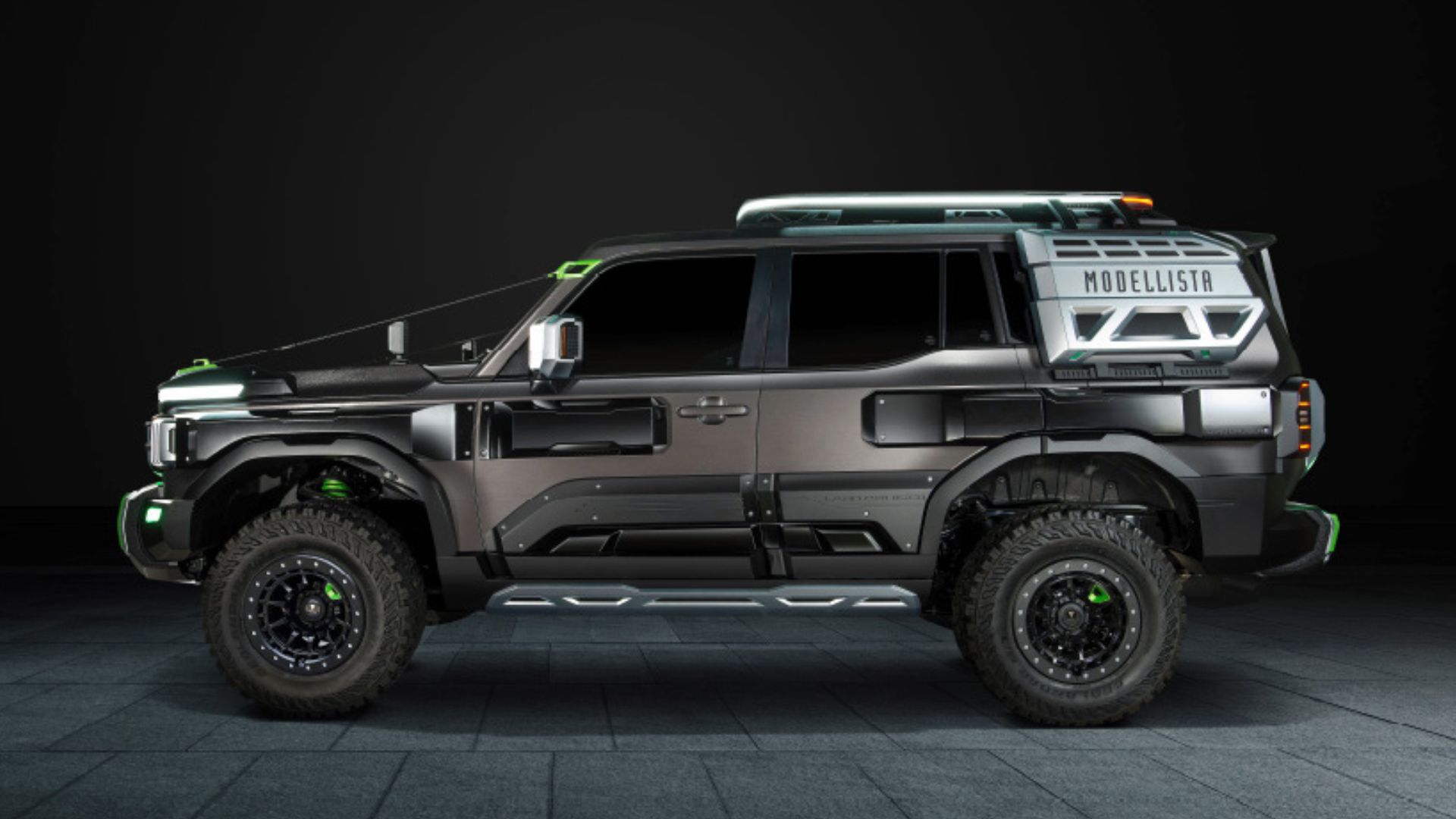
Image via Modellista
For years, getting a genuine Japanese-market Land Cruiser onto U.S. soil meant flying to Japan and hoping an export broker returned your emails, or driving out to San Diego and hoping FLEX Automotive had the right truck in stock. FLEX just made the second option irrelevant everywhere else in the country. The Toyota-focused import specialist announced this week that its entire inventory of more than 100 JDM vehicles is now available to buyers nationwide, with the company handling the trip from a dock in Japan all the way to a driveway in Ohio, Texas, or wherever else the truck needs to go.
What’s Actually in FLEX’s Inventory
FLEX isn’t selling whatever grey-market oddity happened to clear customs that month. The company has built its business since 1967 around one brand and one nameplate in particular: the Toyota Land Cruiser. Its current lineup includes Japanese-market 70, 80 and 100 Series Land Cruisers, along with the Land Cruiser Prado and other Toyota 4×4 models, most priced between roughly $20,000 and $53,000. That range already bakes in ocean freight and import tariffs, which is the part that usually blindsides first-time grey-market buyers who budget for the truck and forget the shipping container. Domestic trucking from San Diego to the buyer’s home state gets arranged and billed separately.
What makes these trucks worth the hassle is the spec sheet Toyota never offered stateside. Japanese-market Land Cruisers came with diesel engines, right-hand drive, and trim combinations that never touched a U.S. dealer lot, which is a big part of why a well-kept 30-year-old JDM Land Cruiser can command real money against a comparably aged domestic-market truck. That inspection regimen is worth noting given that Toyota and Nissan have both had to warn Japanese buyers about panel gaps and paint issues on cars built at U.S. plants, a quality-control gap that runs the opposite direction of what most Americans assume.
The 25-Year Loophole That Makes This Legal
None of this works without the federal 25-year import rule, the regulation that exempts vehicles older than a quarter-century from having to meet U.S. Federal Motor Vehicle Safety Standards. It’s the same rule that turned grey-market imports of Nissan Skyline GT-Rs into a cottage industry over the past decade, and it’s the reason FLEX’s catalog keeps growing instead of running dry. Every year, another model year’s worth of Japanese-market vehicles ages into eligibility. FLEX is already looking ahead to the Land Cruiser Prado 120, which debuted in Japan in 2002 and starts becoming import-eligible in 2027. Enthusiasts have spent years obsessing over unicorn JDM metal, arguing over everything from GT-R pricing to whether someone really traded a rare GT-R for a Nissan Leaf, and that appetite hasn’t shown any sign of cooling off.
The Route From Osaka to Your Driveway
The logistics are the actual product FLEX is selling here, arguably more than any individual truck. Every vehicle passes through FLEX’s own Technical Center in Japan first, where it gets inspected, repaired, and given preventative maintenance before it’s ever loaded onto a ship. From there it crosses the Pacific to the Port of Long Beach, clears U.S. customs, and gets trucked down to FLEX’s San Diego dealership for a second inspection and detailing. Only after that does it head out to the buyer, wherever they happen to live. FLEX director Yohei Nakamura framed the expansion simply: “Our job is to connect the two and make the process much more straightforward.” FLEX says its current customer base skews toward Texas, Arizona and Florida, though it has already delivered well outside that footprint, including one buyer whose online review specifically praised the company for arranging transport across the country and checking in throughout the process.
What FLEX Won’t Do For You
Buying nationwide doesn’t make the process turnkey the moment a truck leaves San Diego. Registering a 25-year-exempt import is a state-by-state headache: some states process these Land Cruisers like any other used vehicle, while others require additional inspections, VIN verification, or paperwork specific to imported vehicles, and a right-hand-drive truck can raise questions at a DMV counter that a left-hand-drive equivalent never will. FLEX supplies the export and import documentation buyers need, but the registration legwork itself is on the customer. It’s also worth calling your insurance agent before you wire any money: some insurers price grey-market imports differently than a domestic-market equivalent, and not every lender is comfortable financing a vehicle with a Japanese title history. None of that is a reason to skip the purchase, but it is a reason to make a couple of phone calls before your dealer does.
The Bigger Picture
FLEX’s expansion also plugs into a business it already runs out of San Diego called Renoca, a customization program that dresses up modern Toyota platforms with retro-inspired styling, essentially exporting Japanese Land Cruiser culture in both directions at once. It’s a reminder that the appeal here isn’t rarity for its own sake. A properly sorted 80 Series with a diesel engine carries real off-road credibility, the kind that companies building six-figure electric off-roaders like the BYD Yangwang U8 are still trying to manufacture through software. For the overlanding crowd already shopping for blast-shielded trailers to drag behind whatever they’re driving, a JDM Land Cruiser that never needed to be reimagined for the apocalypse is arguably the more honest purchase.
About the Author