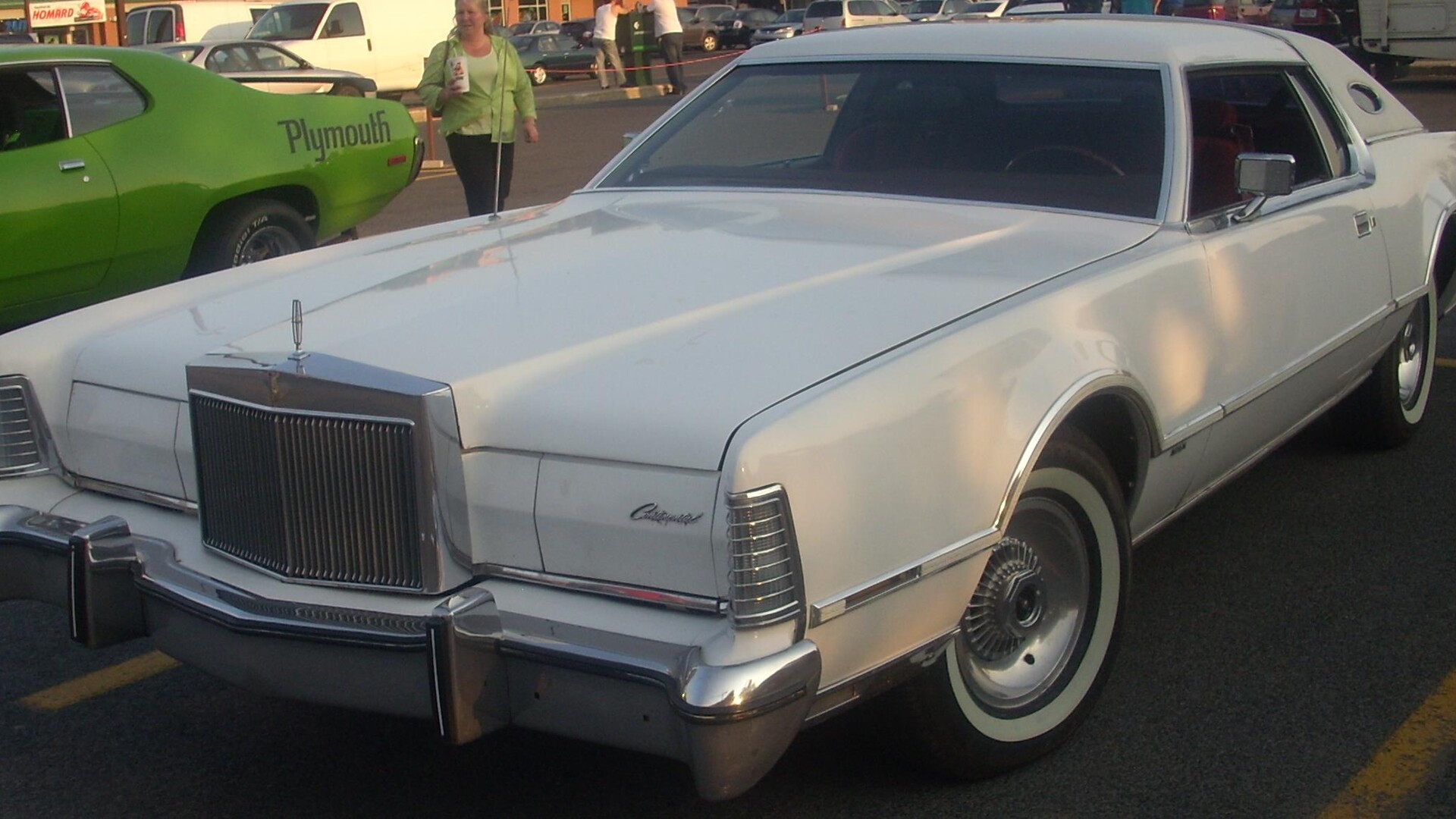
A Lincoln Continental Mark IV, the model Ken Carter's team built its rocket car around, photographed in Montreal. Photo: Bull-Doser via <a href="https://commons.wikimedia.org/wiki/File:Lincoln_Continental_Mark_IV_(A%26W_St._Leonard).jpg">Wikimedia Commons</a> (public domain)
At 11:30 a.m. on Oct. 5, 1979, a winged, rocket-powered Lincoln Continental left a ramp in a farm field west of Morrisburg, Ontario, pointed at Ogden Island near Waddington, New York, a mile away on the far side of the St. Lawrence River. Ken Carter, the Montreal stuntman who had spent four years selling that flight as the “Mad Canadian,” was not in the car. Kenny Powers, a South Carolina stuntman who was Carter’s friend and protégé, was. According to the account North Country Public Radio’s James Morgan assembled from news reports and police witnesses, the Lincoln got about 400 feet past the end of the ramp, broke apart, flipped and landed in the river right side up. Powers broke his back.
Four hundred feet is about 7.6% of a mile. The newspaper ads, the press conferences and a $250,000 television offer had all covered the full distance, several times, starting in 1976. I went back through the local reporting and the record of who promised what and when, and the jump looks less like an engineering project that failed than a promotion that ran out of postponements. The launch date was set by deadlines Carter didn’t control: a network that walked away, Canadian officials who threatened to pull their permission, and a government film crew that was ready to pack up.
Four Years of Jump Dates on the St. Lawrence
Work on what became known as the Morrisburg Superjump began in 1975, with a jump date of Sept. 25, 1976. Crews started a ramp on farmland along Hanes Road, between Highway 2 and Lakeshore Drive. ABC’s Wide World of Sports planned to air the jump and, according to NCPR’s account, offered $250,000 in sponsorship. Evel Knievel came to Morrisburg to file an advance report for the show and doubted the jump would work. The 1,400-foot ramp was behind schedule, the rocket car wasn’t ready, and ABC pulled out. The 1976 date passed.
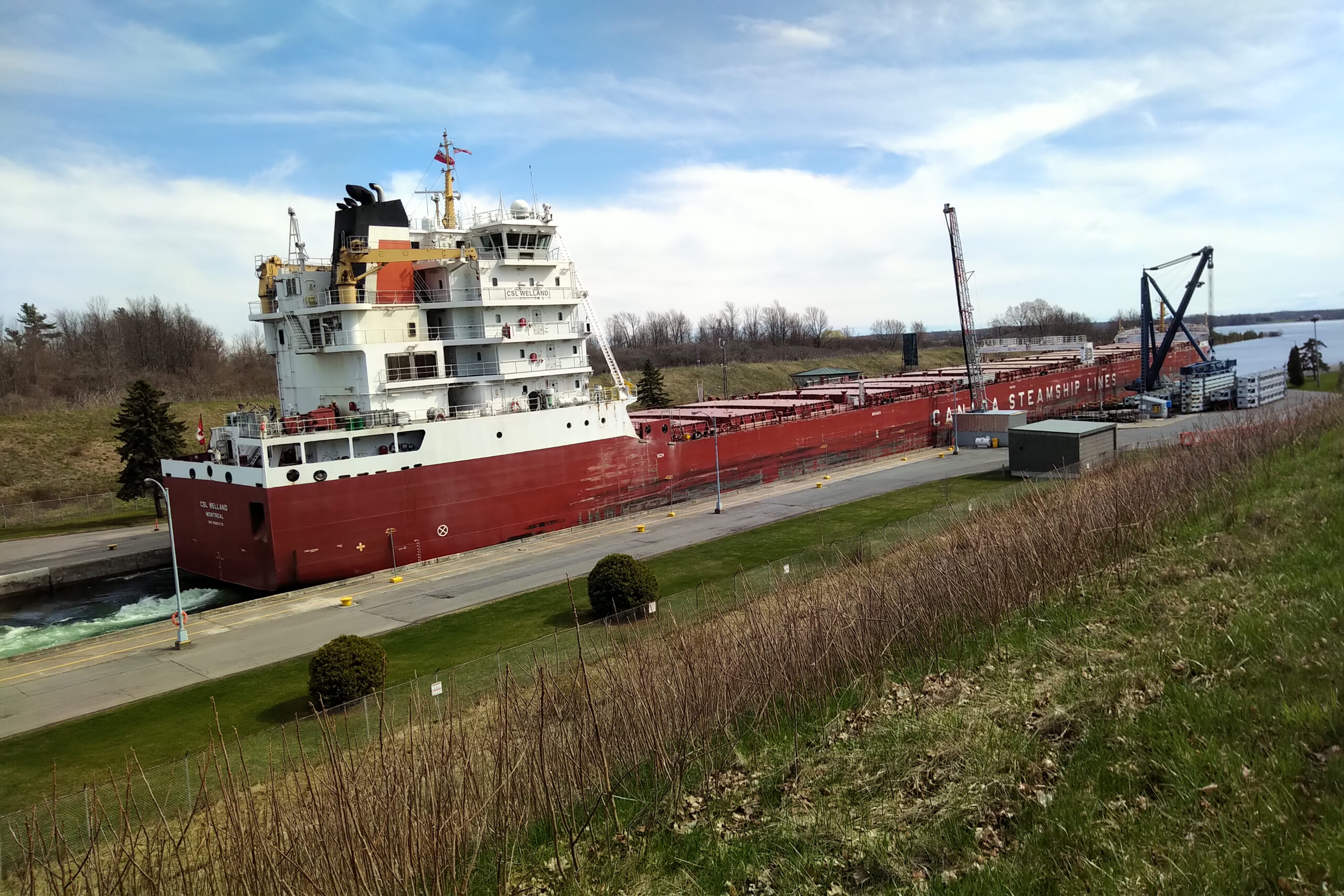
Carter insisted that the jump had been postponed, not canceled. Historian Lawrence Gooley, who traced the saga through period newspapers for the Adirondack Almanack, writes that the 1977 revival came with a new vehicle, a rocket-powered Lincoln Continental Mark IV. A big personal-luxury coupe built for highway cruising is an odd choice of airframe. Gooley says St. Lawrence Seaway authorities announced that ship traffic would carry on as usual and that “Carter will have to schedule his jump between the vessel movement.” At an Ottawa press conference, Carter said, “The only thing that’s going to stop me this time is my death.”
Five days before that jump date, reporters asked ABC about Carter’s claims of TV coverage. Gooley writes that the network told them it was “not interested.” Carter’s reply: “I just don’t give a damn what ABC says, I don’t give a damn what NBC says, I don’t give a damn what anybody says. I just want to jump a river and I just want to jump it in style!” Few tickets had sold, despite predictions of 50,000 or more spectators, and the jump was postponed again.
In 1978, Carter was busy trying to arrange a jump over Idaho’s Snake River Canyon, hoping to succeed where Knievel had failed. Gooley writes that during those talks, Canadian officials told Carter they would rescind the permissions they had granted for the St. Lawrence jump unless he committed to finishing it. He announced a July 1, 1979 date. By June, newspaper ads read “Evel Knievel Has Never Been This High: The Ken Carter Rocket Ride to New York, Sept. 25th.” In late August he told the Ogdensburg Journal he would go “sometime around Labor Day weekend.” Labor Day came and went, which Carter blamed on “inclement weather.” The next date was Sept. 23.
On Sept. 14, the yellow rocket Lincoln, valued at $250,000, was reported stolen, along with its hauler. Montreal police confirmed the report. A day later, Gooley writes, it turned out that a member of Carter’s own team had taken it and “went off with his girlfriend.” On Sept. 21, the jump was pushed to “early October,” supposedly to avoid a clash with the Canadian Grand Prix.
The National Film Board of Canada had been following Carter for years, filming the town-to-town stunt shows behind the headlines. On Sept. 26, the Film Board said its documentary was finished with or without a river. “It’s our opinion we have a film regardless of whether or not he jumps,” Film Board representative Barry Howells said, according to Gooley’s account. Carter could have the jump in the movie if he did it by the end of the week. He didn’t make that deadline either, but the cameras were there on Oct. 5. The footage of the launch and of Powers being pulled from the water appears in The Devil at Your Heels, Robert Fortier’s 102-minute NFB documentary, which the Film Board says won the 1983 Genie Award for best theatrical documentary.
Why the Morrisburg Jump Was Lost on the Ramp
The Lincoln ran on twin hydrogen-peroxide rockets that NCPR puts at 11,000 pounds of thrust combined. A peroxide rocket has no ignition system and burns nothing. Highly concentrated hydrogen peroxide is forced through a catalyst, and it breaks down into superheated steam and oxygen, which come out of the nozzle. It’s a simple design, which is why it shows up in drag cars and jet packs, and it is thirsty. Gooley writes that reporters watched a test run reach an estimated 230 mph and that the car’s consumption worked out to 50 gallons per mile. A stock Mark IV with its 460 V8 was no miser, but it at least measured fuel in miles per gallon and not the other way around.
The rockets only matter until the lip of the ramp. After that, the Lincoln is a projectile, and the only number that counts is how fast it was going when it left. The textbook range formula for an object launched over level ground (distance equals speed squared, times the sine of twice the launch angle, divided by gravity) makes the problem easy to see. To cover a mile with a perfect 45-degree launch and no air resistance, the car needs about 281 mph at the lip. That is Backfire News’s math, not the team’s, and it ignores the height of the ramp, which would help some, and drag, which hurts a lot on something shaped like a Mark IV.
According to an account two local collectors gave the Cornwall Seaway News in 2015, the Lincoln was supposed to leave the ramp at 270 mph and managed about 180. They said the ramp surface had deteriorated, the car bounced, and Powers, who was shorter than Carter, was thrown around in the cockpit and couldn’t keep the throttle in. At 180 mph, the same formula gives a best case of about 2,170 feet, which is well under half a mile, before any air resistance. Once the speed was gone at the top of the ramp, there was no outcome that ended on Ogden Island. That account puts the actual distance at 506 feet. NCPR’s says about 400. Either way it was less than a tenth of a mile.
Kenny Powers in the Driver’s Seat on Oct. 5
The jump went off unannounced. Why Powers drove instead of Carter has never been settled. NCPR lists the competing versions. A story that started in the Ogdensburg Journal and was carried by the Associated Press said Carter had hurt his arm. Carter said he wanted to jump for a film crew tied to his new backers, not for a crowd. Local reports said the crew was tired of the delays and brought Powers in at the last minute. Even Carter’s whereabouts that morning differ by account: an Ottawa hotel room, or on the road to Morrisburg while organizers declined to wait for him.
An unnamed Ontario Provincial Police officer who saw the jump described the Lincoln breaking up and flipping before it hit the water, according to NCPR. Volunteers in boats pulled Powers and the pieces out of the river, and paramedics took him from shore for what turned into a long hospital stay. Carter later said Powers wasn’t prepared. Both men said there would be another attempt. There wasn’t.
What a Morrisburg-to-Waddington Jump Would Need Today
Carter’s flight plan ended in another country, at a spot with no customs booth. As federal law reads now, 19 U.S.C. § 1433(b) says vehicles “may arrive in the United States only at border crossing points designated by the Secretary,” and the person in charge has to report the arrival and present the vehicle and everyone in it for inspection. That language came later than 1979, and none of the reporting I found says how Carter meant to deal with U.S. customs. The car never got near enough to New York for anyone to find out.
The modern answer to a Morrisburg-to-Waddington jump is on the record. In 2014, American stuntman “Mad Mike” Hughes announced he would make the same crossing with a steam rocket strapped to his back. According to NCPR, the plan was shelved because the town and other authorities would not grant the permits. Carter already held his Canadian permissions, and the only pressure officials applied, per Gooley, was a threat to withdraw them if he didn’t get on with it. The Seaway’s only condition on record was that he work around the freighters.
Carter’s Last Rocket Jump, in Peterborough, Ontario
Carter kept jumping. In a midnight stunt at Westgate Speedway in Peterborough, Ontario, he tried to beat his own ramp-to-ramp record of 186 feet in a rocket-powered car. UPI reported on Sept. 4, 1983 that, according to speedway officials, the rocket motor failed to shut off at the right moment, and the car flew 295 feet instead of the planned 200. It overshot the landing ramp by about 100 feet and fell roughly 75 feet in front of about 2,500 spectators. Carter, 45, was pronounced dead at Peterborough Civic Hospital.
The St. Lawrence jump failed because the car arrived at the lip too slowly. In Peterborough, the car flew too far. Both come down to the speed at the moment of takeoff, and the two rocket jumps that define Carter’s story missed it in opposite directions. Powers, a U.S. Navy veteran, died in 2009 at a veterans hospital in Virginia. He was 62.
The rocket Lincoln itself went missing after the crash. In 2015, Cody Glive and Andrew Whitton told the Cornwall Seaway News they had one of its wings and fiberglass body pieces and wanted to find the rest of the car so it could be displayed. When NCPR’s Morgan visited the site in 2017, he found no real trace of the ramp. Carter’s story is in theaters again in the feature film The Stunt Driver, which is based on the NFB documentary. If you want to hear him sell it himself, CBC’s archive has his 1978 interview with Hana Gartner on Take 30, a year before Powers took his seat. For a land-speed car that did hit its numbers, see ThrustSSC’s 714-mph run.
Hughes was refused permits for the same crossing in 2014. Should towns and border authorities let a stuntman try a jump like Carter’s if he takes on the risk himself, or did Morrisburg in 1979 show the refusal was the right call?
Lead image: Bull-Doser via Wikimedia Commons (public domain)
About the Author