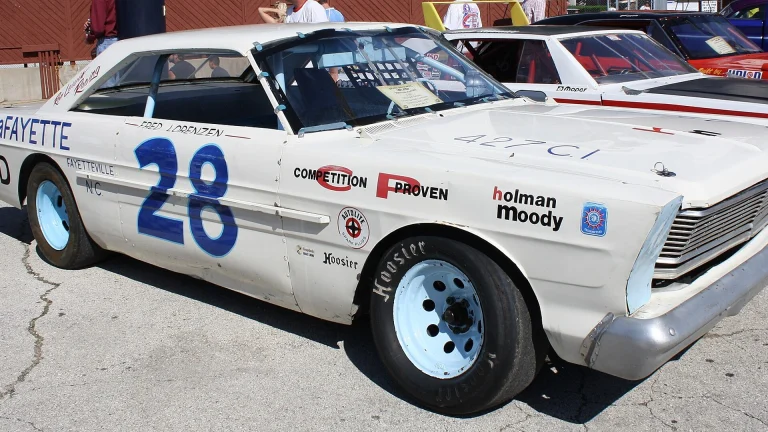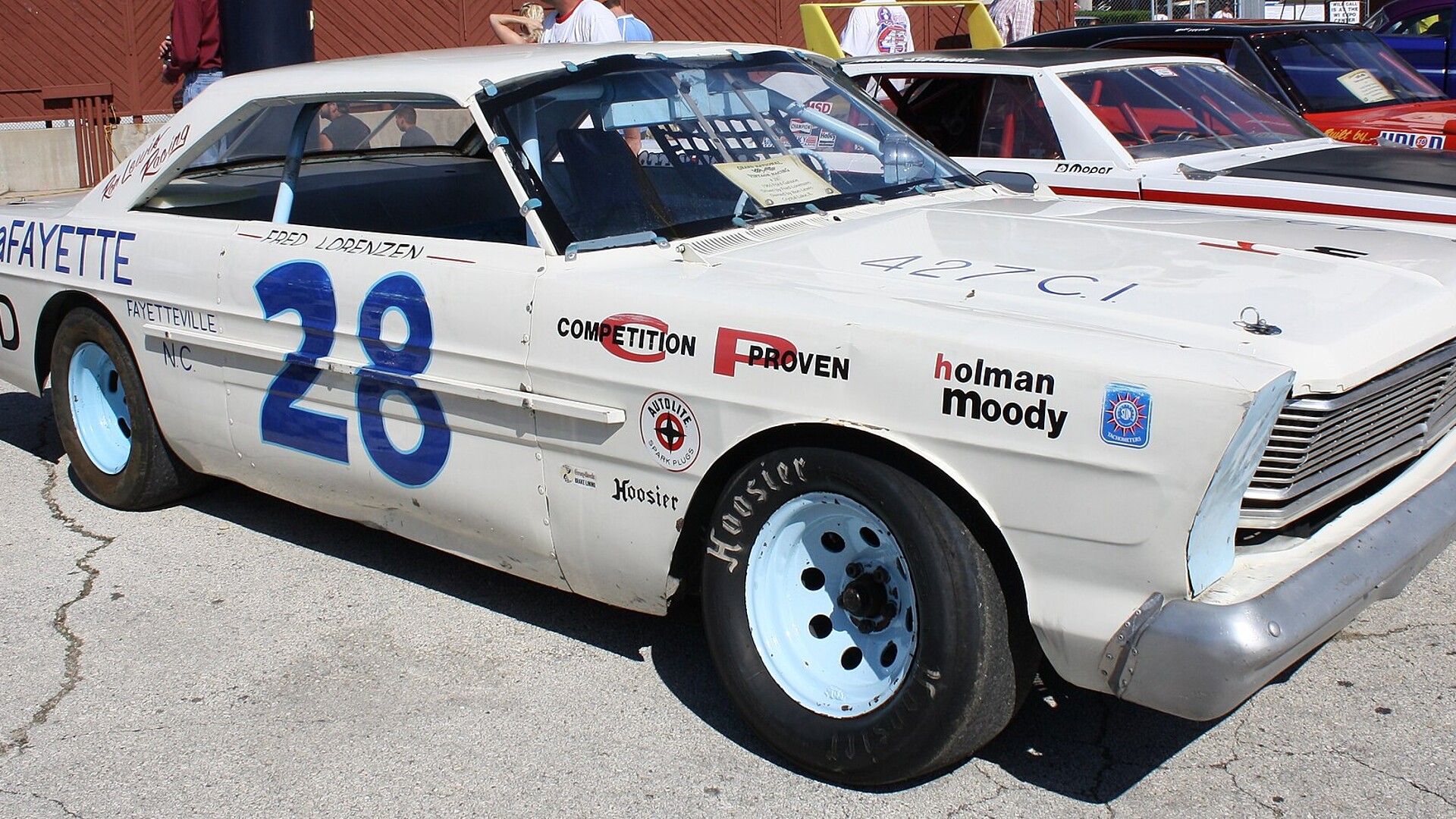
A replica (possibly the original) of the 1965 Holman-Moody Ford Galaxie Fred Lorenzen drove. Photo: Royalbroil via Wikimedia Commons, CC BY-SA 3.0
Fred Lorenzen’s brain showed stage 3 chronic traumatic encephalopathy, marking the first known diagnosis of the brain disease in a NASCAR driver. Neuropathologists at the Boston University CTE Center made the diagnosis from the brain he donated, on a scale that tops out at stage 4. Lorenzen, who won the 1965 Daytona 500 in a Holman-Moody Ford, died in December 2024 at 89.
The Concussion & CTE Foundation released the results on Oct. 20 on behalf of his children, Chris Lorenzen and Amanda Lorenzen Gardstrom, together with a $1 million donation from the two of them. Midway through, the release says the family opened talks with NASCAR leadership in January about the diagnosis and that “NASCAR declined to join the initiative.” It gives no reason, and NASCAR had not posted a statement on the diagnosis when we checked.
The word “first” comes with a qualifier in the foundation’s own release. CEO Chris Nowinski calls Lorenzen “the first NASCAR driver to be studied.” One brain from the sport has been examined so far, and it was positive.
What the pathologist found
Dr. Thor Stein, the BU neuropathologist who examined the tissue, said Lorenzen had cortical-sparing CTE, the first subtype of the disease to be identified. In those cases the damage is worse in the parts of the brain that control behavior and movement. Stein puts it at about 10% of CTE cases and says it brings behavioral symptoms and Parkinson’s-like movement disorders that start earlier in life.
Stein was senior author on the 2024 Acta Neuropathologica paper that defined the subtype. BU’s announcement of that study counted it in one of every six people with high-stage CTE, and said those patients were less likely to have dementia and had milder cognitive impairment than people with the typical form. Lorenzen lived with dementia for 20 years. His daughter says he was diagnosed in his 60s and “struggled for many years” before that.
The release doesn’t describe any of his symptoms beyond dementia, so it doesn’t say whether he had the early movement or behavior problems the subtype is associated with. It also doesn’t list a single crash or concussion from his career. It cites the National Institutes of Health on CTE being caused in part by repeated traumatic brain injuries and leaves the connection to Lorenzen’s racing there.
The driver
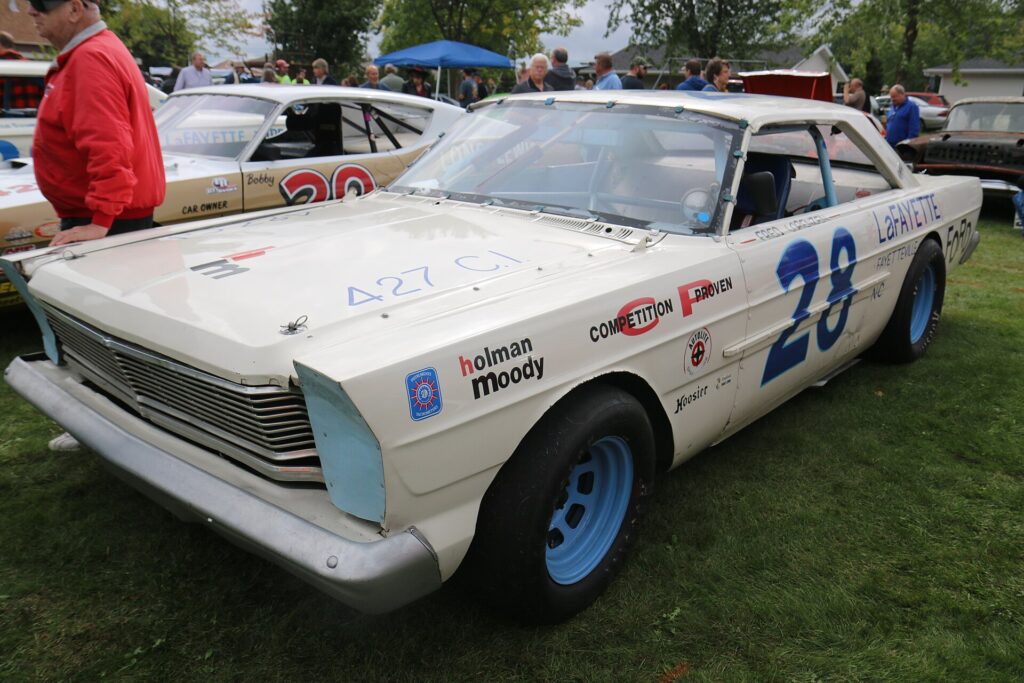
Lorenzen made 158 starts in NASCAR’s top series and won 26 of them from 1961 through 1967. NASCAR’s Hall of Fame profile puts his 16.46% winning rate fifth all-time. Holman-Moody entered its white No. 28 Ford only in the schedule’s biggest races, and in 1965 he won the two biggest, the Daytona 500 and the World 600 at Charlotte.
Fans voted him Most Popular Driver in 1963 and 1965, and the foundation credits him as the first driver to earn $100,000 in a season. He walked away after 1967, ran parts of 1970 through 1972, and later said, “I quit way too early.”
He went into the NASCAR Hall of Fame in 2015 on his fifth year on the ballot, in the same class as Rex White.
The 2016 pledge
Lorenzen agreed to donate his brain in July 2016, when he was 81 and already years into dementia. His daughter told the Associated Press, as NASCAR.com reported at the time, that the family wanted to support Dale Earnhardt Jr., who had pledged his own brain to science that spring. That same week Hendrick Motorsports said Earnhardt would miss the New Hampshire race with concussion-like symptoms, the absence that put Alex Bowman in the No. 88.
Where the money goes
The donation creates the Fred Lorenzen Memorial HelpLine, a free referral service for current and former drivers and their families dealing with suspected CTE or lingering concussion symptoms. A licensed clinical social worker runs it, and the foundation says requests for provider recommendations get an answer within three business days. The rest backs work by Dr. Ann McKee and Dr. Michael Alosco at BU on diagnosing CTE in living patients. Right now it can only be confirmed after death.
Chris Lorenzen said his father’s dementia care “came at a significant financial and emotional cost to our family” and that the family “had hoped NASCAR would join us.” The release credits NASCAR with “strides in improving driver safety” and asks it to extend that commitment to retired drivers. It doesn’t say what the family asked NASCAR to put in, money or otherwise.
Waltrip and the living
Four weeks before the Lorenzen release, Darrell Waltrip’s family announced that the 79-year-old has frontotemporal degeneration “complicated by possible chronic traumatic encephalopathy (CTE), likely from injuries incurred during his racing career.” The foundation quotes that statement in its Lorenzen release. “Possible” is as far as a diagnosis can go while Waltrip is alive, which is the gap the BU research is trying to close.
The foundation is asking former racers to enroll in its research registry, the pool any second NASCAR diagnosis is likely to come from. NASCAR has not said whether it will revisit the Lorenzen family’s offer.
Should NASCAR be paying for the care of retired drivers with suspected brain injuries, or does its responsibility end when a driver stops racing?
Sources: Concussion & CTE Foundation press release, Oct. 20, 2026; Fred Lorenzen Memorial HelpLine page; Alexander et al., Acta Neuropathologica, Feb. 26, 2024, and BU Chobanian & Avedisian School of Medicine announcement; NASCAR.com, Jan. 16, 2015, and July 17, 2016.
Lead image: Royalbroil via Wikimedia Commons, CC BY-SA 3.0
About the Author