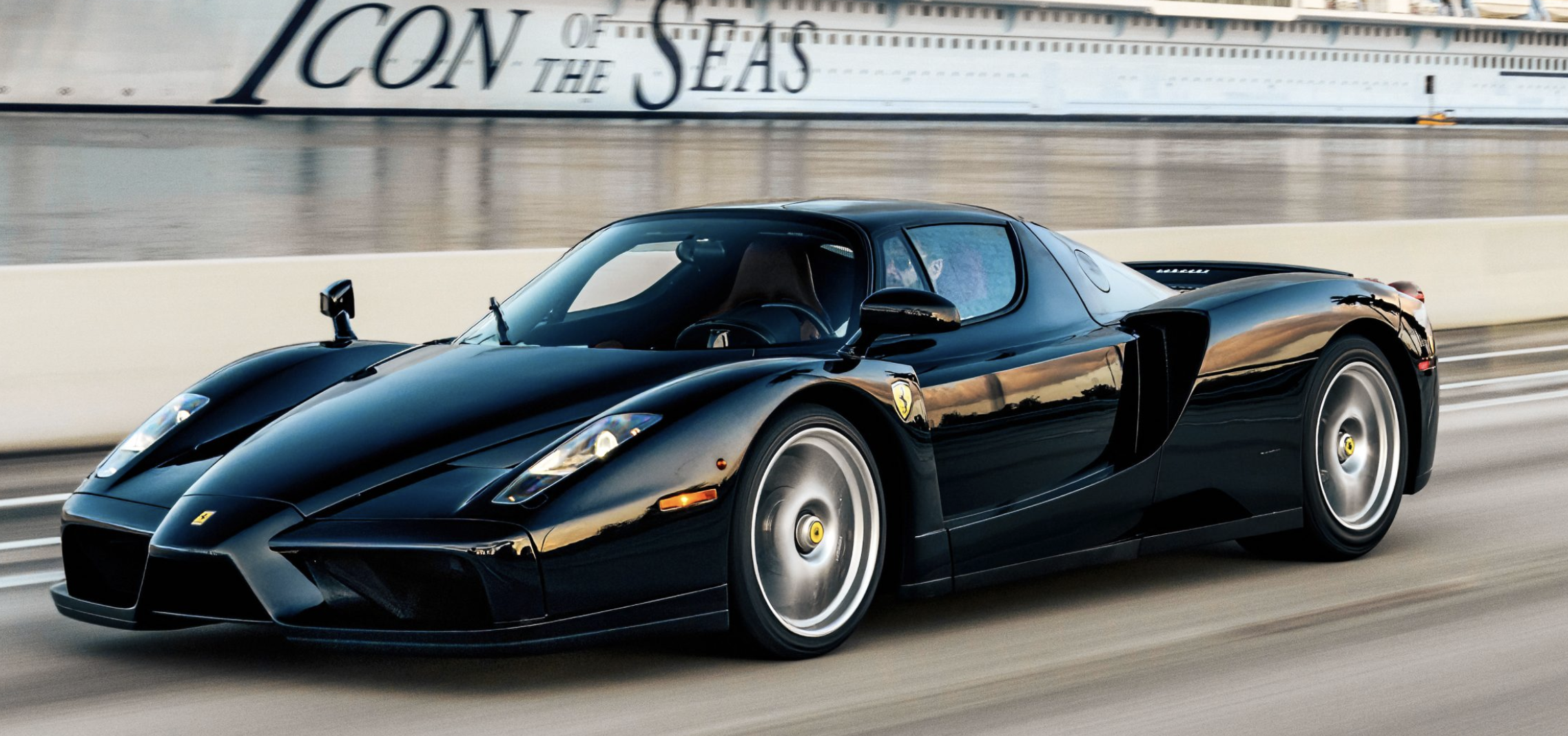
Broad Arrow has been feeding out its Quail Auction catalogue in pieces for weeks, and it saved the one that matters. A 2003 Ferrari Enzo, chassis ZFFCW56A130132652, estimated at $9 million to $11 million, crossing the block on Friday, August 14 in Carmel.
Offered without reserve.
Everyone will lead with the colour, and fair enough — it’s one of twelve U.S.-market Enzos finished in Nero D.S., and one of only three of those trimmed in Rosso leather, with Nero carpets, Rosso instrument dials and XL-size Racing Seats. That’s a genuinely unusual car. But the two words that should interest you are the ones about the reserve, because they tell you more about the 2026 market than the paint code does.
What no reserve means at eight figures
A no-reserve consignment removes the floor. Whatever the hammer says, the car sells. The consignor absorbs all downside risk in exchange for one thing: certainty in the room.
That certainty is worth real money. Bidders who know a lot is definitely selling behave differently from bidders who suspect they’re being used to chase a hidden number. Underbidders stay in longer. Phone bidders commit earlier. Auction houses use no-reserve on cars they believe will overperform — and they generally use it on the lot they want people talking about after the sale.
Related Articles
- Senna’s Battle-Scarred 1992 Shoei Sells for $837,500 — And the Stone Chips Are Why
- Final Gemballa Mirage GT in Build Sequence Headed for Monterey Auction Block
Doing it on a car estimated at up to $11 million, at your first-ever Quail Auction, is not a casual decision. It’s a statement of confidence about where Enzo money currently sits, from a house that has just taken over as the official auction of The Quail after years at the Jet Center.
Read the catalogue, not the press release
The genuinely instructive document here is Broad Arrow’s own top-20 list for the sale. The Enzo sits at number one. Below it: a 2025 Bugatti W16 Mistral at $8–10 million, a Ferrari F12tdf at $3.3–3.8 million, a Porsche 918 Spyder, a 1968 Miura P400 S at $3.2–3.6 million, a 1967 275 GTB/4 at $3.2–3.5 million, a 959 Komfort, and a 1955 300 SL Gullwing at $1.85–2.2 million.
Sit with that ordering for a second. A 23-year-old Ferrari is estimated at roughly three times a 275 GTB/4 and nearly three times a Miura — cars that were, within living memory, the immovable blue chips of the entire collector market. It’s estimated above a brand-new, hand-built Bugatti.
That’s the whole shift in one column of numbers. Money has moved toward the cars that today’s buyers grew up with posters of, and away from the ones their grandfathers coveted. The 300 SL isn’t less special than it was. There are just fewer people left who organise their emotional life around it.
The 20-year threshold nobody talks about
This Enzo carries recent Ferrari Classiche certification, and that detail is doing more work than it appears to.
Ferrari’s Certificate of Authenticity is available for road cars over twenty years old, plus Special Series, Sport and F1 models. The process runs four steps, starting at an authorised dealer or in Maranello, and it begins by verifying the chassis is original — an absolute requirement, not a preference. Bodywork and interior are then checked against original specification.
Do the arithmetic. The Enzo entered production in 2002. The entire generation of early-2000s flagships has only recently become eligible, which means the modern supercar market is right now going through the same certification sorting that happened to 275s and Daytonas decades ago. A Red Book is quietly becoming the price of admission at the top of the modern-classic market, and cars that can’t get one are going to find out what that costs.
Here’s the wrinkle specific to this era: certifying originality on a 1960s car means engine numbers and body stampings. Certifying a 2003 car means engine numbers, body panels, and electronics, hydraulics and composites — an automated-manual gearbox with its own control hardware, and a bonded carbon-fibre structure that can’t be sectioned and repaired the way steel can.
What an owner is actually signing up for
Consumables and originality now pull against each other. The Enzo was the first Ferrari road car to use Brembo’s carbon-ceramic CCM discs — technology the Scuderia had been running for years but which had never reached a customer car. Carbon-ceramic rotors last a long time in normal use and cost a fortune when they don’t. The same tension applies to the F1 transmission’s clutch, which is a wear item by design. Every one of those replacements is a decision with a Classiche consequence attached. Use Ferrari parts, keep records, and don’t let a well-meaning independent shop fit something clever.
The engine is the reason any of this matters. Ferrari’s 65-degree V12 for the Enzo displaced 5,998 cc and made 660 hp at 7,800 rpm with 11.2:1 compression — 110 hp per litre from a naturally aspirated road engine in 2002. That number is why the car is worth eight figures and a McLaren F1-era rival built on softer engineering isn’t.
Related Articles
- Rare Ducati Works Racer From Historic 1972 Imola 200 Heads to Monterey Auction
- BMW S 1000 RR Recall: 16,736 Superbikes Can Lose Power While Riding
Insure it against today’s market, not the one you bought into. Values in this corner have moved fast enough that a policy written two or three years ago is likely badly short. Agreed-value cover is not optional here, and the Red Book plus a documented sale result is exactly the evidence an appraiser wants. Understand also that a carbon monocoque changes the total-loss maths — structural damage to a bonded tub can write off a car that still looks repairable, which is precisely why the agreed figure needs to be right before anything happens.
If you’re bidding: confirm the paperwork is in hand. Classiche certification and the physical Red Book are not always delivered simultaneously. On a car where certification is part of the value proposition, “granted” and “in the folder” are different states. Ask.
The realistic read
Rare-spec cars cut both ways. A colour combination only twelve U.S. cars ever wore is a genuine differentiator — and also means there are almost no directly comparable sales to anchor a valuation. That ambiguity is exactly what a no-reserve format is designed to resolve, in public, in one afternoon.
Which is the useful thing about August 14. Whatever this car brings, it becomes the reference point for black Enzos, and probably for rare-spec Enzos generally. The estimate is Broad Arrow’s opinion. The hammer will be the market’s.
Images Via: Broad Arrow
About the Author