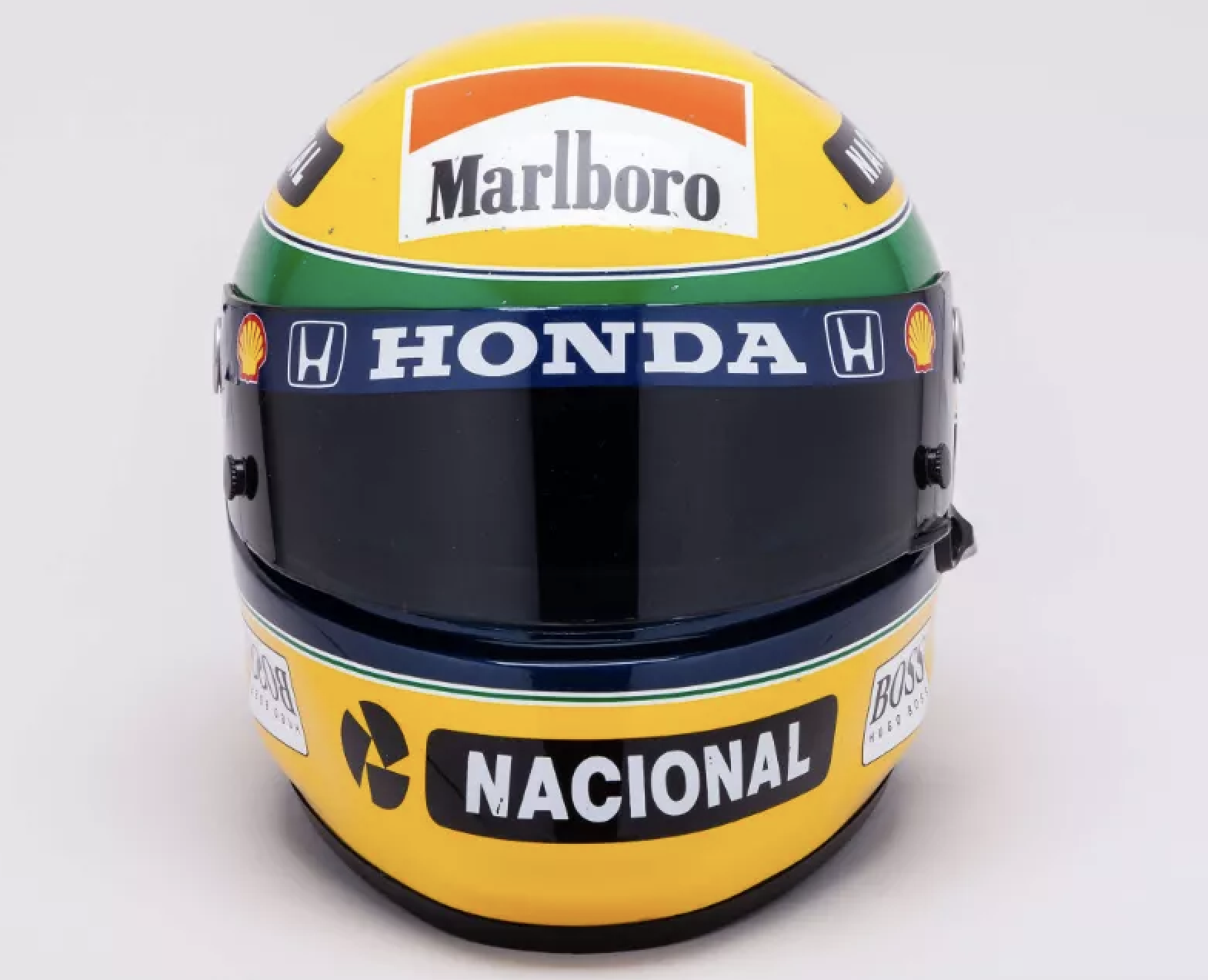
Somewhere in a private collection right now sits a Formula 1 helmet with the shell integrity of a gravel driveway, and someone just paid $837,500 for the privilege of owning it. That’s not a typo, and it’s not a joke about collector psychology gone wrong. Ayrton Senna’s race-worn 1992 Shoei crossed the block at BUDDS’ Motorsport Icons Live Auction at the Silverstone Museum on July 7, hammering at £500,000 before the buyer’s premium pushed the final tally to £625,000 — roughly $670,000 and $837,500 in dollars, depending on which number you’re quoting.
If that sounds like an absurd amount to pay for a helmet with stone chips, you’re thinking about this backwards. Those chips are the whole point.
What $837,500 Actually Buys You
The lot in question — number 361 in a 358-lot sale stacked with racing ephemera — is a Shoei helmet Senna wore across three races in the 1992 Formula 1 season: the British, German, and Hungarian Grands Prix. He won at Hungary wearing it, which is the kind of detail auction houses put in bold for good reason. BUDDS’ specialists ruled out a fourth appearance, the French Grand Prix, through photo matching, the forensic process of lining up the exact scuffs, chip patterns, and decal placement on the physical object against period race photography until they match like a fingerprint.
That process is really what you’re paying for. Nobody verifies a helmet by its paint scheme alone, since Senna’s yellow, green, and blue Shoei design barely changed race to race. What changes is the damage: a chip here from a stray piece of gravel at Silverstone, a scuff there from a mid-race adjustment at Hockenheim. Auction houses and independent authenticators build catalogs of these marks and cross-reference them against archival photography and broadcast footage, frame by frame. It’s tedious, unglamorous work, and it’s the entire reason a race-used helmet is worth six figures while a signed replica sells for the price of a used golf cart.
The Serial Number Nobody Notices
Inside the shell, the helmet still carries its original production tag, marked “Production No A / MAR 1992 / Inspector: H. Takayama,” along with a Snell SA90 safety certification sticker bearing serial number SA 0025979. Snell Memorial Foundation’s SA90 standard was the racing-helmet homologation benchmark of that era, part of the same certification lineage that still governs what drivers are legally allowed to wear in sanctioned competition today. That serial number matters for more than nostalgia: it’s a manufacturing fingerprint that can, in theory, be traced back to a specific production batch, giving authenticators one more data point beyond photo matching. The helmet also comes with an official McLaren Certificate of Authenticity, which functions as the team’s own institutional sign-off — not a nice-to-have at this price point, but close to a requirement.
A Livery Detail Most Fans Never Clocked
Here’s the part that deserves more attention than it gets: several of Senna’s 1992 helmets, this one included, show alterations tied to tobacco advertising restrictions. Britain and Germany both limited how cigarette sponsorship could appear at televised sporting events that year, which meant McLaren’s Marlboro branding had to be blanked out or swapped for alternate decals depending on the host country. Most fans remember this as a car livery quirk, but it applied to driver equipment too. It’s a small regulatory footnote that doubles as a genuinely useful authentication tool, since the specific blanking treatment used at a given race is one more detail photo-matchers can cross-check against the object in hand.
1992 Wasn’t Senna’s Best Season, and That’s the Interesting Part
It’s worth being honest about where 1992 sits in Senna’s career, because auction copy tends to skip it. He came in as the reigning World Champion, but Nigel Mansell’s Williams-Renault ran away with the title that year, and a young Michael Schumacher was already putting Benetton on notice in his first full season. Senna picked up three race wins, including Hungary, but 1992 was ultimately the last season of the Honda-McLaren partnership that had dominated the sport since 1988, and everyone in the paddock knew it. The German Grand Prix that year produced a genuine footnote: it remains the only race in Formula 1 history where Senna, Schumacher, and Mansell shared a podium together, a snapshot of the sport’s power shifting in real time. A helmet tied to that specific stretch of races carries a different kind of significance than one tied to a dominant title-winning run — it’s a documented piece of a transition period, not a victory lap.
How This Stacks Up Against Other Senna Helmets
Context helps here. In an online sale in the spring of 2025, RM Sotheby’s sold a different 1992 Senna Shoei — a lightweight X-4 variant built that April and tied specifically to the Belgian Grand Prix at Spa, where Senna famously stopped his own car mid-session to help pull an injured Érik Comas from a wrecked cockpit — for £720,000 total. That helmet carried its own Snell SA90 serial, SA 0026237, distinct from the BUDDS lot, confirming these are two separate physical objects from the same season rather than one helmet resurfacing twice. The Spa helmet’s premium over the BUDDS helmet is a useful data point for anyone trying to read this market: a single, cinematic, life-saving moment attached to one specific helmet apparently commands more than a helmet tied to three races and a win. Provenance density matters, but a great story attached to a single object still moves the number more.
The gap becomes even clearer inside the same BUDDS sale. A framed, signed Senna race suit replica from 1994 sold for £3,200, and a 1988 McLaren Constructors’ Championship medal in yellow metal went for £3,800. Both are legitimate Senna-adjacent collectibles. Neither comes close to six figures, because neither was strapped to his head while he was doing the thing that made him famous. That’s the entire hierarchy of motorsport memorabilia in one auction result: signed and adjacent is nice, race-used and photo-matched is a different asset class entirely.
What This Means If You’re Actually Shopping This Market
If you’re a buyer rather than a spectator, the practical takeaway is that documentation is the product. A certificate of authenticity from the team, a paper trail of photo-matching against specific sessions, and a traceable serial number are what separate a six-figure helmet from a very expensive paperweight. Insurance underwriters covering pieces like this will want exactly that file, and appraisers revisiting the piece in a decade will lean on it too. It’s also worth remembering that the hammer price and the number that makes headlines are two different figures — the buyer’s premium, the auction house’s cut layered on top of the winning bid, added roughly 25 percent here, which is fairly standard across the collectibles world and worth budgeting for before you raise a paddle on anything with a Senna, Schumacher, or Mansell name attached.
Racing memorabilia has been climbing for years, but Formula 1 in particular has caught a second wind as the sport’s global audience keeps expanding well past the paddock. Senna’s own market shows no signs of cooling, in line with Senna’s first F1 car heading to auction this year for a price well into seven figures. It’s the same collector logic that’s made Paul Newman’s dirt-caked, race-scarred Mustang more valuable than a pristine restoration would ever be — wear isn’t damage in this world, it’s documentation. McLaren, for its part, keeps leaning on that same well of nostalgia in its current lineup, most recently with the Artura Spider MCL39 Championship Edition built to trade on that same F1 heritage. None of it happens in a vacuum, either — Formula 1’s cultural footprint keeps growing off-track too, including Hollywood’s growing appetite for Monaco, and every bit of that attention feeds back into what people are willing to pay for a genuine piece of the sport’s history.
A beat-up helmet outselling a running car sounds backwards until you remember what collectors are actually buying: not the object, but the thirty-three-year-old moment frozen inside it. Somebody in Hungary in 1992 watched Senna cross the line wearing that exact piece of fiberglass and resin. That’s not replicable at any price — except, apparently, $837,500.
and it’s the entire reason a race-used helmet is worth six figures while a signed replica sells for the price of a used golf cart.
The Serial Number Nobody Notices
Inside the shell, the helmet still carries its original production tag, marked “Production No A / MAR 1992 / Inspector: H. Takayama,” along with a Snell SA90 safety certification sticker bearing serial number SA 0025979. Snell Memorial Foundation’s SA90 standard was the racing-helmet homologation benchmark of that era, part of the same certification lineage that still governs what drivers are legally allowed to wear in sanctioned competition today. That serial number matters for more than nostalgia: it’s a manufacturing fingerprint that can, in theory, be traced back to a specific production batch, giving authenticators one more data point beyond photo matching. The helmet also comes with an official McLaren Certificate of Authenticity, which functions as the team’s own institutional sign-off — not a nice-to-have at this price point, but close to a requirement.
A Livery Detail Most Fans Never Clocked
Here’s the part that deserves more attention than it gets: several of Senna’s 1992 helmets, this one included, show alterations tied to tobacco advertising restrictions. Britain and Germany both limited how cigarette sponsorship could appear at televised sporting events that year, which meant McLaren’s Marlboro branding had to be blanked out or swapped for alternate decals depending on the host country. Most fans remember this as a car livery quirk, but it applied to driver equipment too. It’s a small regulatory footnote that doubles as a genuinely useful authentication tool, since the specific blanking treatment used at a given race is one more detail photo-matchers can cross-check against the object in hand.
1992 Wasn’t Senna’s Best Season, and That’s the Interesting Part
It’s worth being honest about where 1992 sits in Senna’s career, because auction copy tends to skip it. He came in as the reigning World Champion, but Nigel Mansell’s Williams-Renault ran away with the title that year, and a young Michael Schumacher was already putting Benetton on notice in his first full season. Senna picked up three race wins, including Hungary, but 1992 was ultimately the last season of the Honda-McLaren partnership that had dominated the sport since 1988, and everyone in the paddock knew it. The German Grand Prix that year produced a genuine footnote: it remains the only race in Formula 1 history where Senna, Schumacher, and Mansell shared a podium together, a snapshot of the sport’s power shifting in real time. A helmet tied to that specific stretch of races carries a different kind of significance than one tied to a dominant title-winning run — it’s a documented piece of a transition period, not a victory lap.
How This Stacks Up Against Other Senna Helmets
Context helps here. In an online sale in the spring of 2025, RM Sotheby’s sold a different 1992 Senna Shoei — a lightweight X-4 variant built that April and tied specifically to the Belgian Grand Prix at Spa, where Senna famously stopped his own car mid-session to help pull an injured Érik Comas from a wrecked cockpit — for £720,000 total. That helmet carried its own Snell SA90 serial, SA 0026237, distinct from the BUDDS lot, confirming these are two separate physical objects from the same season rather than one helmet resurfacing twice. The Spa helmet’s premium over the BUDDS helmet is a useful data point for anyone trying to read this market: a single, cinematic, life-saving moment attached to one specific helmet apparently commands more than a helmet tied to three races and a win. Provenance density matters, but a great story attached to a single object still moves the number more.
The gap becomes even clearer inside the same BUDDS sale. A framed, signed Senna race suit replica from 1994 sold for £3,200, and a 1988 McLaren Constructors’ Championship medal in yellow metal went for £3,800. Both are legitimate Senna-adjacent collectibles. Neither comes close to six figures, because neither was strapped to his head while he was doing the thing that made him famous. That’s the entire hierarchy of motorsport memorabilia in one auction result: signed and adjacent is nice, race-used and photo-matched is a different asset class entirely.
What This Means If You’re Actually Shopping This Market
If you’re a buyer rather than a spectator, the practical takeaway is that documentation is the product. A certificate of authenticity from the team, a paper trail of photo-matching against specific sessions, and a traceable serial number are what separate a six-figure helmet from a very expensive paperweight. Insurance underwriters covering pieces like this will want exactly that file, and appraisers revisiting the piece in a decade will lean on it too. It’s also worth remembering that the hammer price and the number that makes headlines are two different figures — the buyer’s premium, the auction house’s cut layered on top of the winning bid, added roughly 25 percent here, which is fairly standard across the collectibles world and worth budgeting for before you raise a paddle on anything with a Senna, Schumacher, or Mansell name attached.
Racing memorabilia has been climbing for years, but Formula 1 in particular has caught a second wind as the sport’s global audience keeps expanding well past the paddock. Senna’s own market shows no signs of cooling, in line with Senna’s first F1 car heading to auction this year for a price well into seven figures. It’s the same collector logic that’s made Paul Newman’s dirt-caked, race-scarred Mustang more valuable than a pristine restoration would ever be — wear isn’t damage in this world, it’s documentation. McLaren, for its part, keeps leaning on that same well of nostalgia in its current lineup, most recently with the Artura Spider MCL39 Championship Edition built to trade on that same F1 heritage. None of it happens in a vacuum, either — Formula 1’s cultural footprint keeps growing off-track too, including Hollywood’s growing appetite for Monaco, and every bit of that attention feeds back into what people are willing to pay for a genuine piece of the sport’s history.
A beat-up helmet outselling a running car sounds backwards until you remember what collectors are actually buying: not the object, but the thirty-three-year-old moment frozen inside it. Somebody in Hungary in 1992 watched Senna cross the line wearing that exact piece of fiberglass and resin. That’s not replicable at any price — except, apparently, $837,500.
About the Author