There’s a version of this story that leads with a price. I’d love to write it. The problem is that neither company involved has published one, and I’m not going to invent a number and dress it up as reporting.
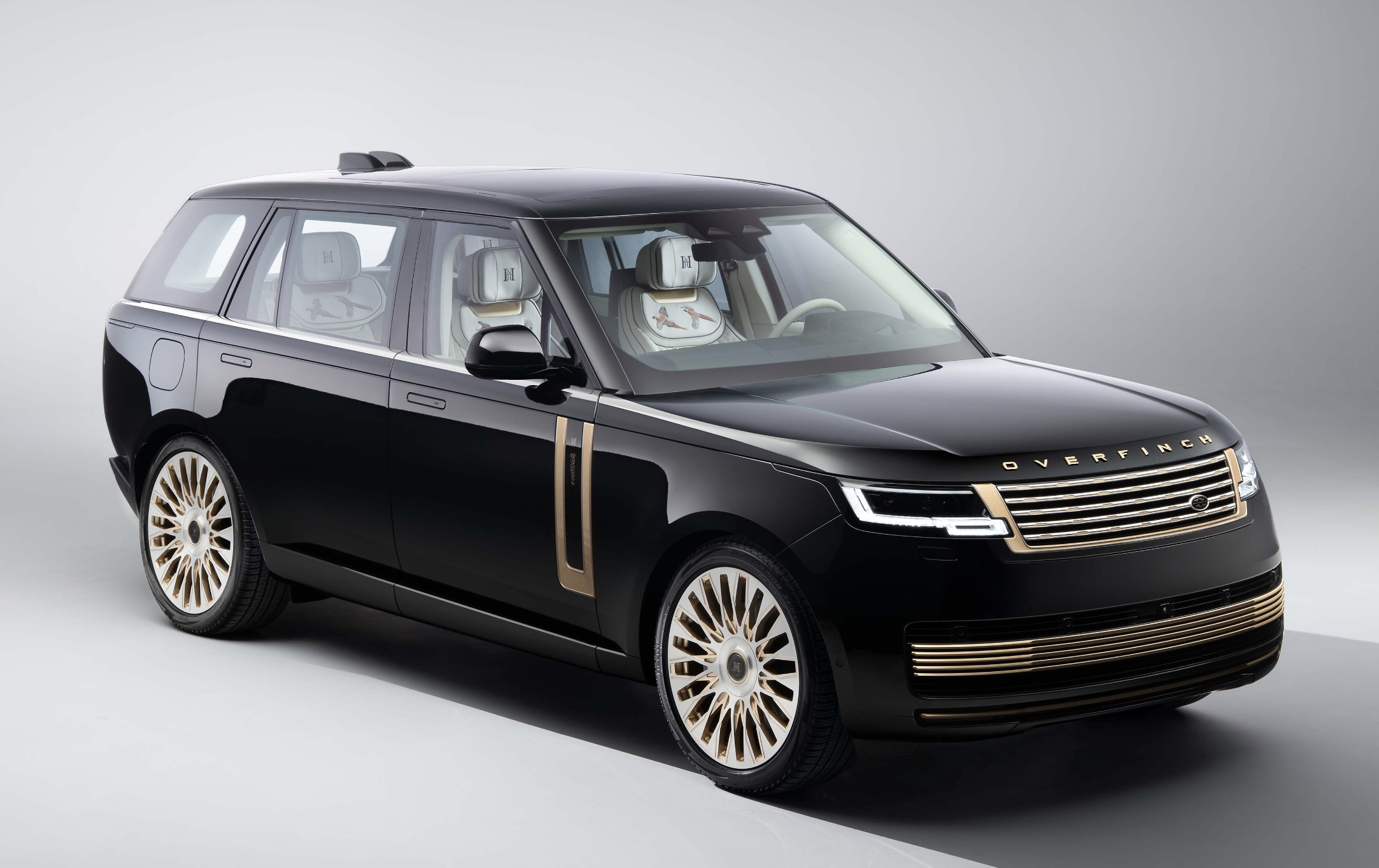
What we do know is documented. Overfinch, the Yorkshire-founded Land Rover specialist, has built a single one-of-one commission with London gunmaker Holland & Holland — an evolution of the 25-car Holland & Holland Edition it launched in November 2025. And what makes it interesting isn’t the money. It’s what the money bought, and what a car like this quietly asks of the person who owns it.
What actually changed
The series car is a long-wheelbase Range Rover SV in British Racing Green, with the Royal scroll — the engraving pattern from Holland & Holland’s flagship side-by-side shotgun — etched across stainless trim, open-pore French walnut throughout, quilted Bridge of Weir leather, a walnut-wrapped steering wheel, and 23-inch forged wheels with self-levelling centre caps so the H&H hallmark always parks upright. The door casings carry hand-engraved forend diamonds, echoing the chequering on a gunstock. Buyers pick from three interior colourways built around London Tan and Harris Green.
The one-off throws that palette out. Deep black with gold picking out the grille, side vents, wheel detailing and rear finisher. Ivory and black leather inside with black piping. Bird embroidery on the seats, contrast monogram embroidery on the headrests.
And then the piece that justifies the whole exercise: handcrafted moorland marquetry set into the deployable rear tables. Closed, the veneer reads as a landscape. Unfolded, the scene extends into game birds in flight. That’s not a decal. That’s veneer selected for grain and tone, cut and assembled by hand, on a component that has to hinge, deploy, and survive a decade of being slammed shut by children and dogs.
The mechanical story is that there isn’t one
Overfinch’s own material for this car talks about palette, craftsmanship and detailing. It does not talk about power. That’s notable from a firm that also sells a Velocity Edition explicitly built around enhanced performance, and that spent decades making its name dropping bigger engines into Range Rovers.
Related Articles
- Honda Beat This Paint-Peeling Lawsuit Once. It’s Back, and Honda’s Already Fighting It Again
- Bryce Harper, Guy Fieri and a Room Full of Champions Just Bought Into Jimmie Johnson’s NASCAR Team
That shift is the real market signal here. The modern personalisation business has largely stopped selling speed and started selling labour hours. A Range Rover SV is already fast enough that adding horsepower is a rounding error nobody feels. Hand-cut marquetry, by contrast, is something you can photograph, explain to a guest, and — crucially — cannot be optioned from the factory. Scarcity has migrated from the engine bay to the trim shop.
The bit nobody covers: where do the guns actually live?
A car built for the shooting client raises a question the brochures skip. In the UK, if you hold a shotgun certificate, secure storage isn’t a suggestion — the Home Office’s firearms security handbook sets out that it’s a condition of the certificate that guns be kept so as to prevent access by unauthorised persons, so far as reasonably practicable. The home standard is a cabinet built to BS7558 and fixed to the structure of the building.
A vehicle is not that. It’s transit, and the guidance treats it as such. Read the transport section and it’s a list of things a boot cabinet doesn’t do by itself: keep guns in the locked boot and out of sight; don’t leave the vehicle unattended for long periods; fit an immobiliser or alarm; if it must be left, don’t keep gun and cartridges together; where practical, remove an operating part — a shotgun’s fore-end, for instance — and carry it on you or lock it separately.
Two practical consequences follow. First, a beautifully lit display cabinet is philosophically at odds with guidance built around concealment. Second, and more usefully: the same handbook notes that shotgun cartridges aren’t covered by the secure-storage certificate condition — but recommends locking them away anyway, and separately from the guns. If you’re commissioning boot furniture, that’s an argument for two lockable compartments, not one grand one.
Ownership realities
The warranty is split. Overfinch states on its own site that it isn’t endorsed by or affiliated with Jaguar Land Rover. Your base vehicle carries JLR’s warranty through JLR’s network; the conversion is Overfinch’s responsibility through Overfinch’s. Get the demarcation in writing before you sign, because the interesting failures always live at the boundary.
Wood is not paint. Veneer in a car lives with UV, humidity swings and heat cycling that furniture never sees. Marquetry integrated into a deployable table adds mechanical stress to that. Park it in the sun with a light interior for five summers and see what the joints do. Ask what the refinishing pathway is and whether the original craftsperson’s records are retained.
Declare everything. A significantly modified vehicle that isn’t declared is a claim waiting to be reduced or refused. This is a bespoke conversion on a high-theft-target platform, and any firearms carried are a separate insurance conversation with their own conditions about vehicle security. An agreed-value policy, with the commission documentation attached, is the only sane structure.
Related Articles
- Backfire News Weekly Wrap-Up: July 27–31, 2026
- Enter Now: Backfire News Readers Can Score Bonus Tickets in the Super Chevy Dream Giveaway Before It Ends 8/4
Resale is the open question. Overfinch says the Holland & Holland Edition can be built as a complete car or commissioned onto a client’s existing Range Rover, with pricing set by specification and location. Which is a polite way of saying the market has no reference price. One-of-one commissions on a depreciating mass-production base are bought, not invested in.
The longer arc
Holland & Holland dates its relationship with Overfinch to 2009 and framed the current five-year collaboration as something its own clients pushed for — collectors of both guns and cars asking two brands they already used to stop circling each other. The gunmaker marked its 190th year with the series car.
That’s the honest read on this one-off. It isn’t a technical achievement or a new benchmark. It’s two heritage businesses discovering that their customer lists overlap almost perfectly, and building something to sit at the intersection.
Whether that intersection is worth seven figures is between Overfinch and one client. Neither of them is telling.
Images Via: OverFinch
About the Author