Two Ferraris, Two Different Bets, And Only One Of Them Is About The Car
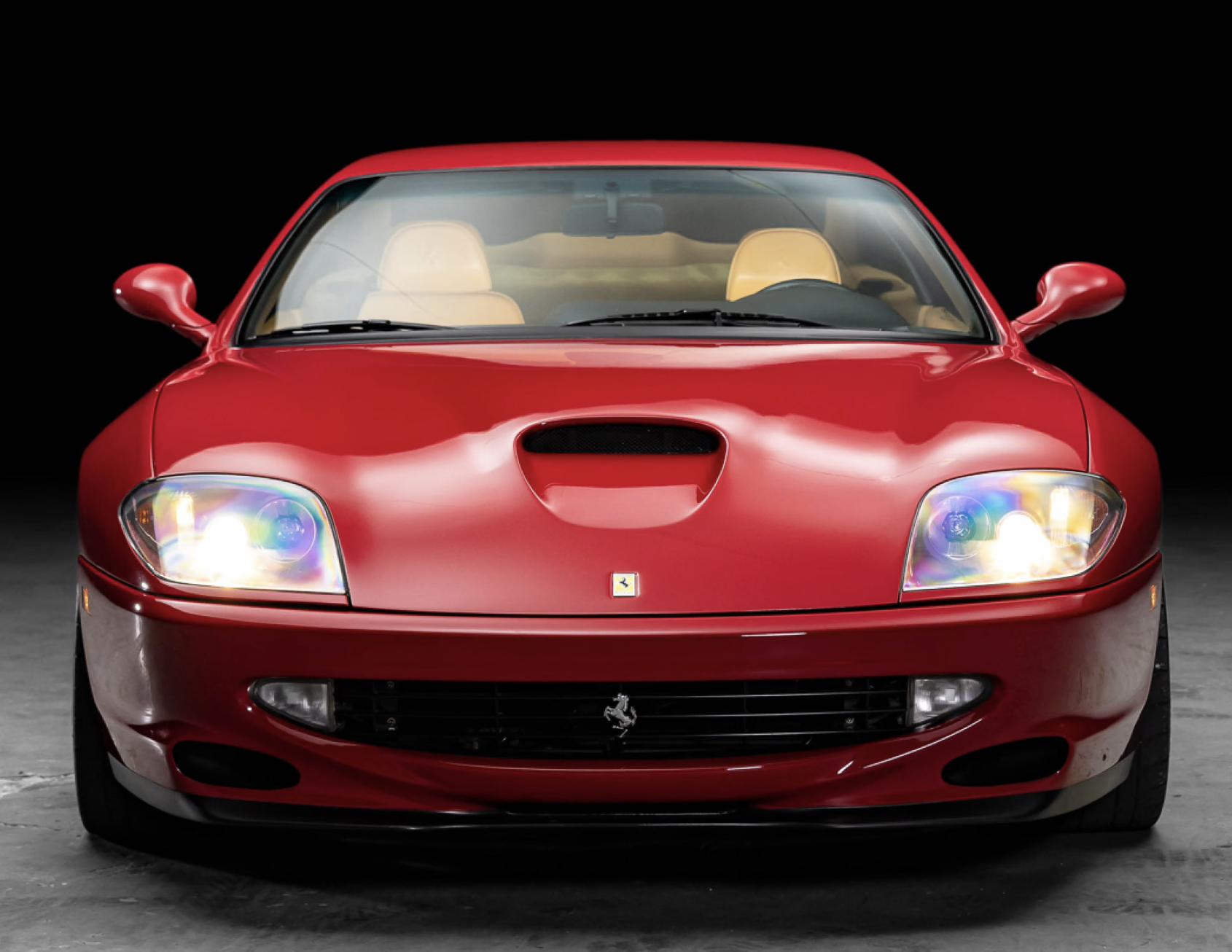
There are two Ferraris worth paying attention to this month, and neither one is priced on the metal. One is a 1997 550 Maranello that Michael Jordan drove out of the United Center with a cigar and a trophy. The other is a 2015 LaFerrari that has covered 92 kilometres in eleven years. Between them they explain exactly what the modern Ferrari market is buying, and it isn’t horsepower.
Start with the number nobody is putting next to the Jordan car.
The estimate starts above the model’s world record
JOOPITER, Pharrell Williams’ auction platform, has Jordan’s 550 up as Lot 1 with online bidding from 15 to 30 September and an estimate of $700,000 to $1,300,000. Chassis 108712 was delivered to him on 29 May 1997 through Foreign Cars Italia in Greensboro, North Carolina, and the factory warranty card still carries his signature and his Durham address. Rosso Barchetta over tan, chrome Speedline wheels, an Illinois vanity plate reading MJ 5.
Related Articles
- Watch A Panamera Owner Ripped His Own Bumper Off Fighting a Glendale Tow Truck — And Still Lost the Car
- Lando Norris Keeps Driving His Porsche 911 GT3 RS Through Monaco Instead Of a Track Where It Belongs
Now the context. Three weeks ago at Monterey, Broad Arrow sold a 527-mile, Classiche-certified 1998 550 Maranello for $648,500 against a $450,000 to $550,000 estimate, and its own results release called that a world record price for the model.
So JOOPITER’s low estimate opens roughly $50,000 above the highest public price any 550 Maranello has ever achieved, and the high estimate is double it. That’s not a stretch estimate. That’s a declaration that the model’s price ceiling is irrelevant to this particular car.
The reason it’s defensible is also the reason it’s interesting. That record-setting car had 527 miles and a Red Book. Jordan’s car, by JOOPITER’s own account, carries roughly 6,400 miles of his actual use, driven to home games, practices and appearances. It is, mechanically speaking, a used 29-year-old Ferrari GT. Every dollar above the model record is being paid for documents and a story, not for condition.
What the paperwork actually is
This is where the lot deserves credit, because celebrity-car claims are usually thin. The provenance chain here runs Foreign Cars Italia, then Jordan from 29 May 1997, then Lake Forest Sportscars on 4 December 2002, then a single California private collection from 2002 to 2026, then CURATED. The signed warranty card is the anchor document, and the car was located because Ferrari’s own historical dealer records still listed chassis 108712 under Jordan’s name with that MJ 5 plate attached.
That last detail is the useful takeaway for anyone chasing a car with a story. Factory records and registration files are the provenance trail. A vanity plate is effectively a searchable index entry, and it’s the kind of thing that outlives memory. Anyone buying on provenance should be asking to see the paper that a manufacturer or a state agency generated, not a folder of magazine clippings.
Note also what the listing doesn’t mention: Classiche certification. That matters, because Broad Arrow’s Monterey release shows the market paying twice for it in the same sale, with the record 550 Maranello and a Red Book certified 2001 550 Barchetta Pininfarina at $1,627,500. Celebrity provenance and factory certification are separate premiums and they stack. Ferrari’s own Classiche programme requires the chassis to be original as a first condition, examines bodywork, interior and all mechanical and electrical systems, and grants certified owners access to long-term spare parts. On a car that spent 24 years in one collection, a Red Book would be a rational next move for whoever wins it.
The mechanical bit, since somebody should mention it
Ferrari’s own history of the 550 Maranello describes the Tipo F133 A as a 65-degree V12 of 5,474cc with an 88mm by 75mm bore and stroke, four valves per cylinder, twin overhead camshafts per bank and dry-sump lubrication, with Nicasil-treated alloy liners and titanium con rods, Bosch Motronic 5.2 engine management, a variable back-pressure exhaust and 485bhp at 7,000rpm driving through a six-speed transaxle.
Read that as an owner rather than a spectator. The transaxle layout is what makes the 550 a genuine long-distance GT with balance the mid-engined cars couldn’t match, and it’s also what makes clutch and gearbox work an expensive, rearward-facing job rather than a bell-housing afternoon. Dry-sump plumbing means more hose runs and more places for old oil to sit. And a car that has been dormant in a private collection since 2002 sits squarely in time-based service territory rather than mileage-based, which is the category that surprises people. Whoever wins this car should budget for a full recommissioning on top of the hammer price and the premium, and should have that quoted before bidding rather than after.
The LaFerrari is the same lesson with a bigger invoice
Over in Switzerland, Broad Arrow has a 2015 LaFerrari headlining The Zürich Auction at the Dolder Grand on 7 November, estimated at CHF 5.5 million to CHF 7.5 million and offered without reserve. Chassis 214333 is finished in Bianco Fuji over Bianchi/Neri with Giallo Modena calipers, was delivered new to the Ferrari concessionaire in Hong Kong, and showed 92 kilometres at cataloguing.
Here is the part every prospective hypercar buyer should read twice. A 202-point inspection in November 2025 found the high-voltage battery due for replacement. The work was done at Rossocorsa, the official Ferrari dealer in Milan, and Broad Arrow states the battery was a key element of service work totalling more than €200,000.
Two hundred thousand euros, on a car that has driven the length of a decent Sunday route.
That is the defining maintenance reality of the first generation of hybrid hypercars, and almost nobody talks about it. Per Ferrari, the LaFerrari pairs a 6,262cc naturally aspirated V12 making 800hp with a 120kW electric motor for 963hp total via the HY-KERS system. The electric motor isn’t a fuel-economy garnish; it fills torque and it is part of how the car drives. So a degraded high-voltage pack isn’t a cosmetic problem, it’s a drivability problem, and lithium cells age on a calendar whether the wheels turn or not. Parking a hybrid hypercar to preserve its value does nothing to preserve its battery.
Practically: if you are looking at any LaFerrari, or an SF90, F80, or 296 in a decade’s time, the battery service history is the single most important document in the folder, and €200,000 is now a published, real-world benchmark for what a factory-level job plus associated work costs. Ask for the invoice. If there isn’t one, price it in.
Related Articles
- What Hyundai’s Boulder Design Filing Really Reveals About Its Ladder-Frame Plans
- A Camaro, a Bridge, and Nine Charges: What a Tennessee Drag Race Actually Costs When Kids Are in the Back Seat
The no-reserve angle is worth flagging too. On a CHF 5.5 million to CHF 7.5 million car, no floor means genuine price discovery on the night, and a consignor confident enough to accept that after a year in which LaFerrari results have been climbing hard. For bidders, no reserve is an invitation; for the market, it’s a data point that will be quoted for the next twelve months either way.
What the two lots have in common
Nothing, and that’s the point. The Jordan 550 is priced on documents, and its mechanical condition is a cost line rather than a value driver. The Zürich LaFerrari is priced on condition, and its documents are a cost line that has already been paid. Both are worth more than the sum of their parts, but for opposite reasons, and a buyer who confuses the two will overpay on one and underinsure the other.
If you’re bidding on either: get an agreed-value policy written before the car ships, name your specialist repairer in it, and read the terms of sale on buyer’s premium and export before you decide what your ceiling really is. The hammer price is never the price.
Images Via: Joopiter
About the Author