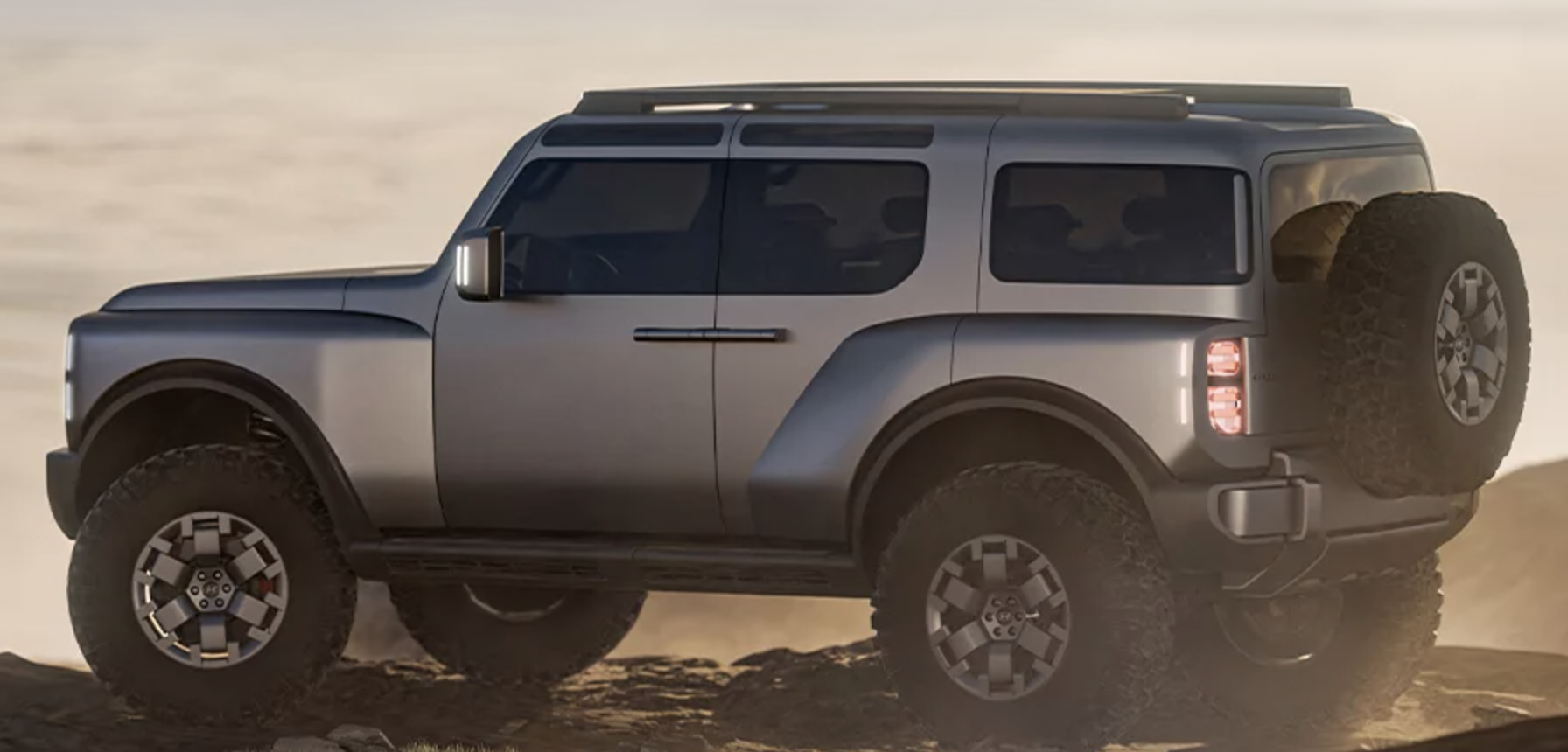
Hyundai’s Boulder has quietly moved from auto show turntable to government paperwork. A design registration numbered 502534-001 now sits in India’s design register, filed in May and searchable through the design status portal run by the Office of the Controller General of Patents, Designs & Trade Marks. That’s the same route most leaked “production” renderings take before anyone at the automaker wants them out.
Before anybody starts pricing out a LandCruiser trade-in, it’s worth understanding what a filing like this actually protects, because the answer is narrower than the coverage usually suggests.
A design registration tells you almost nothing about the truck
Under India’s Designs Act, a registration covers the visual appearance of an article and nothing else. Shape, configuration, surface pattern, ornamentation. It doesn’t cover the frame, the suspension geometry, the driveline, or the powertrain. There is no engineering disclosure in a design filing the way there is in a utility patent.
The term runs ten years from the registration date and can be extended by five more. Once accepted, the design is published in the journal the Patent Office issues weekly, and that publication is precisely why these images escape. It’s not a leak. It’s the system working as designed.
Related Articles
- Sold Your Car in Ontario? Why Your Name May Still Be on It
- Milwaukee ‘Street Takeover Organizer’ Allegedly Built His Hellcat 300 From Three Stolen Mopars
Two more things worth keeping straight. A registration filed in India creates enforceable rights in India. It does not create rights in the United States, and it is not a statement of intent about where a vehicle will be sold. Automakers file design protection in markets where they expect to litigate or where copying is a live commercial risk. India is both. Hyundai also has an actual reason to file there: at its Investor Day, Hyundai Motor India laid out a roadmap through FY2030 that includes entering the off-road SUV segment for the first time.
What Hyundai has actually committed to
The concept itself is documented. The Boulder Concept debuted at New York on April 1, and Hyundai was clear that it’s a design study previewing a fully-boxed body-on-frame architecture whose first production application is a midsize pickup due by 2030. The SUV shape was the messenger, not the message. Separately, Hyundai committed at its 2025 CEO Investor Day to launching its first midsize pickup in North America before 2030.
“Fully-boxed” is the term to pay attention to. It means the frame rails are closed box sections rather than open C-channel. Closed sections carry torsional load far better, which matters when one front wheel is up on a rock and the other three are loaded differently. C-channel rails twist under that input; boxed rails resist it. The trade-off is weight, cost, and harder internal corrosion inspection, since you can’t see inside a sealed rail without a borescope.
For owners, body-on-frame changes the repair math in both directions. Body panels bolt to the frame through isolated mounts, so a moderate impact often means replacing a bolt-on structure instead of sectioning a unibody. That’s the good half. The bad half is that a bent frame on a ladder truck is frequently an economic total, and insurers know it. Expect the claims math on this thing to look more like a Tacoma than a Palisade.
The concept’s hardware is a wish list, not a spec sheet
Hyundai says the show car rides on 37×12.50R18 LT mud-terrains with a full-size spare hung on the tailgate. Do the arithmetic and that’s roughly 9.5 inches of sidewall on each side of an 18-inch wheel. Beautiful for airing down, brutal for everything else.
Fitting 37s from the factory forces engineering decisions most people never think about. Rolling diameter jumps something like 15 to 18 percent over the 31- and 32-inch tires typical of a midsize truck, which effectively lengthens the final drive by the same margin unless you shorten the axle ratio to compensate. Speedometer and ABS wheel-speed calibration have to follow. Unsprung mass climbs hard, which loads wheel bearings, ball joints, and CV or U-joints. Brake rotors have to grow to keep the same stopping distance because you’ve lengthened the moment arm the brakes work against. And a mounted 37-inch mud-terrain runs well north of 100 pounds, so the double-hinged tailgate Hyundai showed off has to carry that load through two different hinge sets without sagging over a decade of trail abuse.
Related Articles
- A CDL School Told Inspectors Its Classroom Was Inside a School Bus. That’s How Bad Trucking Fraud Has Gotten.
- Ford Let a Timing Belt Rot in Motor Oil for a Decade — Now 135,000 Owners Are One Warning Light From a Dead Engine
The coach doors are the detail I’d bet against hardest. Rear-hinged rear doors with no fixed B-pillar require the door structures themselves to carry side-impact load, which drives up door mass, hinge and latch cost, and side-impact certification complexity. It also means a moderate side hit can compromise two doors and the reinforcement between them at once, which body shops price accordingly. Almost nobody keeps this feature past the concept stage, and the ones who do charge for it.
The part that actually matters
Read Hyundai’s own language on the production program and the interesting word isn’t “off-road.” It’s “steel.” Hyundai committed that these vehicles will be designed in America, developed for America, built in America, and forged with Hyundai-produced U.S. steel, all under a $26 billion U.S. investment running from 2025 through 2028.
That’s a supply chain statement dressed as a marketing line. Building a ladder-frame truck out of domestically produced steel from a company-owned supplier is about as tariff-proof a structure as you can engineer in the current trade environment, and it’s a hedge Toyota and Ford can’t replicate as cleanly on midsize product.
For buyers, the practical read is this: the pickup is real and dated, the SUV is not confirmed for anywhere, and the Indian filing tells you Hyundai wants the shape protected in a market where it has separately promised an off-roader. Everything else is a drawing.
Images Via: Hyundai
About the Author