The “Only” Lagonda Shooting Brake Isn’t, But The Real Claim Is Better Anyway
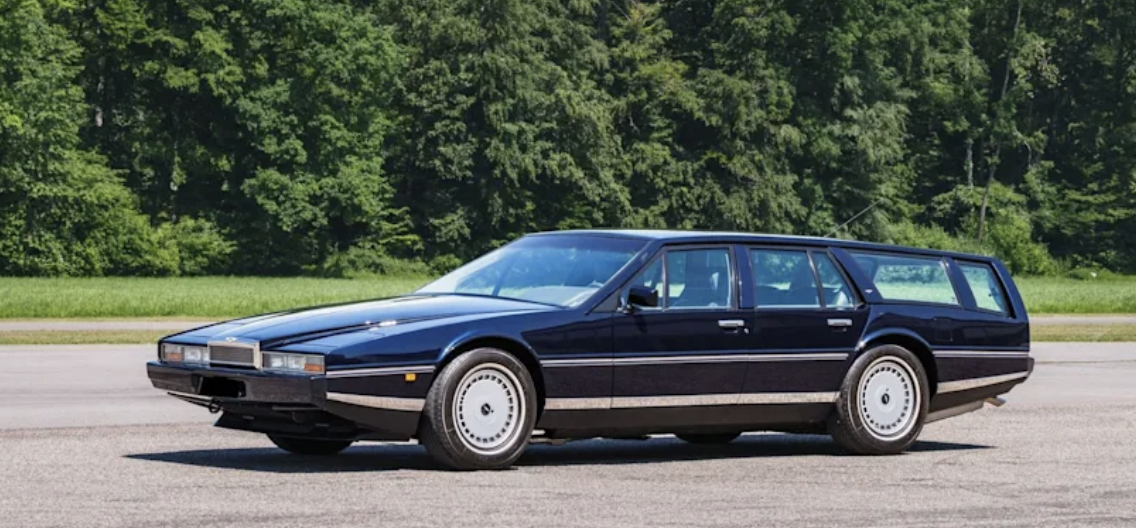
Broad Arrow is bringing a wedge-shaped Aston Martin Lagonda estate to The Zürich Auction at the Dolder Grand on 7 November, converted by Switzerland’s Roos Engineering, offered without reserve, estimated at CHF 250,000 to CHF 350,000. The phrase attached to it everywhere is “world’s only.”
It isn’t. And the auction record proves it, which is a slightly awkward thing for the collector-car world to have forgotten in seven years.
There are at least two, and the other one already sold
At Monterey in 2019, RM Sotheby’s sold a 1987 Aston Martin Lagonda Shooting Brake, chassis SCFDL01S3HTL13533, for $98,000. That car was delivered new to a Danish owner living in Switzerland who specified it with a cocktail set, a television, picnic tables and lamb’s wool rugs, then collected it in person at Newport Pagnell. Its second owner, in Sweden, commissioned Swedish industrial designer Ted Mannerfeldt to turn it into an estate.
Related Articles
- What Camping World’s Shrinking Store Count Really Means for RV Buyers
- Truck Engine Fuel Rules Voided: What Federal Rollback Means for Diesels
Here is the part that matters. RM’s own catalogue states plainly that Mannerfeldt’s design brief took inspiration from the conversion carried out by Roos Engineering in 1996, with the goal of preserving as much of William Towns’s original design as possible, keeping the C-pillars and the symmetry intact.
So the Roos car isn’t the only Lagonda shooting brake. It’s the first, and it was influential enough that somebody else copied the idea a decade later and tried to do it more tidily. That’s a considerably more interesting story than “one of one,” and it also gives us the only genuine comparable transaction that exists for this body style.
What actually makes the Zürich car unique
Strip out the marketing and the defensible claim is narrower and stronger: factory approval. Aston Martin sanctioned the Roos conversion and supplied parts for it. Nobody says that about the Mannerfeldt car.
For a coachbuilt one-off, that distinction is the whole ballgame. A conversion done with the manufacturer’s blessing sits in a different category from a private commission, because it carries an implied endorsement that the work met the factory’s standards, and because it means original components went back into the car rather than fabricated approximations. On a model with as much bespoke hardware as a Lagonda, that’s not a footnote.
The paperwork trail goes back further than most people realise
This chassis has been through a public sale before. Bonhams offered it in 2016, and its catalogue entry is the most detailed primary account of the build in existence. Roos Engineering, based in Frauenkappelen, began work in 1996 at the request of a customer in Hong Kong. The car took four years and was ready at the start of 2000. The customer then kept it in Switzerland, where Roos maintained it, and by 2016 the owner was resident in Germany with the car registered there. All the conversion bills were on file, along with Swiss registration papers.
Two things in that entry are worth a raised eyebrow. Bonhams catalogued the car as a 1986; it’s now being sold as a 1987. And on the mechanical side, Bonhams described the upgrades as a four-speed automatic replacing the original Torqueflite three-speeder plus improvements to the fuel system, noting that otherwise the mechanicals were left pretty much standard. That’s a narrower account of the work than the more comprehensive engine-and-electronics rebuild being described now. Neither version is necessarily wrong, but a buyer should want the invoices to reconcile the two before deciding which car they’re bidding on.
The gearbox swap is the smart bit nobody talks about
Everybody looks at the glass. The interesting engineering decision is the transmission.
The Lagonda left Newport Pagnell with a Chrysler Torqueflite three-speed automatic: robust, simple, and geared with no overdrive top. Fine for a 1970s luxury saloon, less fine on a modern motorway, where a big V8 sits at high cruising revs all day. Swapping to a four-speed adds an overdrive ratio, which drops engine speed at speed, cuts noise, improves fuel consumption and takes meaningful stress out of a hot-running V8. For a car whose owner intended to actually drive it in Switzerland, it’s the single most useful modification on the list.
The ownership consequence is less romantic. A Torqueflite is one of the most supported automatics ever built, with parts available anywhere. A mid-1990s four-speed conversion means the unit in this car is whatever Roos chose to fit, adapted to a bellhousing and driveline it was never designed for. Before you bid, identify the transmission by casting and part number and find out who can service it. Somebody eventually will need to.
Nobody can agree how rare it is
Broad Arrow describes it as one of 76 Series 3 cars. RM Sotheby’s, in the 2019 catalogue, calls the fuel-injected Series III the rarest Lagonda variant at 85 cars built in a single year. Two of the most respected houses in the business, nine cars apart on a production figure. Bonhams, meanwhile, records the model total at 645 across the whole run to May 1990, with the Series 4 facelift arriving in 1987 and roughly one car a week leaving Newport Pagnell.
Treat every Lagonda rarity claim as an estimate rather than a fact, and ask for the build sheet.
The money question
This is where the RM result becomes genuinely useful. The only other Lagonda shooting brake to sell publicly made $98,000 in 2019. Broad Arrow’s low estimate here is roughly three times that, and the high end roughly four and a half times.
Some of that gap is seven years of appreciation in wedge-era Astons, and some is the currency. But most of it is the factory-approval premium and the fact that this is the original of the two rather than the response. Whether the market agrees is genuinely open, and the no-reserve format means we’ll find out precisely, because there’s no floor to hide behind. That’s the most valuable thing about this lot: it will produce a real number for a category that currently has exactly one data point.
What a buyer should actually be checking
Related Articles
- Dreame Bought a $10 Million Super Bowl Ad to Sell a Hypercar It Never Actually Built
- Electric Defender Timeline: What JLR Has Actually Committed To Building
Insurance first. There are no comparables here, so a market-value policy is worthless. This needs an agreed value, a named specialist repairer written in, and an honest conversation about the glass. Custom-cut glazing on a one-off has no part number and no shelf, and a stone through the tailgate is a pattern-making exercise rather than an insurance claim.
Then the tax. Bonhams flagged in 2016 that because the car was Swiss registered, local import taxes of 5% would apply to the hammer price if it stayed in the EU. That was six years before Brexit-era complications settled and it’s still the right instinct: a Swiss sale, a Swiss-and-German history, and a global bidder pool means import duty and VAT need modelling into your ceiling before the gavel drops, not after.
Finally, read the addenda. RM’s 2019 listing carried two notes that tell you more about buying these cars than any amount of catalogue prose: the odometer had been replaced by Aston Martin Lagonda Limited in September 2005, with genuine mileage under 30,000 km supported by documentary evidence, and California emissions rules meant the car had to be sold to a dealer or an out-of-state resident.
Neither of those facts appears in a headline. Both would have changed what somebody paid.
Images Via: Broad Arrow
About the Author