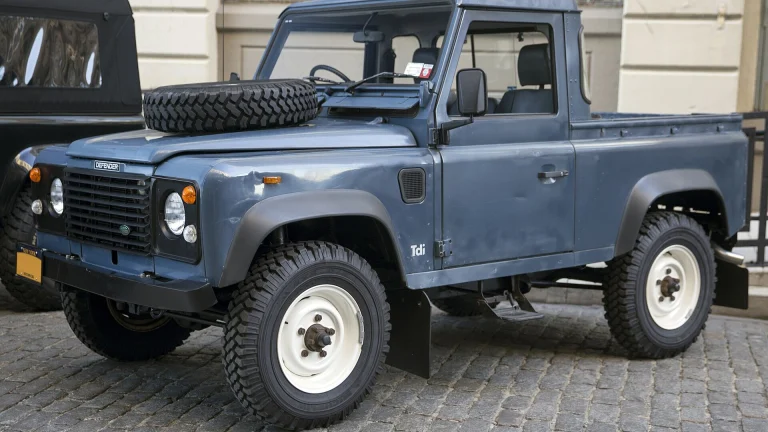
Land Rover’s electric Defender was never actually on a calendar. That’s the part worth understanding before anyone gets worked up about it slipping.
Go looking for a date and you won’t find one. What you’ll find instead is JLR’s investor update from June 17, which is the document that actually tells you how Gaydon is thinking. In it, JLR confirmed that a new Defender-family model will be the second vehicle on its Electrified Modular Architecture, the platform built at Halewood — and that EMA will now offer a full hybrid option alongside the battery-electric one. The first EMA car isn’t a Defender at all. It’s a Range Rover, due to be revealed this year.
That single sentence — hybrid and electric on EMA — is the whole story, and it’s a bigger deal than most people realize.
Why adding a hybrid to an EV platform is expensive
EMA was conceived as a battery architecture: 800-volt electrics, a flat floor, a structural pack doing double duty as a stiffening member. Bolting a combustion engine and a hybrid transaxle into that concept isn’t a calibration exercise. You need a fuel tank, an exhaust path, a driveshaft tunnel or a very creative transverse layout, an engine bay with crash structure sized for a hard object instead of a crumple-friendly frunk, and a completely separate thermal circuit because engines and battery packs want to live at different temperatures.
Related Articles
- Ferrari Patents a Taillight That Doubles as a Spoiler
- Rivian Is Baking Waze’s Cop and Speed Camera Alerts Straight Into the Dashboard
Every one of those changes eats packaging space that a BEV-native floor was supposed to give back. It also means one body-in-white has to satisfy two crash-load paths and two cooling architectures. Engineering time and tooling money get spent twice. That’s the real cost of “flexibility,” and it explains why a program built around it doesn’t move fast.
For anyone hoping the current Defender might sprout a battery mid-life: JLR putting the electric one on a new architecture is your answer. If the existing car could take a pack, it would already have one. There is no retrofit coming and no aftermarket conversion that will keep a warranty attached.
The regulation nobody can ignore
Britain’s ZEV mandate isn’t a target, it’s a statutory instrument. The Vehicle Emissions Trading Schemes Order 2023 sets up trading schemes with rising annual zero-emission registration shares climbing toward 80% of new cars in 2030, backed by financial penalties. Manufacturers can bank credits, borrow against future years at interest, trade with rivals, or pool across brands under common ownership. That flexibility is the pressure valve, and it’s why a company can miss a product date without immediately writing a cheque.
The ground is also moving. On August 14 the government launched a consultation on the mandate, running to October 23, asking industry how the pathway to 2030 and 2035 should work. Nobody plans a decade-long, billion-pound vehicle program against rules currently sitting in a comment period.
Meanwhile JLR’s own boilerplate still says that before the end of the decade each of its brands will have a pure electric model, with Jaguar entirely electric. Defender is a brand in that structure. That commitment and a 2030s electric Defender do not obviously fit in the same sentence.
Follow the tariff geography
Here’s the bit that gets overlooked. JLR builds the Defender 90, 110 and 130 at Nitra, Slovakia — the company said so plainly in June. Slovakia is in the EU. So the Defender does not ride on the UK’s tariff-rate quota, which US Customs set at 100,000 UK-origin automobiles a year under Executive Order 14309. It lands under the US-EU framework instead, where Commerce and USTR amended the tariff schedule so EU automobiles carry a combined 15%.
JLR’s best-selling nameplate is the one product in the portfolio that gets no benefit from the deal Britain negotiated. Which reframes the non-binding MOU JLR signed with Stellantis in May to explore US product and technology development — the company confirmed in June it will point that collaboration at the Defender brand specifically. Build Defender-brand product in North America and the tariff problem stops being a problem. That’s a structural fix, and structural fixes take years.
The money explains the patience
FY26 was rough. JLR reported full-year revenue of £22.9bn, down 20.9%, with profit before tax and exceptional items of £14m against £2.5bn a year earlier, and an adjusted EBIT margin of 0.7% — hit by tariffs, China, the Jaguar wind-down and a production pause following the cyber incident. Q1 FY27 wholesales came in at 79,300, down 9.2%, though Range Rover, Range Rover Sport and Defender made up 80.8% of them.
Related Articles
- Yamaha’s 155cc Retro Standard Is Headed to American Dealers
- The MotoGP Movie Faces Problems No Racing Film Has Solved
Against that, JLR is targeting £1.7bn of savings to push breakeven toward 300,000 units while holding an £18bn investment commitment through FY29. When three nameplates carry four-fifths of your volume and your margin is thin, you do not rush a clean-sheet replacement for the one selling best. You protect it.
What this means if you’re buying
If you want a Defender, buy the one on the lot. It isn’t going anywhere, JLR has committed to keeping the brand in production at Nitra, and the propulsion menu across Range Rover, Defender and Discovery is now MHEV, HEV, PHEV or BEV — meaning electrified options arrive on the Defender family before a battery-only version does.
If you’re holding out for the electric one as an investment in future-proofing, reconsider the timeline. The Range Rover Electric — a different car on a different platform — carries a waiting list JLR put at 76,976 in its 2026 annual report, and that car is only launching now after years of slippage. A Defender EV sits two products behind it on an architecture that just took on a second powertrain family.
Residuals on the current car should hold better than they would if a replacement were imminent. That’s the quiet upside of a program with no date attached.
About the Author