Six months ago, Dreame Technology put a rocket-boosted electric hypercar in front of the world and made the case that a vacuum cleaner company had earned the right to build the fastest car on the planet. Now the automotive division behind that car is being wound down, its headcount cut from close to 1,000 people to a skeleton crew, and Dreame is describing the retreat, in its own words, as smart strategy rather than a failure.
That framing deserves scrutiny, because Dreame didn’t quietly shelve a side project nobody noticed. It spent real money making sure everyone noticed. In February, during the single most expensive advertising window on American television, Dreame ran a 30-second national commercial reported to cost around $10 million, showing a robot vacuum, a robotic lawn mower, and its concept hypercar morphing into robots and hurling a flaming ball at the camera. That’s not a company quietly testing the waters. That’s a company making a very loud statement. Six months later, the statement has been walked back.
The Car, On Paper
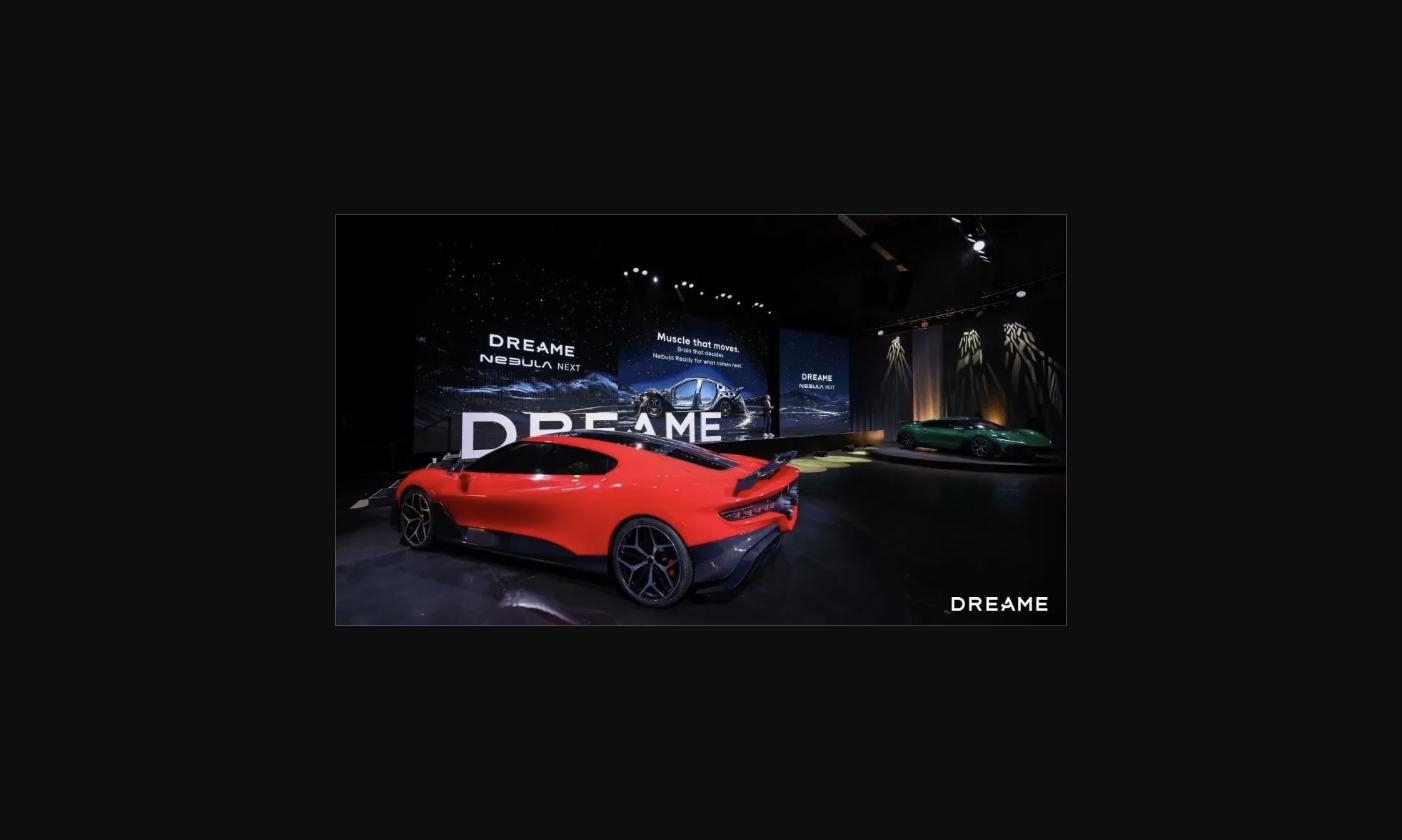
Dreame’s automotive ambitions surfaced in 2025 under an internal effort the company has called the Star Project, with a stated goal of building the world’s fastest car. The first hardware to reach the public, a two-door concept called the Nebula NEXT 01, appeared at CES in January with four electric motors making a claimed 1,876 horsepower and a 0-62 mph time of 1.8 seconds, dressed in active aerodynamics the company said were tuned for cooling and high-speed stability.
By late April, at a company showcase called DREAME NEXT in San Francisco, the concept returned as the Nebula NEXT 01 JET Edition, and the pitch escalated considerably. Dreame bolted on a pair of solid-fuel rocket boosters rated for 100 kN of peak thrust with a 150-millisecond response time, claiming the added shove cut the 0-100 km/h time to 0.9 seconds. Alongside the car, Dreame introduced a lidar unit it calls the DHX1, said to resolve potholes, road debris, and pedestrian movement at what the company describes as image-level detail rather than the rougher point-cloud output of a typical automotive lidar sensor. Dreame also detailed a self-driving stack built on what it calls a third-generation VLA and World Model architecture, split into an L2++ tier for door-to-door urban driving and an L3+ tier aimed at fully unmanned operation, plus a CTP 4.0 battery-to-chassis structure that deletes the crossmembers and longitudinal beams a conventional pack would need, freeing up vertical space. Stanford professor Sebastian Thrun, an early pioneer of autonomous vehicle research and the founder of Udacity, appeared at the reveal and said, “I’ve never seen a product announcement as exciting as this.”
Rocket Boosters Were Never Going Anywhere
Here’s the part worth explaining to anyone who isn’t an engineer: a 0.9-second sprint to 100 km/h via solid rocket boosters was never a preview of a production feature, because solid rocket motors don’t behave like a battery pack or a fuel tank. They are single-use pyrotechnic devices, closer in classification and handling to fireworks or ammunition than to anything sold at a car dealership today. Once fired, the motor is spent; there’s no refueling, only physically swapping the cartridge. Hardware in that thrust class falls under hazardous-materials rules governing manufacture, storage, and transport, which makes a dealer stocking replacement boosters in the parts department, or an insurer underwriting a car with an explosive-charge propulsion assist, effectively impossible under current regulation. None of that makes the underlying engineering fake, the thrust figures and response time are plausible for hardware of that type, but it does mean the 0.9-second number was never a roadmap to a production spec. It was built to be filmed once, not driven twice.
A Retreat Dressed As a Decision
Dreame’s account of what happened, delivered directly to Reuters in a statement on August 26, is unusually candid for a company backing out of a program it spent a year publicly promoting. The company said it had reviewed the auto industry’s research and development cycle, the sustained investment intensity required to compete, and the state of market competition, and decided against advancing the automotive project as an independent business unit for the time being. Crucially, Dreame said the project had never reached commercial mass production or required significant heavy-asset investment, meaning the shutdown carries no material adverse impact on its finances. Intellectual property and technical work from the program, the company said, will be redeployed across its smart mobility, robotics, and broader research platforms.
The numbers behind that statement tell a rougher story than the press release does. The automotive division peaked at close to 1,000 employees; state media reported the group had been reduced to a few dozen staff handling supplier settlements and corporate deregistration, following layoffs that began back in May. Senior executives have reportedly already moved on to other opportunities. In a separate statement posted to Weibo, Dreame said it would concentrate going forward on four areas: smart homes, outdoor living, smart mobility, and embodied AI, without directly addressing whether it was exiting vehicle development altogether.
The Spending Pattern Is the Real Story
Compare that to how Xiaomi handled the same basic idea. Xiaomi also arrived at cars as a phone and appliance company with zero automotive pedigree, and it also drew plenty of skepticism at the outset. The difference is that Xiaomi built an actual factory, actually shipped cars, and delivered its 500,000th SU7 in under two and a half years. Dreame, by contrast, spent roughly a year and a reported $10 million Super Bowl slot building attention around a car that, by its own account, never got close to a factory floor. That isn’t automatically dishonest; plenty of legitimate concept programs never reach production. But it’s a very specific kind of spending pattern, heavy on marketing reach and light on the capital-intensive parts of actually building cars. A real hypercar program, the kind that takes deposits and eventually delivers something into a customer’s garage, looks a lot more like what Gordon Murray Automotive has been doing at Goodwood, where the reveal is backed by an actual production allocation and buyers who have already paid to be in line.
What Owners and Enthusiasts Actually Take From This
Nobody lost a deposit here, and that’s worth saying plainly. Dreame’s statement makes clear the project never reached an ordering stage, so there’s no equivalent of the reservation-holder heartbreak that has followed other EV startup collapses. The people who did lose something are the employees, close to a thousand of them at peak, who took jobs at a car company that may have always been more marketing vehicle than automaker. The lidar and autonomous-driving ambitions Dreame described are also worth watching with the same skepticism currently aimed at systems that are actually deployed: Waymo’s robotaxis are already running into real-world limits in the very city Dreame chose for its rocket-car unveiling, and regulators in San Francisco have made clear that impressive sensor specs on a press release don’t automatically translate into a system that behaves itself on public roads. If any of Dreame’s actual engineering work, the lidar, the battery packaging, the driving stack, ends up inside a robot vacuum or a future mobility product, that’s a more honest use of the research than the rocket car ever was.
Dreame will keep making very good vacuums. It just won’t be selling you on the idea that it was also building the fastest car in the world, which, in hindsight, was always the more implausible product of the two.
About the Author