Lot S221 at Mecum’s Nashville sale is a 2024 Lamborghini Huracán Sterrato LP610-4 with 2,281 miles on the clock, finished in a green-gold pearl Lamborghini calls Verde Gea Lucido over a black Nero Ade interior. It’s scheduled to cross the block Saturday, September 26, and according to Mecum’s listing, it’s one of just 1,499 Sterratos Lamborghini built before retiring the Huracán nameplate entirely. That number is the whole story here: this isn’t a car anyone can special-order anymore, and the used market is about to get a fresh data point on what that’s actually worth.

This Isn’t Just a Lifted Huracán With Some Stickers
Lamborghini didn’t just crank up the ride height and call it a day. The Sterrato sits roughly 1.7 inches taller than a standard Huracán EVO, wears a widened track, and trades the street car’s underbody for a reinforced floor built with real approach and departure angles in mind. The fender flares aren’t cosmetic, either — they cover the extra width needed for specially developed Bridgestone Dueler all-terrain tires mounted on this car’s 19-inch Morus forged wheels. Lamborghini also added a dedicated Rally drive mode that changes the all-wheel-drive torque split, loosens the electronic aids, and remaps throttle response for loose surfaces, layered on top of the torque-vectoring AWD system already standard across Huracán EVO variants.
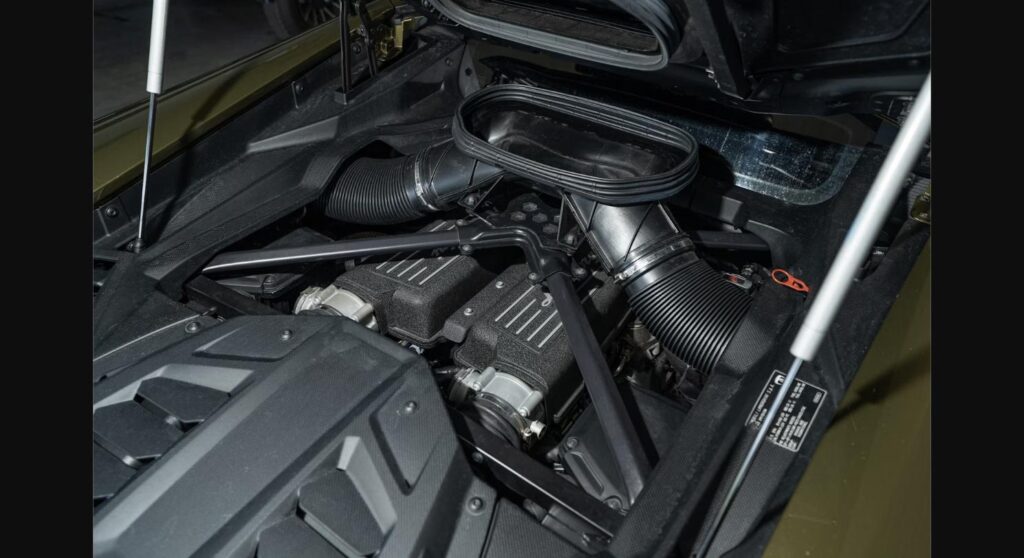
None of that touched the powertrain. This one still runs the naturally aspirated 5.2-liter V10 rated at 602 horsepower, backed by a seven-speed dual-clutch automatic — the same basic formula that made the original Huracán LP610-4 a benchmark, just now capable of a gravel road. Underneath is Lamborghini’s aluminum-and-carbon-fiber hybrid chassis, with double-wishbone suspension front and rear and carbon-ceramic brakes pinched by orange calipers visible through those forged wheels.
The Spec Sheet on This Specific Car
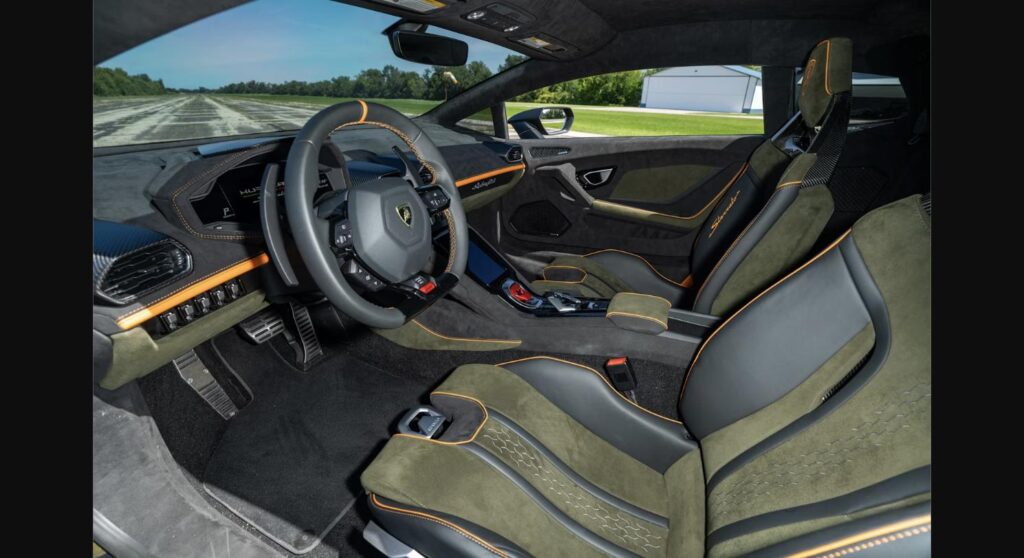
Beyond the paint and the mileage, Mecum’s listing shows this example carrying the Carbon Twill Package, sport seats, and a Sensonum stereo, on top of the roof rack and light bar that have become the Sterrato’s signature accessory even though most owners never take one past a gravel driveway. Equipment includes LED headlamps and taillights, heated mirrors, an electronic parking brake, and Lamborghini’s illuminated door lights. The VIN, ZHWUG7ZF0RLA26312, places it as a late-production car from the Sterrato’s final model year.
Why a Low-Mile Example Matters Right Now
Lamborghini priced the Sterrato at a bit over $273,000 when new, and buyers who wanted one had a short window — production was capped at 1,499 units worldwide and sold out well before the last car left the factory. The Huracán itself is done now, too, replaced by the hybrid V8 Temerario, which makes the Sterrato the final naturally aspirated V10 variant of that platform. That’s a different value proposition than most current Lamborghinis, which lean on rarity and horsepower headlines to hold value; the current flagship Revuelto SV starts at $741,172 before options, and nobody yet knows how that car’s depreciation curve will bend. The Sterrato’s ceiling is set by a fixed, already-closed production number on a drivetrain Lamborghini isn’t going to build again.
At 2,281 miles, this example is close enough to new that a buyer isn’t inheriting somebody else’s off-roading. That matters for a car whose whole pitch is built around actually using it hard: the all-terrain tires aren’t cheap or common, carbon-ceramic rotor and pad replacement on a Huracán can run into five figures if it’s ever needed, and insuring a factory-lifted, rally-mode V10 supercar prices out differently than a standard Huracán depending on how honestly an owner answers the intended-use questions on the application.
Lamborghini Wasn’t the Only One Who Saw It
The Sterrato proved there was real appetite for taking Lamborghini’s smallest V10 off pavement, and the aftermarket noticed. Rezvani’s 800-horsepower Dune, built on a Huracán chassis of its own, is proof the idea has legs well beyond Sant’Agata’s factory build. The difference is that Rezvani’s take is a small-batch conversion; this Sterrato is the version Lamborghini engineered, warrantied, and capped at 1,499 examples.
Crossing the Block in Nashville
This Sterrato is lot S221 at Mecum’s Nashville 2026 sale, scheduled to cross Saturday, September 26. It isn’t the only unusual machine on that docket — a 1946 Solar Midget racer selling with no reserve is crossing the same weekend, a reminder that Mecum sales stack seven-figure exotics next to prewar oddities without blinking. For a broader look at what else is worth watching on track and at auction this week, check our roundup.
Bidding opens Saturday. Whatever this one brings will be one of the first real data points on what a barely-used Huracán Sterrato is worth now that Lamborghini has already moved on to building its replacement.
Photos courtesy of Mecum Auctions.
About the Author