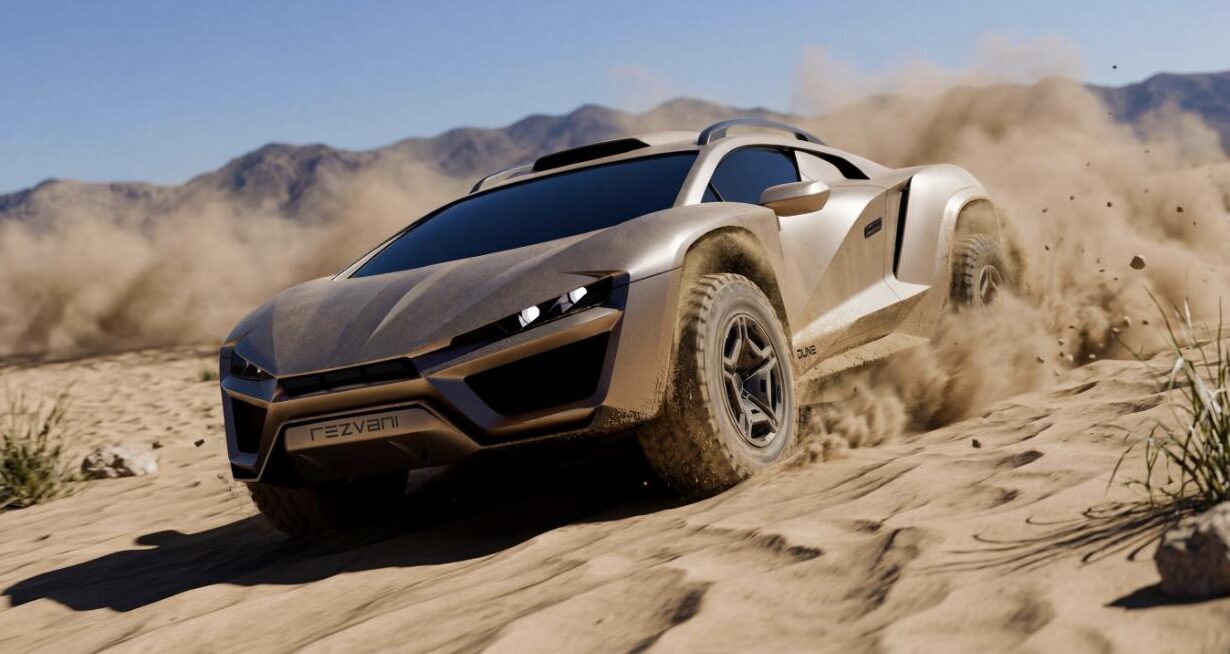
Rezvani Motors just published the photos, the video, and the full spec sheet for the Dune, and buried in the fine print is the answer to a question the company dodged in its own teaser two weeks ago: what is actually underneath this thing.
The headline numbers are straightforward enough. Rezvani says the Dune packs a 5.2-liter supercharged V10 making up to 800 horsepower, sends it through an all-wheel-drive system, and wears a fully bespoke wide-body carbon-fiber shell riding on a 4.5-inch lift system with off-road-sized tires and reworked geometry. Only seven will be built, each one commissioned individually down to exterior finish and interior trim, with deliveries targeted for 2028.
What Rezvani didn’t say outright, but effectively confirmed anyway, is the donor car. The press materials describe the suspension lift as delivering “a 6-inch lift from a factory Lamborghini Huracan,” which is an odd sentence to write unless the Dune actually starts life as a production Huracán. Pair that line with the displacement, the naturally aspirated V10 layout, and the all-wheel-drive system, and every figure matches Lamborghini’s own spec sheet for the car. When we covered Rezvani’s teaser for this project, the company’s history of widebody-kitting donor trucks and SUVs made a bespoke mid-engine chassis feel like a stretch. The full reveal settles that question: the Dune is a heavily reworked Huracán, not a ground-up exotic built from scratch.
That distinction matters more than it might seem. Rezvani and VF Engineering had to design a dedicated supercharger system for an engine Lamborghini never intended to run boosted. The Huracán’s V10 is tuned for high-rpm, naturally aspirated response, with compression, fueling, and cooling calibrated around that assumption. Adding positive-pressure induction means reworking fuel delivery, revising the engine management to control cylinder pressures and knock, and building in enough intercooling to manage intake temperatures, especially if this car is meant to be driven hard through heat and sand rather than a cool test track. Rezvani hasn’t published a direct before-and-after comparison, but factory Huracán variants top out somewhere in the low 600-horsepower range, so 800 horsepower represents a serious jump for a supercharger system engineered from the ground up rather than adapted from an existing bolt-on kit.
The suspension work is arguably the harder engineering problem. Lifting a mid-engine supercar 4.5 inches isn’t a matter of taller springs and longer shocks. The Huracán’s control-arm geometry, half-shaft operating angles, and ride-height sensors are all calibrated around a narrow range of travel, and pushing that range dramatically farther risks binding CV joints, altering camber curves, and exposing a low-slung V10 and its oil pan to rocks and ruts the car was never designed to clear. Lamborghini’s own factory-built off-road Huracán, the Sterrato, makes the point by comparison: it raises ride height a modest amount and adds underbody protection without attempting anything close to the lift Rezvani is claiming here. We saw a similar problem play out when a Virginia shop lifted a Ferrari GTC4Lusso for off-road duty, and in both cases the real engineering challenge is keeping the driveline alive, not just clearing the fender gap.
Rezvani’s seven-unit production cap fits a pattern the industry leans on more often now: when a small builder wants to charge exotic-car money for something the donor platform was never engineered to do, keeping the run tiny limits how many cars have to prove long-term durability. Hennessey took a comparable approach with its Venom F5 LF, building exactly one manual-transmission version of a car everyone assumed would stay automatic-only. A seven-car run of a boosted, lifted Huracán works on the same logic: it lets Rezvani sell the concept without staking its reputation on a full production line.
Buyers circling the $1,500 refundable deposit should ask a few questions before it turns into a signed contract. Rezvani hasn’t said whether customers supply their own donor Huracán or whether the company sources the car as part of the build, and that detail changes everything from delivery timelines to what warranty coverage looks like once a factory Lamborghini gets an aftermarket supercharger and a chassis-altering suspension system. Lamborghini’s factory powertrain warranty almost certainly does not survive that conversion, and most insurers will want a specialty agreed-value policy rather than a standard exotic-car endorsement once a car has been structurally modified this extensively. Titling can get complicated too. Depending on the state and how the finished car is documented, a heavily altered Huracán can end up registered as a modified or reconstructed vehicle, which affects everything from future resale to whether a lender will finance it at all.
None of that makes the Dune a bad idea, just an expensive bet on execution. Rezvani has built widebody kits for trucks and SUVs for years, but it has never taken on a structural, drivetrain, and suspension overhaul of a mid-engine exotic at this depth. The tagline sells freedom from pavement. The seven buyers writing deposit checks are really betting on whether a company that has never attempted this kind of build can pull it off seven times over, on schedule, by 2028.
About the Author