Rezvani Motors builds most of its lineup by taking someone else’s truck or SUV and running it through a very aggressive body kit. The Dune, teased this week on the Rezvani website, breaks that pattern. It is pitched as a clean-sheet, mid-engine machine with an 800-horsepower supercharged V10 and a carbon-fiber body, and the company says it will build exactly seven of them.
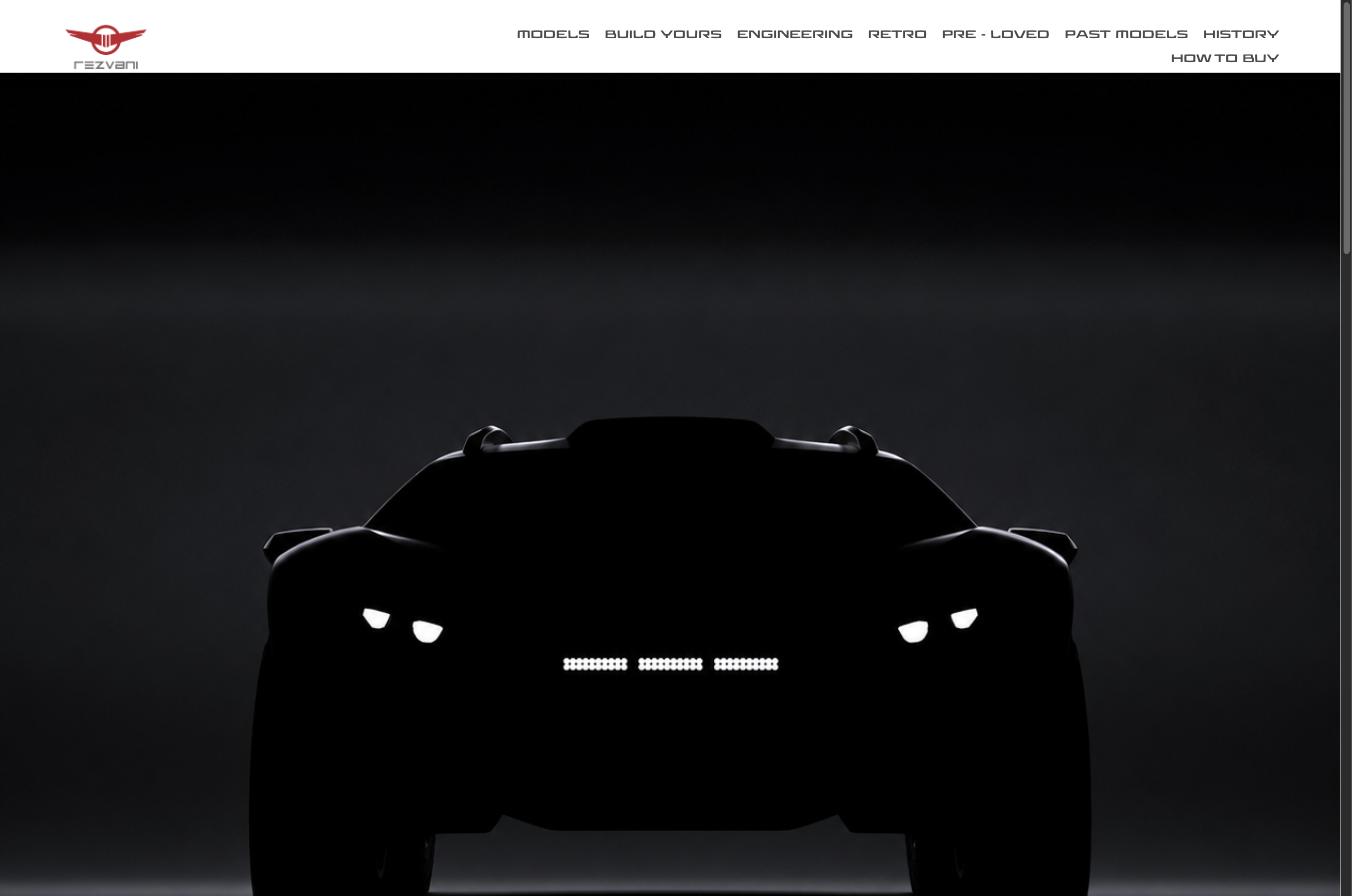
The teaser itself is sparse by design: two backlit silhouette renderings, a tagline, a short list of numbers, and a reservation button. Rezvani sums up the concept as “Supercar Soul. Freedom To Explore,” and frames the pitch around a supercar that gets driven into the world instead of being shielded from it. Whatever you make of the marketing line, it does explain the shapes in the renderings: a low, wide supercar silhouette sitting on what looks like real suspension travel and chunky, all-terrain-sized tires, with a full-width LED light bar splitting a set of narrow, angular headlights up front, and circular taillights bisected by horizontal light blades out back.
Rezvani has the full reveal penciled in for late July 2026, and in the meantime, anyone can put down a $1,500 refundable deposit to reserve a build slot on the company’s site. That is a notably higher ante than the $500 deposit Rezvani charges to reserve a Fortress, the armored, F-150 Raptor-based truck it announced earlier this month. It is refundable and nowhere near the money that locks in an actual purchase, but with only seven build slots total, the deposit reads less like financing and more like a gauge of how many buyers are serious before Rezvani commits to tooling up a car nobody outside the company has actually seen in the metal.
The engineering angle is the more interesting story here. Rezvani’s current catalog, the Jeep-based Tank, the Escalade-based Vengeance, the Urus-based Knight, and the Raptor-based Fortress, is built by widebody-kitting an existing donor vehicle and largely leaving the drivetrain alone. A mid-engine chassis with a V10 sitting behind the cabin is not something you graft onto a donor SUV or pickup frame. It implies a bespoke structure, which is a considerably more expensive and technically demanding project than reskinning a Raptor. Rezvani has not said where the chassis or the V10 actually originate, and until it does, that detail is worth watching more closely than the horsepower figure.
There is also a genuine engineering tension buried in the name. The desert runners this car borrows its identity from, Baja-style buggies and trophy trucks, have almost always carried the engine behind the rear axle specifically because a rearward weight bias helps a vehicle dig for traction in loose sand rather than push itself sideways. A mid-engine layout splits the difference between a supercar’s balance and a dune vehicle’s traction needs, so how Rezvani sorts out suspension travel, ride height, and weight distribution on the Dune will say a lot about whether this is a genuinely capable dune runner or a supercar wearing a costume for the cameras.
Buyers who put down a deposit should think past the horsepower figure, too. A seven-unit run built around a bespoke mid-engine platform is exactly the kind of vehicle that typically needs a specialty, agreed-value insurance policy rather than a standard exotic-car endorsement, and depending on how Rezvani certifies it, the Dune could land in the same show-and-display or low-volume-manufacturer categories that keep other ultra-limited machines off certain public roads entirely. None of that is disqualifying, but it is worth asking about before a refundable deposit turns into a signed build contract.
Selling reservations against a silhouette is not unusual in this corner of the industry anymore. Small manufacturers building a modern successor to the Ford GT40 and even established names like Gordon Murray have leaned on deposit-first, reveal-later strategies to gauge demand before locking in a production run. Rezvani is simply running the same playbook on its most ambitious project yet.
For now, the Dune exists as two moody photographs, a horsepower figure, and a production cap tighter than almost anything else Rezvani has built. Late July 2026 will show whether the finished car backs up the tagline, or whether the silhouette was doing most of the heavy lifting.
Images Via: Rezvani
About the Author