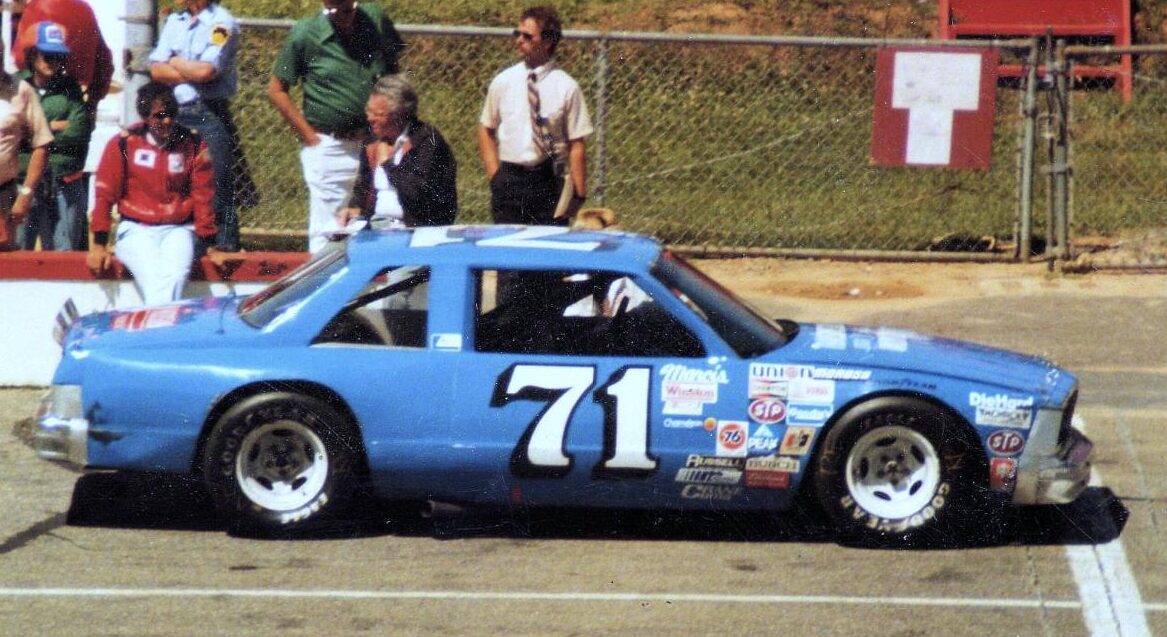
Dave Marcis' #71 Chevrolet at Pocono Raceway in 1983. Photo: Mike Traverse/Wikimedia Commons (CC BY-SA 2.0)
Two people are now facing a combined stack of felony charges after Buncombe County and Henderson County deputies tracked down the pair accused of ransacking retired NASCAR driver Dave Marcis’ home in Arden, North Carolina. That’s a lot of paperwork for what could have been written up as a routine house burglary, and the charge sheet itself hints at something more calculated than two opportunists smashing a window.
We covered the original break-in when it happened in late August, after deputies responded to Marcis’ home and classified the case as felony breaking and entering with high-value items confirmed stolen. Buncombe County Sheriff’s Office Captain Dustan Aldridge summed up the loss simply: “Many of the items taken from Mr. Marcis were personal and irreplaceable.”
The case moved quickly once investigators zeroed in on suspects. On Sept. 8, detectives arrested Hailey Bowlin, initially on a probation violation. A day later, she was booked into the Henderson County Detention Center on second-degree burglary, possession of a firearm by a felon, larceny of a firearm, larceny after breaking and entering, and five separate counts of obtaining property by false pretenses. Cameron Samotis, also charged with second-degree burglary on Sept. 8, was arrested the following day in Henderson County and is being held at the same facility.
That charge list is worth unpacking, because each entry does different legal work. Second-degree burglary is a Class G felony in North Carolina, carrying real prison exposure even for a first-time offender. Possession of a firearm by a convicted felon is its own separate Class G felony, stacked on top of whatever happened inside the house. Larceny of a firearm gets automatic felony treatment under state law no matter what the gun is worth, because North Carolina treats a stolen firearm as a public safety issue, not just a property crime. The five counts of obtaining property by false pretenses are the most telling addition, since that charge applies when someone uses deception to get money or goods, which usually means selling or pawning something under a false story rather than simply carrying it out the door.
Read together, the charges suggest investigators believe stolen property changed hands more than once before anyone got caught, which tracks with how these cases usually unravel. Engraved memorabilia and personal jewelry are hard to sell quietly, and stolen guns tend to surface through pawn shop paperwork, resale marketplaces, or an unrelated police stop, at which point a serial number check turns into a break in an entirely different case. That the arrests required a joint effort between Buncombe and Henderson County deputies suggests the trail crossed county lines before it dead-ended in handcuffs.
Stolen property has a habit of surfacing once documentation catches up with it. A stolen Toyota Highlander needed five years and two border crossings before paperwork exposed it, and a stolen classic Mercedes almost made it onto a cargo ship out of San Francisco before investigators caught the discrepancy. Guns and one-of-a-kind memorabilia move through smaller, sketchier channels than a titled vehicle, but the principle holds: sooner or later, someone asks a question the seller can’t answer.
Marcis isn’t just another name on a police report. He spent 35 seasons in NASCAR’s Cup Series, from 1968 through 2002, and broke Richard Petty’s record for consecutive Daytona 500 starts on Feb. 11, 1995, running his 28th straight 500 behind the wheel of the Olive Garden/Breathsavers Chevrolet. He went on to start 33 Daytona 500s overall, still the record, 32 of them consecutive. That kind of longevity, mostly self-funded and self-owned, is part of why this case drew attention well beyond a routine break-in blotter item.
It also explains why some of what was taken is effectively unsellable to anyone paying attention. The collector market for genuine NASCAR history has gotten pickier about provenance and paperwork, and a set of knives engraved to honor past Winston Cup champions, or a Rolex documented as a personal gift, doesn’t pass a background check the way a generic used watch does.
Both Bowlin and Samotis remain in the Henderson County Detention Center as their cases head toward court. Nothing in the sheriff’s office statement indicates how much, if any, of the stolen property has been recovered. For Marcis, and for anyone else sitting on a house full of career-spanning memorabilia, firearms, and jewelry, the case is a reminder that photographs, serial numbers, and a scheduled personal-property rider on a homeowner’s policy matter far more after a loss than during the years when nobody’s thinking about insurance limits.
The break-in made headlines because of whose house it was. The charge sheet is the part that deserves the attention now, because it reads less like a random burglary and more like two people who thought they had a plan for cashing out afterward.
Your Turn: Does news like this make you rethink how you secure your own garage? Share your thoughts in the comments.
About the Author