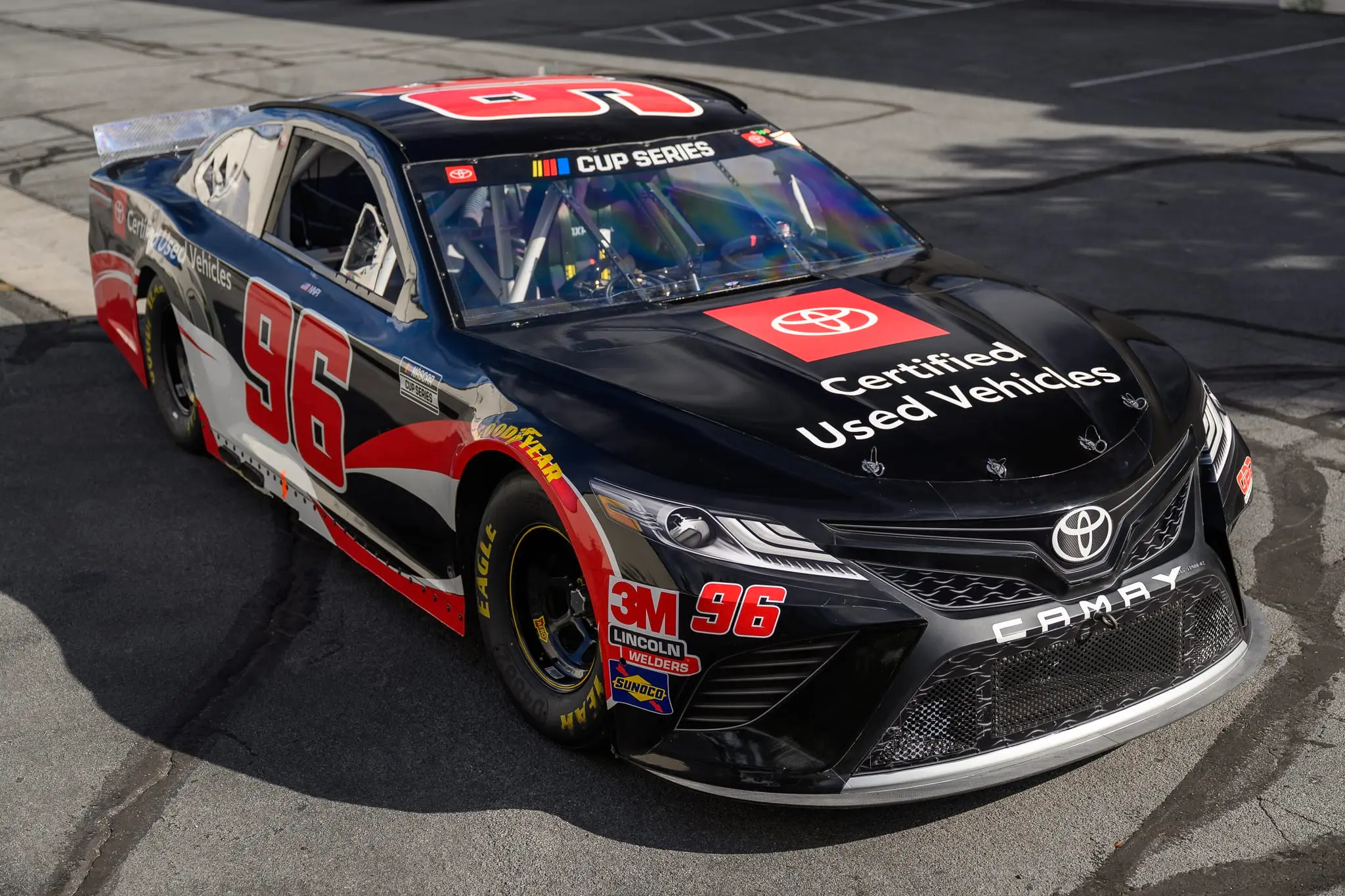
Photo: Bring a Trailer
A real NASCAR Cup car rarely reaches the private market in one piece. Most get cut up for scrap, raided for suspension parts, or repainted into somebody’s tribute build so many times that the chassis tag is the only thing left connecting it to an actual race. This one is different. Chassis MWR179415142, a sixth-generation Michael Waltrip Racing tub wrapped in Toyota Racing Development composite bodywork and fielded by Gaunt Brothers Racing, is sitting on Bring a Trailer out of Reno, Nevada, bid to $31,000 with six days left on the clock. It still wears the black, red and white No. 96 livery Daniel Suarez ran in 2020, and according to the seller, it hasn’t turned a wheel in real Cup competition since a roughly 500-mile stint at Texas Motor Speedway that same year.
A Team NASCAR’s Charter System Left Behind
Gaunt Brothers Racing existed for just long enough to become a footnote, and this car is a physical piece of that footnote. The team ran a part-time Cup schedule in 2018 and 2019, cobbling together 37 combined starts across a rotating cast of drivers, before signing Suarez to run the No. 96 full-time in 2020, his fourth full season in the series. GBR never landed one of NASCAR’s charters, the guaranteed-entry agreements that work like a franchise slot and a starting-spot insurance policy combined, so the team had to qualify on raw speed every single week. That caught up with it almost immediately: GBR missed the season-opening Daytona 500, one of the richest paydays in the sport, because it didn’t qualify for the field. Suarez finished 31st in points that year and led a total of 20 laps, and by September the team and driver had already announced they were splitting up. Gaunt Brothers ran a partial 2021 schedule and then quietly stopped fielding cars altogether.
Half the Horsepower, All of the Attitude
Under the composite skin sits the same basic recipe that still underpins today’s Cup garage: a 358-cubic-inch pushrod V8, built here around TRD/Triad Racing Technologies internals with a McLaren-supplied ECU running the fuel injection. The seller describes the engine as good for around 850 horsepower in its fuller trim and says Gaunt Brothers Racing dialed it back to 430 horsepower for this road-course setup. NASCAR has controlled Cup engine output for decades through tapered intake spacers and, since the series adopted electronic fuel injection in 2012, through ECU-managed restrictions, so a gap between a car’s on-track number and its private, post-retirement tune isn’t unusual. What matters for a buyer is that 430 horsepower in a 3,300-pound tube-frame car riding on slick tires and next to no weather protection is still a seriously quick track-day machine, just one that won’t try to kill a driver on corner entry the way the bigger number would.
What a Bill of Sale Actually Gets You
None of this car is road-legal, and none of it ever will be. It has no VIN and no title, and it’s changing hands the way every genuine tube-frame race car does: on a bill of sale. That’s standard for anything built as a competition car from scratch, since there was never a road-going identity to reconstruct in the first place, but it does shape what ownership looks like day to day. A buyer can’t register the car, plate it, or insure it through a normal auto policy; that takes a specialized track-day or competition-vehicle policy, and even those typically exclude on-track incidents unless purchased through the track or a sanctioning body for a specific event. Getting it anywhere means a trailer, every time. A handful of states will issue a non-road-use or off-highway title for a car like this, but that’s a paperwork convenience for registration-free ownership, not a route to license plates.
The seller says they’ve put about seven hours on the powertrain since buying the car near Charlotte, North Carolina, in 2023, which is modest use for three years of ownership and a decent sign it hasn’t been thrashed. Even so, anyone bidding should plan on spending well past the hammer price. A genuine Cup-spec 358 is a five-figure rebuild the moment something inside it lets go, a set of Goodyear racing slicks can wear out in an afternoon of hard driving, and the AP Racing brakes and Penske shocks are serviced on a race schedule, not a street one. None of that is a knock on the car. It is simply what it costs to keep something that was never built to be cheap actually running.
Genuine Cup iron doesn’t turn up on Bring a Trailer very often, which is part of why this listing already has six bids and nearly 2,900 views with days still left on the clock. Backfire has covered plenty of unusual finds on that same site this year, including a Land Rover pickup with a Hollywood pedigree and a Houston Batmobile that turned out to have a much more ordinary problem than its looks suggested, but a real, running, ex-Suarez Cup car is a different category of rare. It is a piece of a team that no longer exists, being sold by a private owner who has to explain the horsepower math himself in the comment section. Whoever wins this auction is not just buying a fast car. They are buying the closest thing left to physical proof that Gaunt Brothers Racing ever existed at all.
Lead image: Bring a Trailer
About the Author