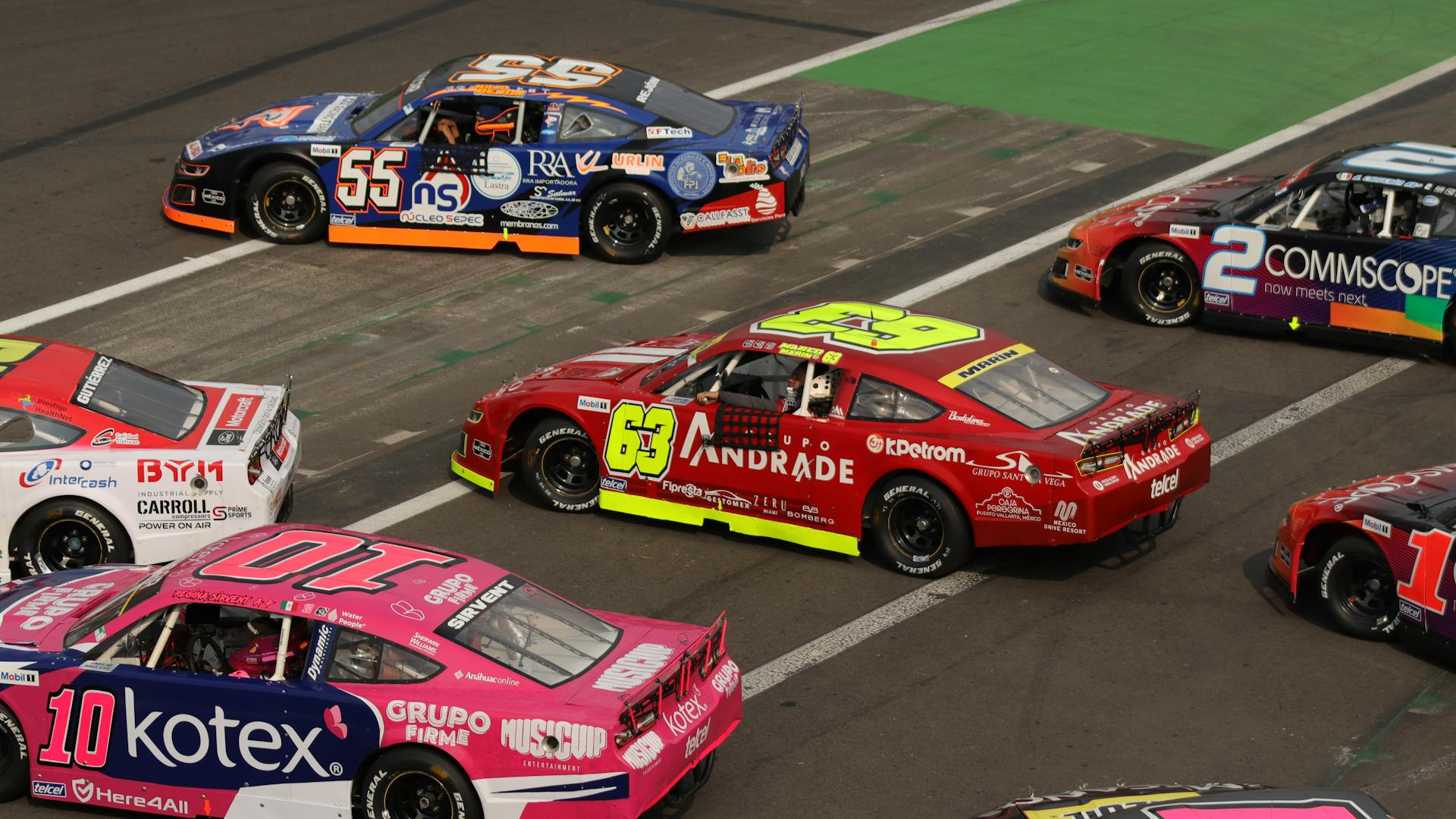
Photo by Diego Martinez on Pexels
Ryan Blaney made the 400th start of his Cup Series career on Sunday, and somebody in NASCAR’s scheduling department deserves a round of applause for the timing: the milestone landed at the one race that actually has “400” in its name. The symmetry ends there. A shove from John Hunter Nemechek sent Blaney’s No. 12 Ford into the wall at Indianapolis Motor Speedway with 40 laps left, and by the time the checkered flag fell, that single moment of contact had cost him a seven-figure check decided by exactly two finishing positions.
The Brickyard 400 wasn’t only Sunday’s points race. It also closed out the 2026 In-Season Challenge, NASCAR’s $1 million bracket tournament that runs alongside the regular schedule every summer. Thirty-two drivers get seeded by points position — this year’s snapshot came right after Pocono — then get paired off in head-to-head matchups over five races. Whoever finishes better in each pairing advances; whoever finishes worse goes home. The field gets cut from 32 to 16, then eight, four, and finally two, with the championship pairing settled at Indianapolis.
Blaney arrived at that final pairing as the heavy favorite. Seeded No. 3 overall, he blew through the bracket with room to spare, at one point leading 171 laps in a night win at EchoPark Speedway to eliminate William Byron, then knocking out Christopher Bell at North Wilkesboro to punch his ticket to the final. His opponent was a very different story.
Todd Gilliland entered the tournament seeded 25th and proceeded to make a mess of everyone’s bracket. The Front Row Motorsports driver upset Daniel Suárez in the opener, beat Carson Hocevar at Chicagoland, took down Alex Bowman at EchoPark, and knocked off a Cup Series champion in Chase Elliott to reach the final. NASCAR’s own broadcast team took to calling him the “Toddfather,” and by Sunday afternoon the nickname had earned its keep.
The finale unraveled for Blaney on a restart around Lap 120. Nemechek made contact that sent the No. 12 up into the outside wall, damaging both ends of the car in the process — a nose-and-tail hit that’s about as bad as it gets for a Next Gen Cup car. Blaney pitted for repairs and rejoined 30th on Lap 126, a hole in the field that no amount of clean air was going to erase. He fought back to 26th by the finish, but the damage was done, on the sheet metal and on the scoreboard.
That detail matters for how the day actually played out. The Next Gen car’s front clip and rear clip are both single-source, spec-built assemblies — teams keep a limited number of spare noses and tails on hand at the track, not full replacement corners for every conceivable angle of impact. Bending both ends in one incident means a longer trip down pit road while crews cut away crumpled bodywork, check for bent suspension geometry underneath, and hope the splitter and diffuser are still doing their jobs once the car rejoins. Losing four rows of track position in that kind of repair isn’t bad luck so much as it’s the built-in cost of how these cars are designed to be fixed mid-race.
Gilliland, racing conservatively behind him, needed only to stay two spots ahead to win it all. He did exactly that, crossing 24th to Blaney’s 26th. “My heart was pounding those last 25 laps,” Gilliland said afterward. “It seemed like one slipup and I was going to be right in front of him or right behind him coming down to the very end.” He was candid, too, about catching a break when Blaney’s car got loose: “You never cheer against someone. After it’s over with, you’re like, all right, that definitely helped us out.”
The math matters more for one of these two organizations than the other. Front Row Motorsports just spent the last two years in court establishing that its charter is worth serious money, a fight that ended with the team’s ownership stake valued near nine figures. A $1 million bonus check lands very differently at a shop built on that kind of underdog math than it does at Team Penske, which has spent decades winning championships and doesn’t need a bracket gimmick to prove it belongs.
For Blaney, the loss wasn’t just a missed bonus. He came into Indianapolis third in the championship standings, already locked into a playoff spot, with wins already banked this season at Phoenix and EchoPark. The wreck also dropped him 33 points behind Denny Hamlin in the race for the regular-season points lead, a real, non-bracket consequence that will matter more in September than a knockout tournament ever will. Nemechek, for his part, apologized over the radio after the contact, and his own day wasn’t much better; he finished two laps down in 32nd.
The 400-start milestone still counted for something, even with how Sunday ended. Blaney made his Cup debut at Kansas Speedway in May 2014, in the same No. 12 Ford, for the same Roger Penske-owned operation. Since then he’s collected 19 wins, 14 poles, more than 100 top-five finishes, and a 2023 championship. “It does fly by. I had no idea it was 400 this weekend,” Blaney said earlier in race week, adding that he’s closing in on a more personal number: the 473 career starts made by his father, Dave Blaney, over 17 seasons.
None of this changed the actual race winner. Corey Heim held off the field to win the Brickyard 400 outright, his second Cup Series victory of 2026 and a milestone of its own, a crown jewel win in just his 15th career Cup start. It capped a busy weekend across NASCAR’s three national series and beyond, one we broke down in full in our weekend racing recap.
That’s the appeal and the cruelty of a bracket built on top of a 400-mile race: it turns an entire season of grinding into blunt arithmetic. Two spots, one restart, one bump from a driver who wasn’t even in the tournament, and $1 million changes hands. Gilliland’s shop gets to plan its offseason a little differently because of it. Blaney gets a nice round number on his career stat sheet and a long flight home to think about what a cleaner restart might have been worth.
About the Author