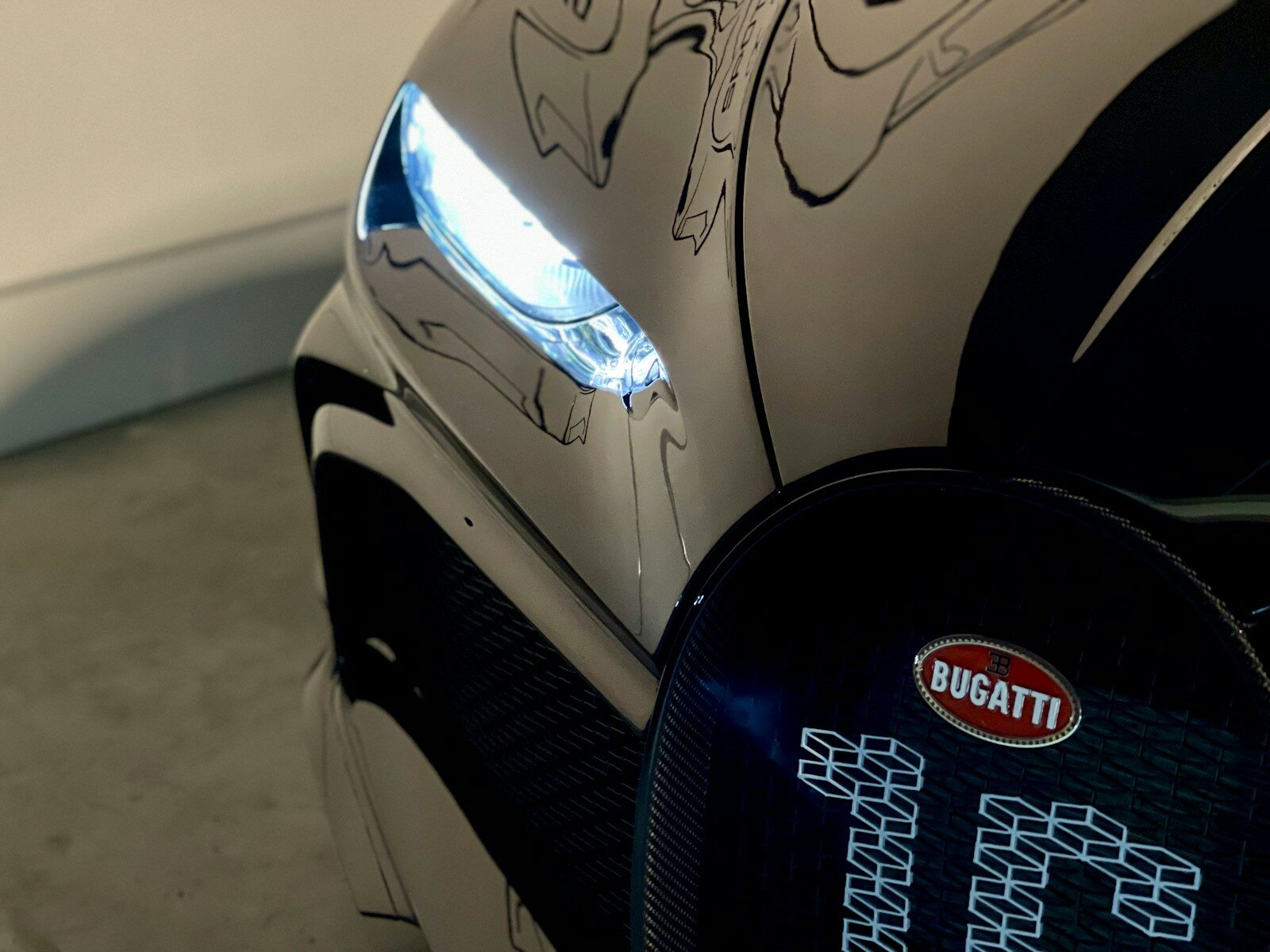
Photo: Agent J / Unsplash
Bugatti’s test drivers usually get away with dents nobody sees, because prototypes wear vinyl camouflage specifically to keep spy photographers guessing at what’s underneath. This time the wrap didn’t help. A disguised Tourbillon prototype was stopped at a red light tied to roadworks on a two-lane mountain road in Spain’s Sierra Nevada range in early September when the Volkswagen Polo behind it didn’t stop in time and drove straight into the back of it.
The clip, first captured by a Granada-based car-spotting account and reposted across X and Instagram, pulled in more than 10 million views within about a day. Nobody appears to have been hurt, and neither Bugatti nor Volkswagen has issued a public statement, which tracks with how these things usually surface: a bystander’s phone catches more than any factory communications team is ready to confirm. The footage itself shows both cars stopped nose to tail on a stretch of asphalt lined with guardrail and bare mountainside, exactly the kind of rugged, high-altitude terrain automakers seek out when they want to punish a chassis before it reaches a customer’s garage.
€3.8 million before options and taxes, limited to 250 units, and already sold out through the end of the decade. Under that camouflage wrap sits a naturally aspirated 8.3-liter V16 co-developed with Cosworth, making 1,000 horsepower on its own and backed by three electric motors that push the combined output to 1,800 horsepower. Bugatti’s own figures put 0-100 km/h at 2.0 seconds and top speed at 380 km/h (236 mph) electronically limited, or 445 km/h if the owner has the Speed Key. The Polo that hit it is one of Volkswagen’s cheapest models in Europe, listing from roughly €25,000 in markets like Ireland, a small fraction of the car it just rear-ended.
That mismatch matters for more than bragging rights. The Tourbillon’s structure is a carbon-composite monocoque that integrates the battery casing and front air ducts as load-bearing parts of the chassis, not a body shell bolted over a separate frame. A rear-end hit on a car engineered that way isn’t a bumper-and-taillight job for the nearest body shop; it’s a candidate for a trip back to Bugatti’s atelier in Molsheim, France, where the technicians who hand-assemble these cars in the first place are also the ones qualified to inspect and repair the composite structure. Pulling a prototype off the validation schedule for a structural repair isn’t a paperwork inconvenience, either. It can push back durability testing tied to the very cars customers are waiting years to receive.
The joke racing around social media about a phone call to insurance undersells how this actually gets handled. Automakers don’t run disguised prototypes on personal auto policies; test fleets are typically covered under corporate fleet or garage liability insurance that treats them as commercial assets, valued internally rather than by a claims adjuster working from a used-car guide. On the liability side, the physics and the traffic law point the same direction they usually do: a driver who rear-ends the vehicle ahead is presumed not to have left a safe following distance, camouflage or no camouflage. That presumption is a big reason insurers representing owners of exotic and prototype machinery tend to settle these arguments quickly, even when the numbers on either side of the collision look absurd next to each other.
This is far from the first time an ordinary driver has put a dent in extraordinary machinery. A Ferrari 812 Competizione A ended up wrecked in Malibu after rear-ending a Mercedes convertible earlier this year, and the fallout followed the same script: presumed fault on the trailing car, a repair bill that dwarfs most household budgets, and a debate online about who actually pays for it. Bugatti ownership has generated its own strange headlines lately too, from a Chiron that sat rotting in storage for 25 years after a corporate collapse to celebrity garages that stack a Bugatti next to a Ferrari and a McLaren like they’re Hot Wheels. A camouflaged development car getting bumped by a hatchback in the mountains barely registers by comparison, but it’s a useful reminder that even hand-built, seven-figure engineering exercises still answer to the same red lights and following-distance math as everything else on the road.
For the 250 people who put down deposits on a Tourbillon, none of this changes much. Bugatti runs a separate validation fleet that never touches a customer VIN, the same way Koenigsegg, Pagani, and every other low-volume manufacturer keeps disguised mules in rotation long after a car reaches showrooms, evident every time a convoy of hypercars gets pulled over on the way to a concours weekend. It’s a better prompt for anyone shopping the used or gray-market exotic space to ask a seller directly whether a given chassis ever served as a press or engineering mule, since that history doesn’t always show up on a standard vehicle report the way a salvage title would. Test cars get driven harder, repaired more often, and, as this video shows, parked in traffic like anything else.
Lead image: Agent J on Unsplash
About the Author