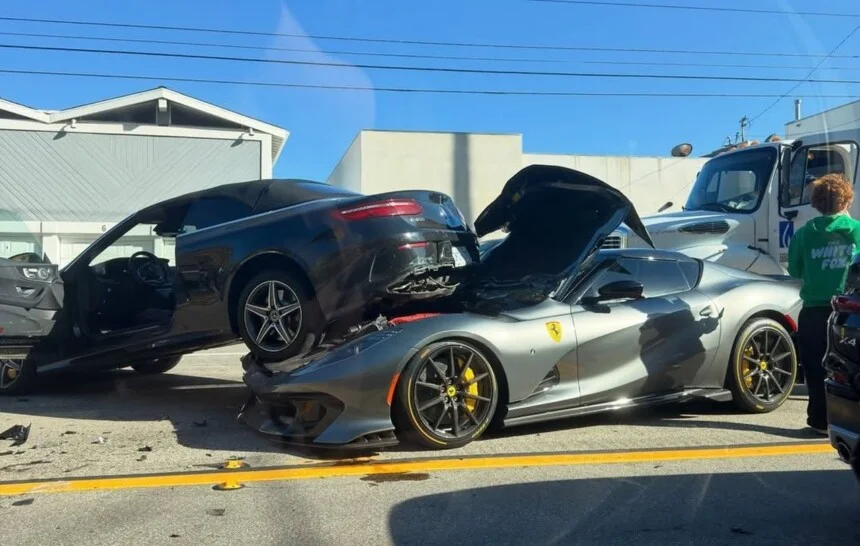
A crash involving one of Ferrari’s rarest modern supercars is turning heads across the automotive world after a Ferrari 812 Competizione Aperta reportedly rear-ended a Mercedes-Benz C400 Cabriolet in Malibu, California.
Not Just Another Expensive Fender-Bender
This wasn’t just another exotic fender-bender on the Pacific Coast Highway. The Ferrari involved is a car most people will never see in person, let alone watch get destroyed in traffic. With only 599 examples built for the entire world, the 812 Competizione A sits near the top of Ferrari’s modern collector hierarchy, and now one of them has serious crash damage after what appears to have been a rear-end collision near Santa Monica. That detail matters because cars at this level don’t simply bounce back from accidents — even when repaired perfectly, the market almost always punishes them hard.
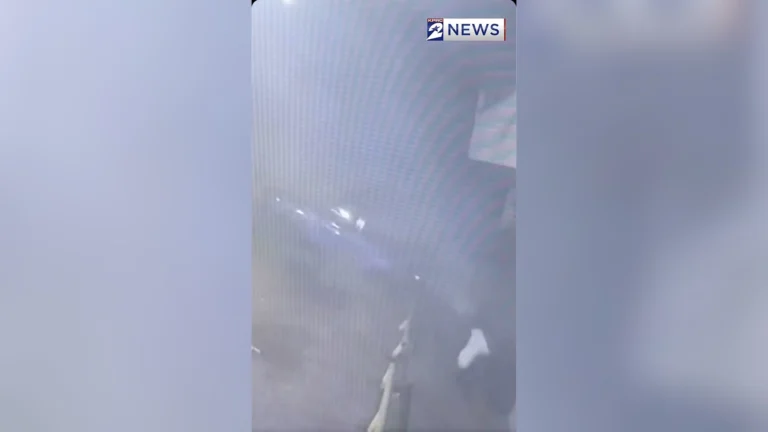
Video circulating on social media shows the roofless Ferrari cruising through the Malibu area before the footage cuts to the aftermath of the crash, and the scene looks brutal, with the Mercedes’ rear axle appearing to sit directly on top of the Ferrari’s V12 engine bay. For a car already worth around $2.5 million in today’s market, the financial hit could be staggering before repairs even begin.
A Ferrari Built for the Elite Just Took a Massive Hit
The Ferrari 812 Competizione Aperta isn’t a normal production Ferrari. It’s essentially the final celebration of Ferrari’s naturally aspirated front-engine V12 era pushed to an extreme level. Ferrari took the already powerful 812 Superfast and transformed it into a more aggressive, track-focused machine, packing a 6.5-liter naturally aspirated V12 producing 830 horsepower and 510 lb-ft of torque, with the engine revving all the way to 9,500 rpm, a figure that sounds almost unreal in today’s turbocharged automotive landscape. That engine is the centerpiece of the entire car — enthusiasts love it because it represents something the industry is slowly abandoning: massive displacement, sky-high revs, and no artificial turbocharging tricks to manufacture excitement. Ferrari knew exactly what it had when it launched the Competizione A, which is why production was limited to just 599 units worldwide, with buyers carefully selected and most examples disappearing immediately into high-end collections.
Malibu Traffic and Million-Dollar Consequences
The Pacific Coast Highway has become almost a rolling car show for Southern California exotics, but it also creates an unusual danger zone. Hypercars and collector Ferraris regularly share crowded roads with normal commuter traffic, tourists, and stop-and-go congestion, and that combination can go sideways fast. From the footage and reported details, the Ferrari rear-ended the Mercedes-Benz C400 Cabriolet while traveling toward Santa Monica. No additional details about injuries or the exact cause of the collision have been released, but visually, the damage appears severe.
This is where the financial reality of exotic ownership hits hard. Even if Ferrari specialists manage to fully repair the car, accident history can permanently damage the value of ultra-rare collector vehicles. Today, low-mileage examples trade around the $2.5 million mark, making this crash especially painful for collectors watching the footage online.
Why Enthusiasts Care About Crashes Like This
People outside the car world often dismiss exotic crashes as rich-people problems, but enthusiasts see something else entirely. Automakers across the industry continue moving toward electrification, downsized turbocharged engines, and hybrid systems, and Ferrari itself has already shifted much of its lineup in that direction. Cars like the 812 Competizione A increasingly represent the end of an era many enthusiasts believe may never fully return, which is part of why values exploded so quickly. The combination of rarity, massive horsepower, a screaming naturally aspirated V12, and limited production turned the Competizione A into an instant collector target — these cars are no longer viewed as just transportation or weekend toys, but as rolling investment pieces tied directly to the shrinking availability of old-school supercar engineering.
The loss of one rare Ferrari might not affect the average commuter, but it hits a nerve among drivers who care about analog performance, naturally aspirated engines, and emotional sports cars built for sensation rather than efficiency targets. Now one of Ferrari’s most extreme V12 machines sits damaged after what should have been a routine drive down one of America’s most famous roads. The repair bill will likely be enormous, and the lost collector value could be even worse. For enthusiasts watching another ultra-rare naturally aspirated Ferrari get smashed in traffic, it feels like watching a shrinking piece of automotive history disappear in real time.
About the Author