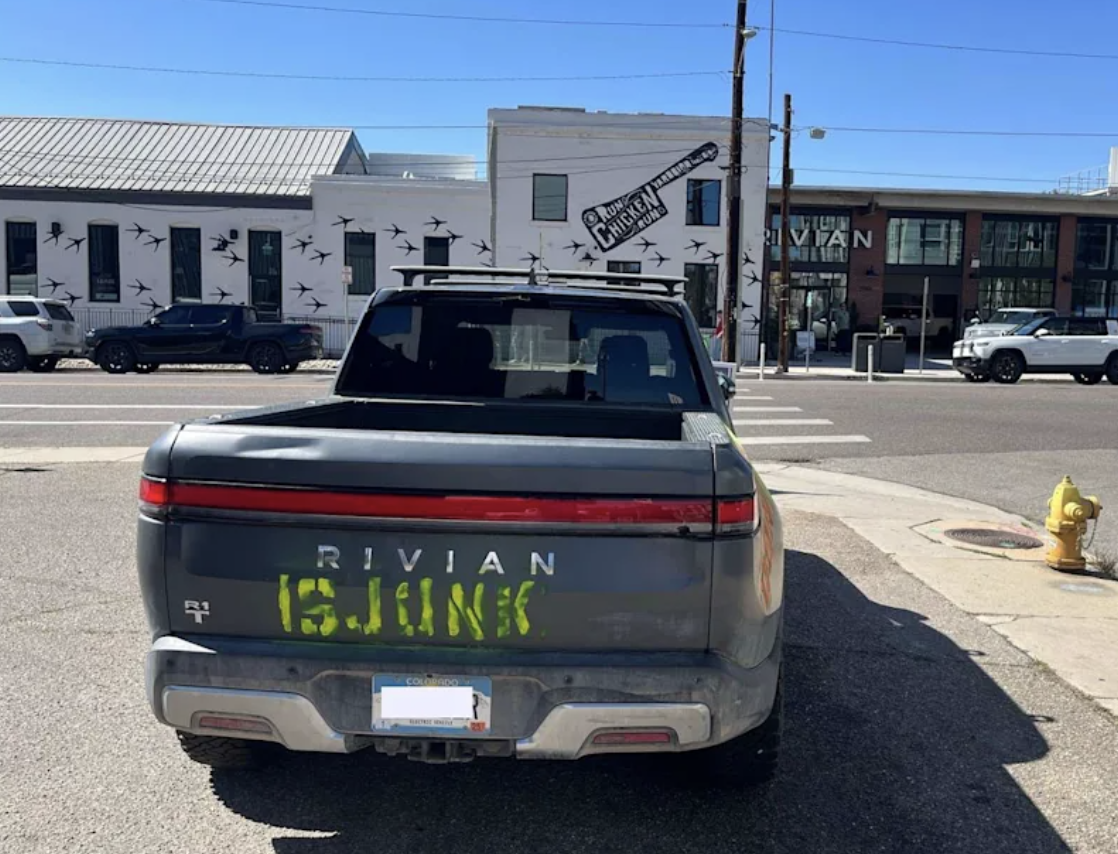
There is a long tradition of angry owners turning their cars into billboards. The “lemon” parade floats of the 1980s, the dealership-adjacent tow trucks, the guy who drags a busted engine behind his pickup. The Denver version of this ritual is a Rivian R1T with slogans painted across its panels, parked within eyeshot of Rivian’s own retail space, backed by a website the owner registered for the occasion.
The owner, who posts as Jake Burns and philociraptor, laid out the whole saga on his own site. By his account, he was an early believer who reserved a Quad-Motor R1T, received a truck that didn’t match what he’d configured, and then spent years chasing phantom braking, corroded tow hooks, drivetrain noises, rattles and software gremlins. He says a steering complaint was never resolved, that the truck has sat parked since July 2025, and that the tipping point was a roughly $1,000 bill to replace a 12-volt battery that died after the vehicle sat unplugged for about 15 days.
Related Articles
- Monza’s Heat Hazard Call Boils Down to One Number: 5 Kilograms
- The Supercharged Defender 110 Nobody Talks About Is The One Worth Buying
Rivian’s answer, issued as a company statement, is that it tried to buy the truck back under Colorado law, that it can’t discuss specifics, and that what Burns is asking for “goes far beyond the value of the vehicle.” Burns also says Rivian’s lawyers contacted his attorney about a possible disparagement claim. Autoblog
So who’s right? Set the paint aside. The interesting part is what the underlying documents actually say, because most of this fight was decided in writing long before anybody bought spray paint.
The 12-volt clause is not a loophole. It’s printed in the book.
Rivian’s warranty guide does cover the original 12-volt battery for three years or 36,000 miles, whichever comes first, and promises free replacement of defective units in that window. But two sentences later it carves out exactly the scenario at issue: the guide warns that 12-volt batteries can be drained or damaged if the vehicle is left unplugged for an extended period, and says batteries “damaged or drained due to such improper maintenance” aren’t covered.
That clause exists for real engineering reasons, and it’s worth understanding whether you own a Rivian or a Mustang Mach-E. In an EV, the 12-volt battery isn’t there to crank an engine. It’s there to wake the car up — to close the contactors, power the body control modules, run the door handles, keep the telematics radio alive so the app can phone home. The traction pack tops it off through a DC-DC converter, but that converter only runs when the vehicle is awake. Park an EV for two weeks with no charger attached, and the always-on modules keep sipping from a small lead-acid or AGM battery with nothing replenishing it.
Lead-acid chemistry punishes that. Take a flooded or AGM battery deep into discharge and lead sulfate crystallizes on the plates in a form that normal charging won’t fully reverse. One hard drain can permanently strip capacity. That’s not a Rivian defect; it’s why every EV manual on the market tells you to leave the thing plugged in. The practical takeaway for owners: if your EV is going to sit longer than a week, plug it in, or put a tender on the 12-volt if the vehicle allows access. It is a $40 problem or a four-figure one, and you pick which.
Where Burns has a fair argument is the diagnostic question. A battery that fails at two years old could be defective, or it could be drained. Rivian’s service records and battery state-of-health logs would show which. A dispute over that data is a legitimate dispute. But “the warranty says three years” is not, by itself, a winning position when the same page carves out the exact failure mode.
Colorado’s lemon law changed, and which version applies depends on delivery date
Colorado overhauled its lemon law with SB24-192, effective August 7, 2024. Per the attorney general’s public advisory, the old statute presumed a “reasonable number” of repair attempts after four failed tries at the same defect or 30 business days out of service, and protected vehicles for one year after purchase. The new law drops that to three attempts, or two for a safety-related defect, or 24 business days out of service, and stretches coverage to two years or 24,000 miles. The statute of limitations went from roughly one year to 30 months from delivery.
An early Quad-Motor R1T was delivered years before that rewrite, which means the tougher old standard is the relevant one. That matters enormously. A defect that surfaces in year two is outside a one-year presumption window entirely, and an owner in that position is arguing under the manufacturer’s express warranty or the federal Magnuson-Moss Act rather than a clean statutory buyback.
Two more details cut against the popular framing here. First, under §42-10-103 the manufacturer, not the consumer, picks between refund and comparable replacement. If Rivian says it offered a repurchase, that is Rivian exercising the remedy the statute hands it. A customer holding out for a different or more expensive vehicle isn’t refusing an insult; he’s refusing the statutory option. Second, SB24-192 added something buyers should file away: a repurchased vehicle now has to carry a “Lemon Law Buyback” decal, and the title must reflect that status. If this truck ever goes back to Rivian, the paint is the least of its problems on a window sticker.
The disparagement threat is the weakest card in the deck
Reaching out to an unhappy customer’s attorney about disparagement is a choice. Truthful statements of experience and clearly labeled opinion are extremely hard to attack, and a federal statute — the Consumer Review Fairness Act, 15 U.S.C. § 45b — voids form-contract clauses that restrict or penalize consumer reviews, and hands the FTC enforcement authority. Any automaker’s purchase agreement is a form contract. The realistic exposure for Burns is narrow: specific factual assertions he can’t document. Everything framed as “here is what happened to me” and “here is my opinion of it” sits on solid ground.
The backdrop Rivian couldn’t script worse
NHTSA’s Office of Defects Investigation opened preliminary evaluation PE26004 on May 26, 2026. Per the opening resume, it covers 114,922 R1S and R1T vehicles from the 2022–2025 model years, prompted by two owner complaints describing the left rear toe link separating while driving and sending the vehicle across multiple lanes. One ended in a collision with another vehicle and a roadside barrier. In both cases the bolt holding the toe link together fractured. Investigators pulled repair histories, onboard video, component photos and a police accident report. Rivian had already flagged that joint’s sensitivity to service procedure in March 2025, then extended the improved procedure through recall 26V-003 in January 2026 to vehicles serviced before that date.
Related Articles
- The DEF Derate Rollback Explained, Including Why It Won’t Help Your Current Diesel
- Why Four Wedding Supercars Were Seized On Sight Under Britain’s New Police Powers
The recall notice covers 2022–2025 R1 vehicles. The wrinkle regulators are chasing: one of the two complaint vehicles had prior toe link service and the other hadn’t — it had been in a collision. Both then ran thousands of miles over months before failing. If a toe link can let go without a botched reassembly upstream, the problem is bigger than a service bulletin.
A preliminary evaluation is the first rung, not a verdict. It can be upgraded to an engineering analysis or closed with no action. But owners of 2022–2025 R1T and R1S trucks should run their VIN at NHTSA’s recall lookup today, and if 26V-003 shows up, book the free bolt replacement.
What this costs the guy who did it
The paint is uninsurable. Comprehensive coverage pays for vandalism committed by other people; every standard auto policy excludes intentional damage caused by the insured. Whatever it costs to strip and refinish those panels comes out of Burns’s pocket, and a documented respray of the hood, doors, fenders and bed sides is a permanent black mark on a vehicle history report even when the work is perfect.
That’s the part worth sitting with. Painting your own truck is a spectacularly bad financial decision, which is exactly why it works as a message. Nobody torches five figures of resale value to win an argument about a battery. They do it when they’ve concluded the normal channels are closed.
Rivian’s position may well be correct on the specific facts. It also spent the week before its most important product launch in years watching a customer prove, in a very expensive way, that he no longer believed the process worked.
Images Via: https://rivianisjunk.com/
About the Author