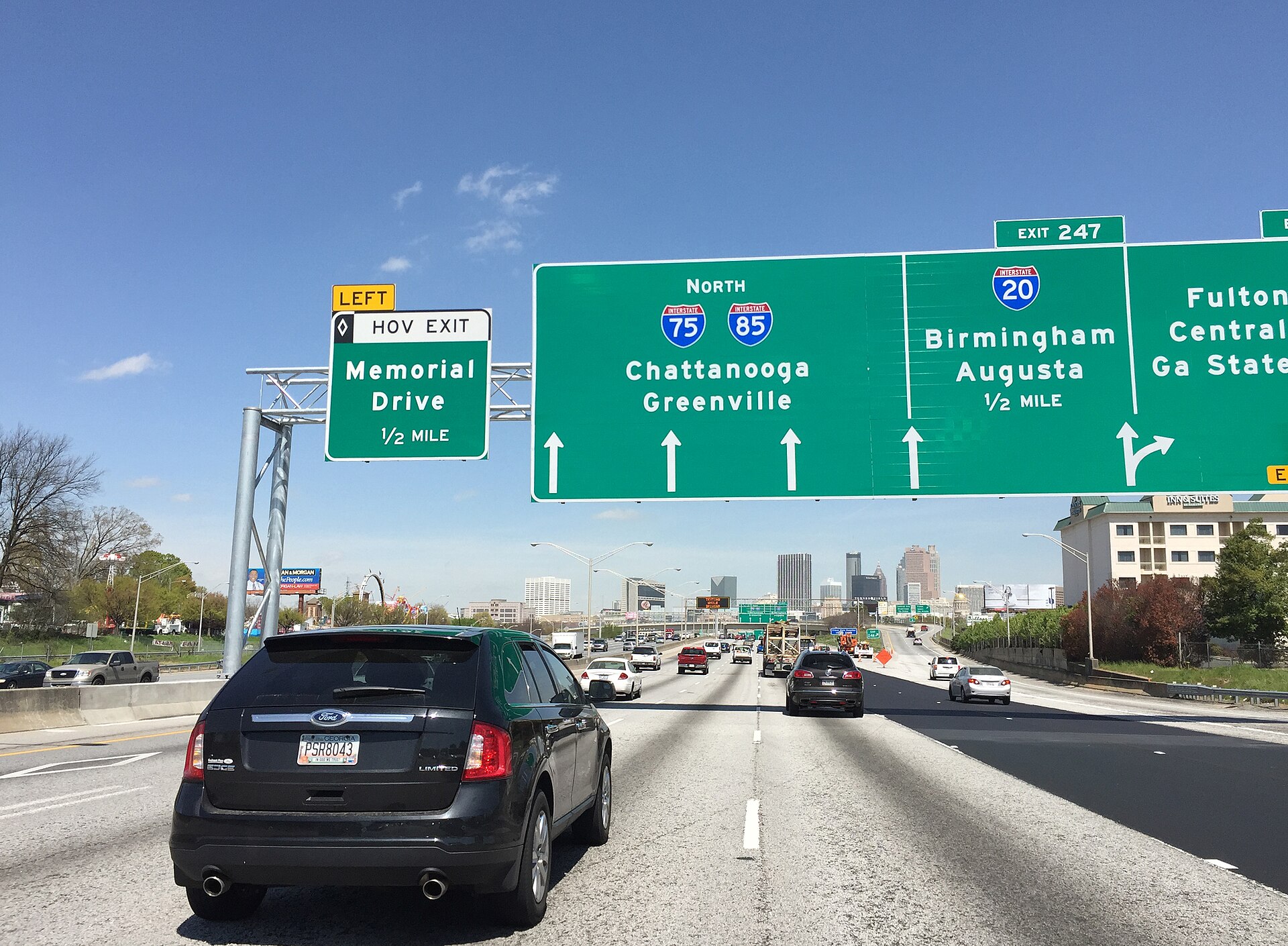
The Downtown Connector (I-75/I-85) near Exit 246 in Atlanta, close to the I-20 interchange. Representative image, not the crash scene. Photo: Famartin via Wikimedia Commons, CC BY-SA 4.0
A single-vehicle crash on Interstate 20 near Windsor Street left a car balanced on structural beams above the Interstate 85 ramp on September 8, and the resulting video, showing a pair of legs hanging out over the edge, gave Atlanta something to talk about that had nothing to do with football.
Two people leaving a club in the area told FOX 5 Atlanta they noticed debris scattered across the road and a crowd gathering near the overpass. When they stopped to look, they found a car perched in a spot no engineer ever designed a vehicle to occupy — hanging over the edge of the structure with the driver’s legs dangling into the tunnel below.
Atlanta Fire Rescue arrived to find the car in what the department described as a “precarious position,” resting on concrete beams directly above the interstate ramp. Crews stabilized the vehicle before the driver climbed out without assistance — no cutting, no jaws of life, no dramatic extraction. Grady EMS evaluated the driver at the scene and transported them to a hospital; officials confirmed the injuries were not critical.
How Does a Car End Up on a Beam Instead of the Pavement?
Overpasses like the I-20/I-85 interchange aren’t solid slabs of concrete. They’re built from box girders and beams that support the roadway deck, with ledges and gaps between those structural supports and the barrier walls that keep normal traffic on the road. A vehicle that breaches a barrier at the right angle and speed doesn’t necessarily plunge straight down; depending on trajectory, it can catch on those support beams and come to rest wedged between the roadway above and the open air below. It’s the same basic reason cars that go off elevated highway sections sometimes hang up on sign structures or barrier extensions instead of falling the full distance — the space underneath an overpass is far busier than it looks from a passing lane.
That’s also why Atlanta Fire Rescue’s first move wasn’t extraction, it was stabilization. Crews typically crib or shore up a vehicle in a situation like this — wedging blocks, struts, or airbags underneath and around it — before anyone touches the doors. A car that looks balanced is still one shift in weight away from rolling off whatever is holding it up, and rescue teams would rather spend extra minutes securing it than risk it moving while someone climbs out. The driver being able to self-extricate here is actually the best-case outcome of that process: it means the car was stable enough, and the driver alert enough, that a technical rescue wasn’t necessary.
What Isn’t Known Yet — And Why It Matters
Atlanta Police haven’t released what caused the crash, and they haven’t identified the driver. That’s normal for an active investigation, but it’s also the piece that determines what happens legally and financially: whether citations get issued, whether the case ends up in court, and how the driver’s insurance company treats the claim. Single-vehicle crashes are generally treated as the driver’s fault by insurers absent some outside cause like a road defect, and depending on what investigators find, this one could range from a routine comprehensive claim to something closer to the felony exposure Backfire covered in Atlanta’s Big Kenzo road rage case, where charges and insurance consequences escalated quickly once the police report came back.
Official crash reports in cases like this can take weeks to finalize, and they tend to tell a far less dramatic story than the viral clip. The Missouri State Highway Patrol’s report on the crash that cost ESPN’s Matt Miller his arm took time to surface and reshaped public understanding of what actually happened on that highway. Expect a similar gap here between the video everyone’s already seen and whatever the official paperwork eventually says.
The Takeaway for Anyone Who Drives That Stretch
None of this required a rollover or a fireball to become one of the stranger crash scenes Atlanta’s had this year — it just took a car leaving the roadway at the right spot on an interchange full of structural ledges most drivers never think about. The barrier walls on elevated highway sections aren’t just there to look tidy; they’re the only thing standing between a routine lane departure and becoming the next viral clip. And if you’re ever the one climbing out of a wrecked car in a strange position, staying still until crews confirm it’s safe is exactly what likely spared this driver a far worse outcome. It’s the same lesson, in a different form, as the one learned by the owner of that 1966 Corvette whose brakes gave out mid-showoff: surviving the wreck is only step one. What happens with the report, the charges, and the insurance company is the part that actually decides how expensive the story gets.
Lead image: Famartin via Wikimedia Commons, CC BY-SA 4.0
About the Author