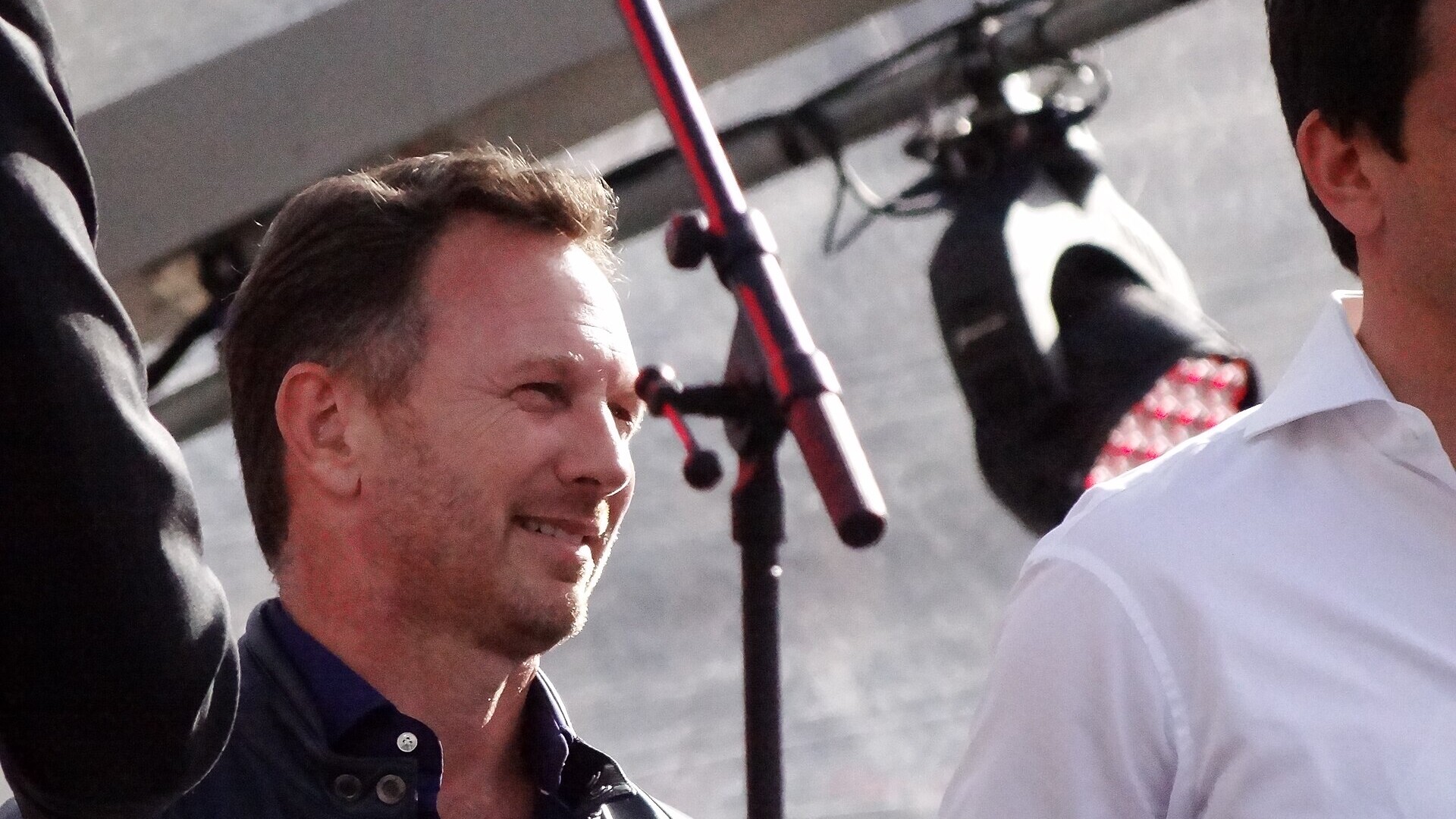
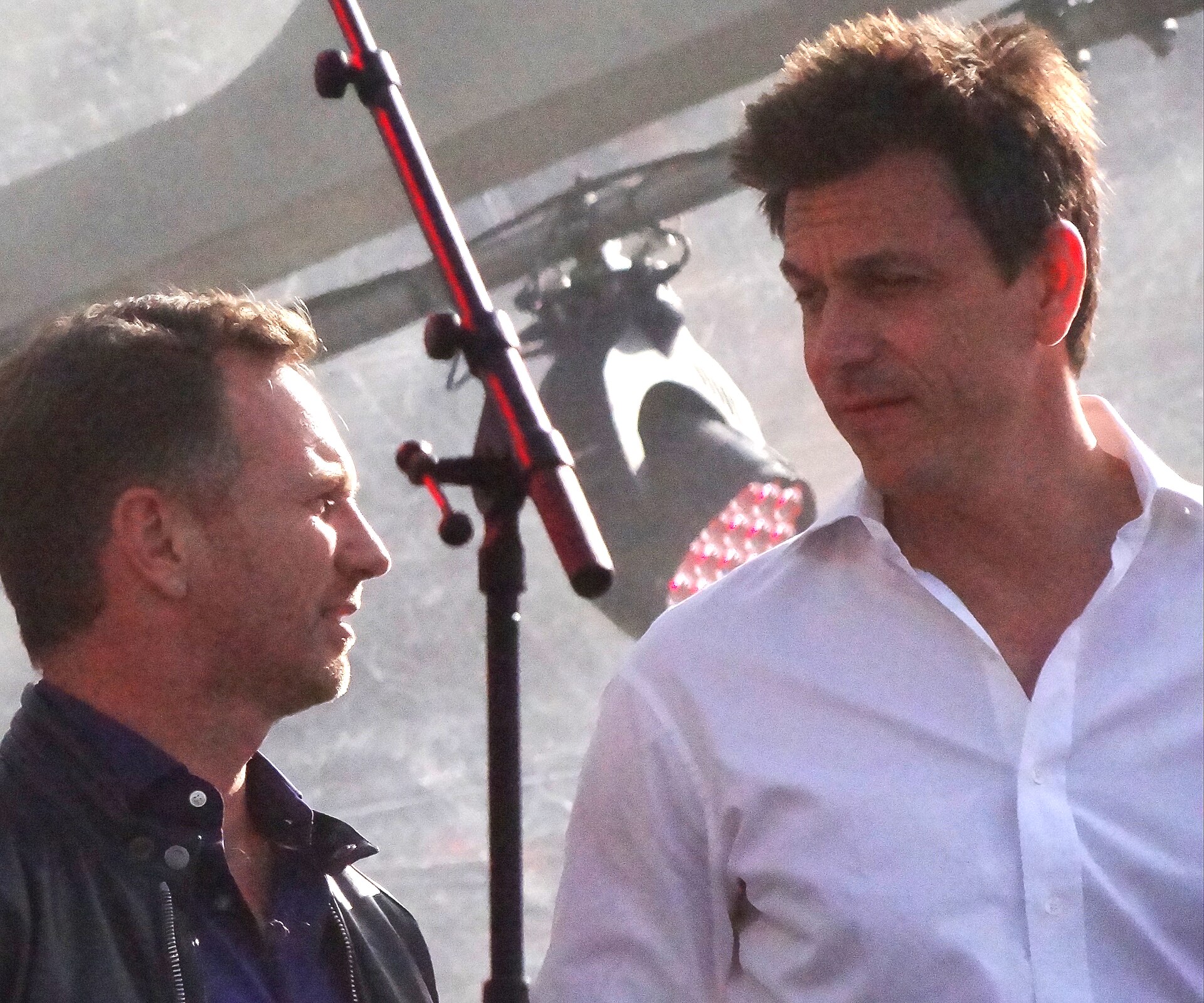
Christian Horner at F1 Live in London, July 2017. Photo: Ben Sutherland, CC BY 2.0, via Wikimedia Commons
Fourteen months after Red Bull removed him, Christian Horner told The Times that Ferrari is “the dream” and the only Formula 1 team he would run without owning a piece of it. Inside a week, the man who holds that job, Fred Vasseur, was answering for it after the race in Baku, Azerbaijan; Ferrari had called an unscheduled media briefing to say the company “has made its choices already”; and Ralf Schumacher, on Sky Deutschland’s Formula 1 podcast, was describing Horner’s pitch as “peinlich,” which is German for embarrassing.
Horner, 52, ran Red Bull Racing from its first season in 2005 until July 9, 2025, when Red Bull announced it had “released Christian Horner from his operational duties” and made Laurent Mekies chief executive. He spoke to The Times ahead of his memoir, Drive, which Bantam publishes on October 22, and the passages Sky Sports reproduced from the interview read like a job application addressed over Vasseur’s head. “I’ve been a hired hand. I did 21 years sitting on the pit wall. I don’t need to go back to that,” he said. “At this stage in my life, there’s only one team for which I would accept non-participation in ownership.” He went on: “Would I consider Ferrari? I mean, Ferrari is the biggest brand in Formula 1. It’s the dream. And arguably it’s the sleeping giant of Formula 1.”
He was less fond of the rest of the grid. Toto Wolff “needs to have his hair f****** ruffled up,” he said, and is “having it easy while I’m not there.” Asked whether he could be back on the grid next year, he answered: “I don’t know. I’m the cure and the problem.”
Vasseur answered in Baku, and Ferrari answered for him on Tuesday
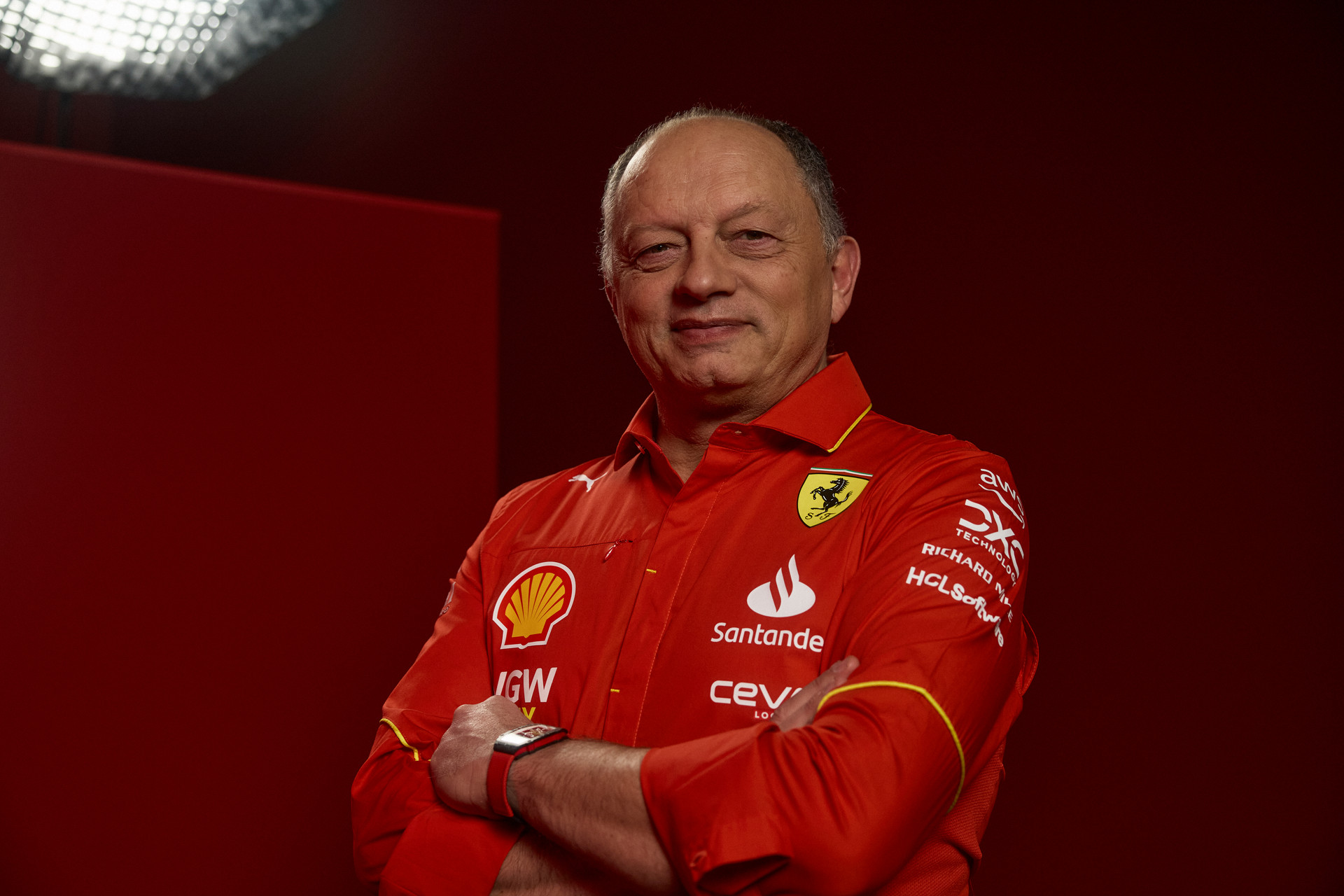
Vasseur’s contract is not the kind that lapses on its own. Ferrari N.V. announced a “multiple-year” extension on July 31, 2025, and chief executive Benedetto Vigna described it as “a trust rooted in shared ambition, mutual expectations and clear responsibility.” Backfire News covered that renewal at the time. This past Saturday evening in Azerbaijan, Vasseur was asked once more why the Horner talk would not die.
“We are not working in the perfect serenity,” he said, in remarks published by Formula 1. “For me, first, but for everybody in the team, for the media, for 50% of the questions [to be] about this, it’s a bit of a frustrating situation.” Then: “But it is what it is, it’s not in my hands. Mr Horner is looking for a job – that everybody knows – everywhere. But what can I do? Just try to do my best to push the team, to rise them to be motivated, focus on what is better today.”
Ferrari’s standing policy on rumors is to ignore them. On Tuesday morning it did the opposite. Chief communication officer Maria Conti gathered selected media for a briefing ahead of this weekend’s race and read the company’s position into the record: “Ferrari’s position is clear, [it] has not changed. Ferrari has made its choices already. We have full confidence in Fred Vasseur and in his team and we continue to do so.” She said the statement carried the backing of chairman John Elkann and Vigna, that it answered more than the Times interview alone, and that Ferrari could “see the storm of communication [on social media] was increasing when normally it is going down.” The company wanted, she said, “to avoid that the next weekend in Malaysia will be focused only on this kind of gossip and speculation.”
Schumacher’s verdict, and the word he chose
Ralf Schumacher, the six-time Grand Prix winner who now works as Sky Deutschland’s Formula 1 analyst, took the interview apart on the network’s Backstage Boxengasse podcast. “Sich so anzubiedern, das schon peinlich genug,” he said: to ingratiate yourself like that is embarrassing enough. His sharper point was about how hiring at this level gets done. “Wenn er tatsächlich Interesse hätte oder auch von Ferrari Interesse bestünde, dann würde man das so nicht machen,” he said. If Horner were serious, or Ferrari were, nobody would go about it this way. He called the episode “ein Armutszeugnis,” a phrase that translates literally as a certificate of poverty and is used in German for an act that mostly exposes the person committing it. “Lustig ist es trotzdem, aber auch schade,” he added. “Er war so ein erfolgreicher Mann und jetzt erzählt er nur noch solche Storys.” Funny, but a shame: he was such a successful man, and now all he does is tell stories like this.
Schumacher is right about the mechanics, and Ferrari’s own hiring record shows it. Vasseur got the job in December 2022 without asking for it in print. Mattia Binotto announced his resignation on November 29, 2022, effective December 31, and Ferrari confirmed Vasseur on December 13. There was no campaign, only a decision between Elkann, Vigna and the candidate, announced when it was done.
Schumacher even offered Ferrari a name in case it ever needs one: Andreas Seidl, who ran McLaren’s team and then Audi’s Sauber project until Audi replaced him with Binotto in July 2024. Seidl, he said, has the character to tell Lewis Hamilton and Charles Leclerc how things are going to be, “wenn Fred Vasseur überhaupt zur Diskussion steht” – if Vasseur is even up for discussion. Ferrari says he is not.
Why Horner is job-hunting out loud
The reason is in the terms of his exit, and they say something about how contracts at the top of Formula 1 work. Red Bull removed Horner from his duties on July 9, 2025, but he remained an employee until September 22, when Red Bull Racing announced his departure with a statement that listed the totals: six constructors’ championships, eight drivers’ titles, 124 wins, 287 podiums and 107 poles. Sky Sports F1 reported that day that his contract had been due to run to the end of 2030 with more than £100 million still owed, and that he accepted a reduced payout “in the region of £75m” in return for being allowed back into the sport as soon as the summer of 2026. That is the trade a settlement like this usually involves: the employer pays for a period in which the departing boss cannot work for a rival, and the departing boss can give back money to shorten it.
So Horner’s window has been open for only a few months, and he has spent it saying he wants to own part of a team rather than work for one. Backfire News covered the first wave of Ferrari speculation the day after his removal, the talk of Cadillac’s new team two weeks later, and the pay-and-tenure demands attributed to him last October. The “hired hand” line explains the rest of the hunt. At every other team he wants equity. At Ferrari, where the racing operation belongs to a company listed on the New York Stock Exchange and a stake for the team principal is not on the menu, he would take a salary.
What makes the Ferrari job different
Two documents explain it better than any mystique. The first is Liberty Media’s annual report for 2025, filed with the SEC in February, which says a share of Formula 1’s prize fund “is paid to Ferrari in recognition of its heritage,” with the remainder split among the teams according to their results in prior constructors’ championships. Liberty’s year-end results put total payments to the teams at $1.4 billion in 2025, up from $1.266 billion in 2024. Every other team principal earns his share of that money on track. Ferrari’s starts the year with a heritage payment already booked.
The second is Ferrari’s own record. The team has not won a constructors’ title since 2008 or a drivers’ title since 2007, and it has gone through five team principals in that time: Stefano Domenicali, Marco Mattiacci, Maurizio Arrivabene, Binotto and Vasseur. That churn is why a public pitch reads as a provocation in Maranello: the chairman decides when the seat is open, and the rest of the paddock finds out afterward.
Where Ferrari’s season stands
Vasseur’s larger problem is on the timing screens. Ferrari sits second in the constructors’ standings on 378 points, 160 behind Mercedes on 538 and 72 ahead of McLaren on 306, and the drivers’ table has Hamilton third and Leclerc fifth. The team has not stood on a podium in five races; in Baku, Leclerc finished fourth and Hamilton sixth. Vasseur told Sky Deutschland after the race that a chassis upgrade can bring pace back but an engine shortfall takes far longer to fix, and that the team has to get to the end of the season with what it has. Backfire Racing has looked at the grid-penalty side of that engine problem and at Ferrari’s refusal to pick a number one driver, which is what Schumacher meant by “Pulverfass,” powder keg: “Die Fahrer denken nicht an den Fortschritt des Teams, wollen nur den jeweils anderen schlagen.” The drivers, in his telling, are not thinking about the team’s progress, only about beating each other.
That is the job Horner says he dreams of: a car short of straight-line speed, two drivers who collided at Monza, and a chairman who has just put his name behind the incumbent.
Sepang this weekend, the book on October 22
Ferrari races at Sepang from October 2 to 4, in a Bahrain Grand Prix being run in Malaysia this year, with eight rounds left to defend second place. Horner’s book arrives on October 22, which means three more weeks of interviews in which every questioner asks about Ferrari and Vasseur is asked to respond. Ferrari has said its piece. Whether the questions at Sepang move on from Horner is now up to the people asking them and, from October 22, to Horner himself.
So which is it: is a free agent whose teams won eight drivers’ titles entitled to say out loud which job he wants, the way any driver angling for a seat does, or did Horner owe the man in that seat his silence, and was Ferrari right to shut the door on him in public?
Lead image: Ben Sutherland, CC BY 2.0, via Wikimedia Commons
About the Author