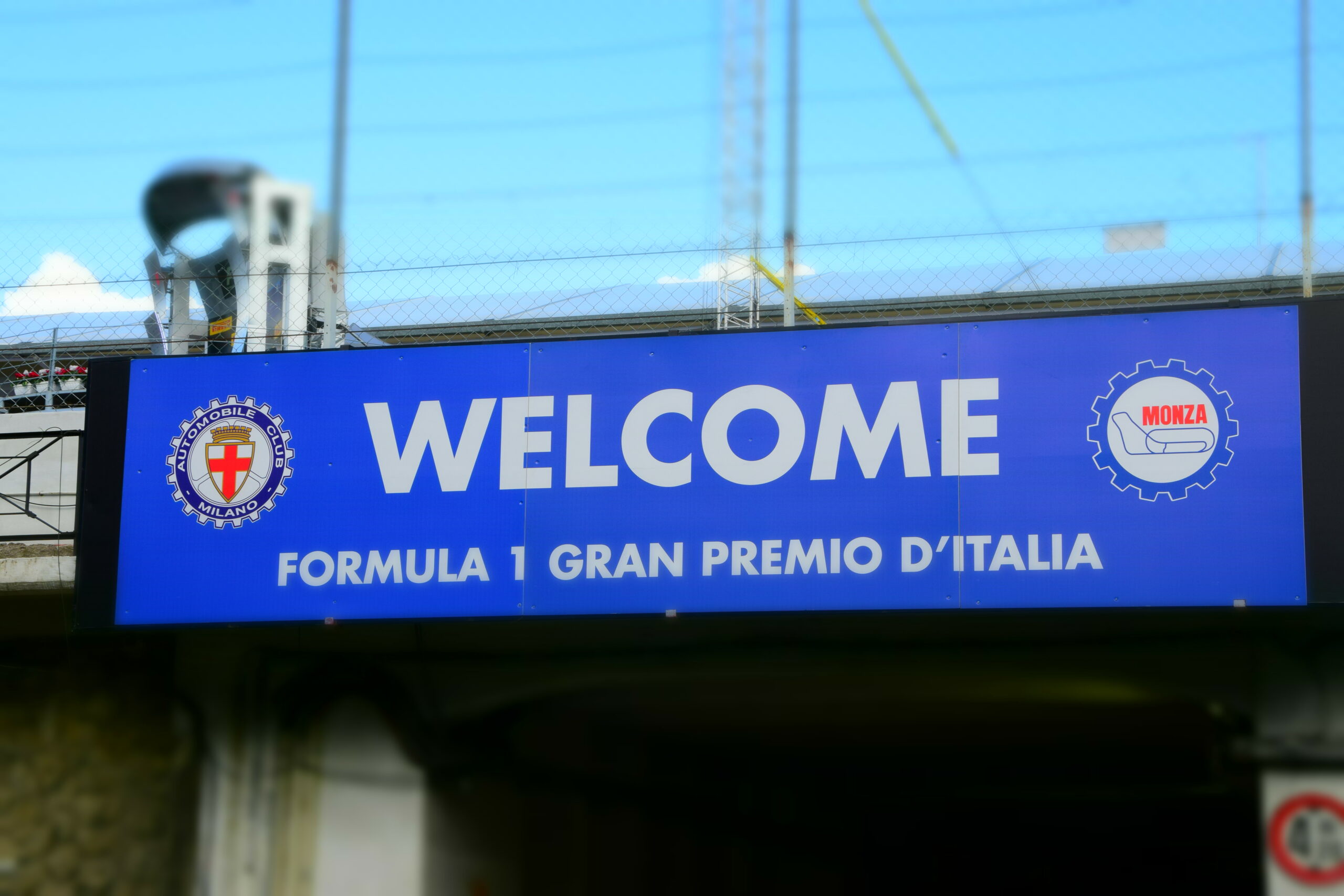
The Autodromo Nazionale Monza. Photo by Ank Kumar, licensed CC BY-SA 4.0 via Wikimedia Commons.
The FIA didn’t need a press conference to make Sunday’s race interesting before a single lap gets run. A one-line regulatory notice did that job instead. Citing a forecast heat index above 31°C at Monza, the FIA invoked Article B1.5.10 of the F1 Sporting Regulations and confirmed that “a Heat Hazard is declared” once the official weather service predicts conditions crossing that threshold at any point during the race. With Sunday’s forecast sitting around 33°C, and practice and qualifying running even hotter, the Italian Grand Prix becomes the second heat hazard race of the 2026 season, following the Austrian Grand Prix at the end of June.
That designation isn’t just a weather footnote for the broadcast graphics. It triggers a specific, mechanical choice for every driver on the grid: wear a liquid-cooled vest that pipes coolant against the body underneath the race suit, or skip it and carry 5 kilograms of ballast instead.
Five kilograms sounds trivial next to a car that scales in around 800 kg with a driver strapped inside. It isn’t. Teams spend entire development cycles chasing single-digit-gram savings in bodywork, brackets, and fasteners, because ballast placement is one of the last legal tools left for tuning weight distribution once the minimum weight limit is fixed. A driver who skips the vest to stay comfortable hands the strategists 5 kilograms they now have to bolt in somewhere, usually low and central to protect the center of gravity rather than placed anywhere it could actually help balance the car. It’s not a season-altering penalty, but at a circuit built entirely around minimizing drag and maximizing straight-line speed, giving up that packaging flexibility is a real, quantifiable cost.
The vest itself is straightforward cooling engineering: thin tubing woven through a fitted garment, connected to a small pump-driven reservoir of chilled liquid that circulates against the driver’s torso for the length of the race. It’s the same basic principle as an industrial cooling suit, shrunk down and made survivable to wear crouched inside a cockpit that regularly runs hotter than the air around it for close to two hours. Driver feedback on the vest has been mixed. Some find the extra tubing awkward layered under a suit that’s already skin-tight, and more than one has burned through the coolant supply before the checkered flag, leaving them right back to sweating out the closing laps anyway.
The rule exists because F1 already ran the experiment nobody wanted. Extreme heat has caused visible physical distress in the cockpit before, drivers battling dehydration and heat exhaustion badly enough that it became a genuine safety story rather than a competitive footnote. That history is exactly why the FIA built a formal heat hazard threshold instead of leaving each race director to guess at what’s survivable in the moment, and why the sport chose a fix that costs teams something real, that 5 kilograms, rather than making cooling gear free to use. A free option would have removed any incentive for teams to keep working on cockpit ventilation and heat extraction as part of the car itself.
Two heat hazard races before September is worth sitting with for a second, too. Monza’s near-zero-shade, low-drag layout was already a brutal environment for man and machine this week, with Friday practice running into its own heat wave before the FIA ever issued Sunday’s declaration. Austria’s heat hazard back in June showed this isn’t a one-circuit problem, and the calendar isn’t getting any cooler.
For a championship fight this tight, small operational decisions carry more weight than they should. Kimi Antonelli arrives at his home race leading the standings, and every gram of ballast or minute lost fussing with a cooling line is a variable nobody wants to explain after a result goes sideways. The FIA has already shown this season it’s willing to write procedural fixes on the fly to protect the racing, and a vest-or-ballast choice is really just another version of that same instinct: legislate the risk instead of hoping nobody gets hurt.
None of this changes the show on Sunday, but it changes what’s happening inside 20 cockpits that the cameras never show. If you’re tuning in, know that the driver crossing the line drenched in sweat may have made a calculated bet to save weight rather than just toughed it out for style points. Either way, Monza’s heat was always going to be this weekend’s story. The FIA just made it an official one.
About the Author