Photo: Thalhah Shafiyurrahman / Unsplash
Isuzu is now running second-generation autonomous heavy trucks on a real commercial freight route in Japan, and the freight in the trailer is Isuzu’s own. That last detail is the most revealing thing about the whole program.
Before getting to why, let’s clear up a date that’s been floating around in two contradictory forms.
The fiscal year problem
You’ll see Isuzu’s Level 4 launch target written as fiscal 2027 in some places and fiscal 2028 in others. Both are correct, which is the annoying part.
Isuzu’s August 2025 announcement of its Mukawa test course states the group aims to launch Level 4 trucks and buses in fiscal 2027, using the standard Japanese convention where a fiscal year is named for the calendar year it begins in. Its November 2025 release on the parts logistics route writes the same window as fiscal 2028 and spells it out: ending March 31, 2028.
April 2027 through March 2028. One target, two naming conventions. If you cover Japanese manufacturers and don’t already do this arithmetic reflexively, start.
What Level 4 actually means legally in Japan
Here’s the part that gets glossed over constantly. In Japan, Level 4 isn’t a vehicle certification you earn once and stamp on a spec sheet. It’s a permit.
The 2022 amendment to the Road Traffic Act took effect in April 2023 and created what the National Police Agency calls specified automated operation, the permission system for driverless operation equivalent to SAE Level 4. The permit attaches to the operation, not the truck. Route, conditions, monitoring arrangements, and the entity running the service all get reviewed.
Related Articles
- Callaway and Waldoch Just Built a 602-HP Silverado That Won’t Void Your Warranty
- California’s ‘Leno’s Law’ Would Let More 1980s Classics Skip Smog Checks — If Sacramento Ever Lets It Out of Committee
That framing matters for how you read Isuzu’s current demonstrations. Isuzu’s own footnote in the November release defines what it’s doing now as automated driving with Level 4 assumed, meaning a driver stays in the seat continuously monitoring and able to take over at any moment. Legally, that’s supervised testing wearing a Level 4 costume. Nobody has removed a human from the cab yet.
The route is the story
The demonstration hauls Isuzu service parts between Isuzu Logistics’ Iwafune Parts Center in Tochigi and its Chubu Parts Center in Ichinomiya, Aichi. The truck enters at Sano-Fujioka IC on the Tohoku Expressway and exits at Ichinomiya-Nishi IC on the Tokai-Hokuriku. The autonomous section runs between the Surugawan-Numazu and Hamamatsu service areas on the Shin-Tomei Expressway, which has priority lanes designated for autonomous vehicles.
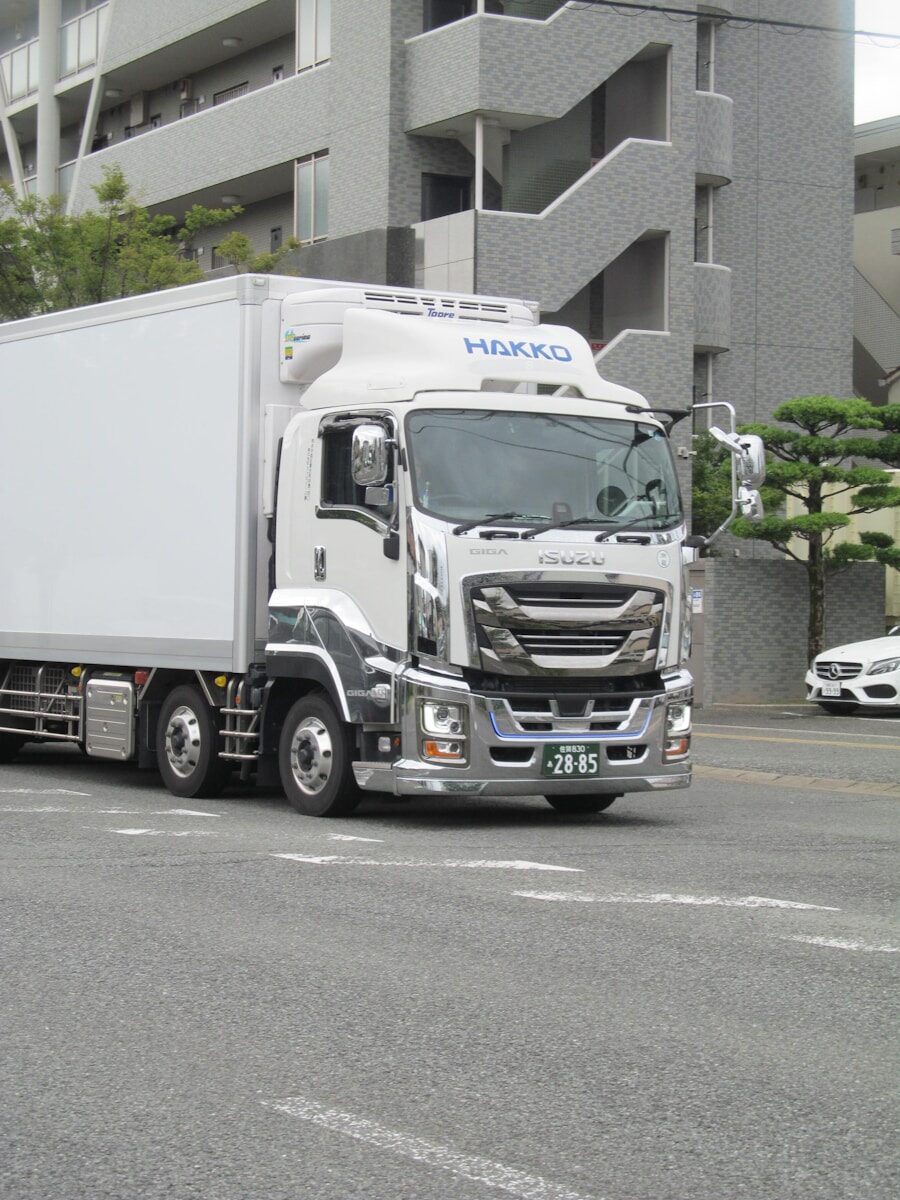
Step 1 used a single GIGA 8×4 heavy-duty truck with a 25-ton gross vehicle weight, operated by ONETRANS, a wholly owned subsidiary of Isuzu Logistics, running roughly five days a week in daylight or darkness with no time restriction.
Read that list again. Isuzu is the truck manufacturer, the shipper, the carrier, and the customer. Every variable that normally kills an autonomy pilot — a shipper who won’t accept schedule risk, a carrier that won’t retrain dispatch, a route that changes weekly — has been engineered out by keeping the whole thing in-house.
That’s smart de-risking. It’s also why nobody should treat this as proof of commercial viability. The economics of an autonomous truck get interesting when a third-party shipper pays market rates for it. Hauling your own oil filters between your own warehouses does not test that.
Gen 1 to Gen 2, and why the software change is the big one
The first-generation trucks, developed jointly with California-based Applied Intuition, ran a fairly conventional heavy-duty sensor stack: millimeter-wave radar for front and side object detection, LiDAR scanning 360 degrees, cameras, GNSS for positioning, and an IMU reading vehicle behavior. Isuzu says that platform accumulated 150,000 kilometers across the US and Japan.
Applied Intuition says the second-generation trucks now running on an expanded 450-kilometer route between Tochigi and Aichi carry upgraded sensors and compute for wider coverage and redundancy, aimed specifically at surface-street work: ETC gates, signalized intersections, pedestrians, mixed traffic, and low-speed maneuvering inside logistics yards.
But the hardware isn’t the interesting upgrade. The software architecture is.
Isuzu says end-to-end driving will be introduced in Step 2. That’s a genuine philosophical break from how most production autonomy has been built. The conventional approach is a modular pipeline: perception identifies objects, prediction guesses what they’ll do, a planner picks a trajectory, controls execute it. Each stage is separately testable, separately debuggable, and separately explainable to a regulator. When something goes wrong you can point at the module.
An end-to-end model collapses that into one learned system that takes sensor input and outputs driving behavior. It generalizes better to weird situations because it isn’t limited by the object categories some engineer thought to define. It’s also substantially harder to validate, because “why did it do that” no longer has a clean answer buried in a planner’s cost function.
That tension is the entire Level 4 certification problem in one sentence. The architecture that handles rare events best is the architecture that’s hardest to prove safe.
Isuzu’s answer is volume. The company plans to put 30 autonomous vehicles on the road by the end of fiscal 2027 purely to gather data and analyze driving behavior.
Why the test track is in Hokkaido
Isuzu is spending about ¥7.4 billion on roughly 190,000 square meters at its Hokkaido Proving Ground in Mukawa, with partial use starting in summer 2026 and full operations in September 2027. The course includes simulated urban streets, highway merge and exit sections, gradients, parking, traffic signals, electronic speed limit signage, bicycle lanes, bus stops, ETC gates, railway crossings, and V2X equipment.
Building it in Hokkaido is not a real estate decision. LiDAR return quality collapses in falling snow, camera lenses ice over, lane markings vanish under slush, and radar picks up spray off the truck ahead. Any autonomy stack that only validates in temperate Honshu conditions is going to have a very educational first winter. Isuzu also says the course will generate the data needed for Level 4 certification and compliance with international regulations, which means it’s regulatory infrastructure as much as engineering infrastructure.
The service department nobody’s talking about
Fleets should be thinking about what a Level 4 truck does to their maintenance operation, because the answer is more than “add a computer.”
Sensor calibration becomes a scheduled service item and an after-repair requirement. Anyone who’s paid for ADAS recalibration after a windshield replacement on a passenger car understands the principle. Now scale it to a truck carrying 360-degree LiDAR, multiple radars, and a camera array, where any front-end collision repair, mirror bracket replacement, suspension work, or ride-height change potentially invalidates the extrinsic calibration of the whole stack. A misaligned sensor doesn’t throw a check-engine light. It quietly degrades perception.
Redundancy also means duplication. Level 4 requires fallback steering, braking, and electrical power, which is more hardware to inspect, more failure modes, and more weight. On a truck already at a 25-ton GVW limit, every kilogram of sensor mast, compute rack, and redundant actuator comes directly out of payload. That’s a real operating cost, not a rounding error.
Does any of this reach American roads
Isuzu’s stated plan is a Level 4 truck and bus business starting in Japan and North America, and its American manufacturing footprint is arriving on a similar timeline. Isuzu North America is converting a one-million-square-foot building on over 200 acres in Greenville County, South Carolina, a $280 million project confirmed by the state government, with operations expected to begin in 2027 and eventual capacity of 50,000 units annually.
Related Articles
- Tom Cruise Crashed a NASCAR Drivers Meeting to Announce ‘Days of Thunder 2,’ and the Garage Already Wants In
- VinFast Paused Three India-Built EVs, and North Carolina Already Wrote the Ending
The company is also reshaping itself at home. In May 2026 Isuzu began a formal merger review with UD Trucks, which would fold two of Japan’s four heavy commercial vehicle makers into one.
For American fleet buyers, the practical takeaway is narrow and specific. What Isuzu is proving out is hub-to-hub linehaul on a fixed, surveyed corridor with dedicated infrastructure at both ends. That’s the only autonomy business case that pencils out in the near term anywhere, and it’s the one segment where a Japanese-developed system could transplant with the least friction, because a US interstate between two distribution centers is a simpler problem than a Japanese expressway feeding into Nagoya-area surface streets.
What it is not is a driverless truck you can order into general freight service. Isuzu still has a safety driver in the seat, is still hauling its own cargo, and is still two years from the fiscal year in which it says the business launches. Anyone selling you a shorter timeline is selling something.
Lead image: Thalhah Shafiyurrahman on Unsplash
About the Author