Photo: Horse Powertrain
Off-road wading specs are usually a suspension and packaging story. Raise the intake, seal the doors, run the axle breathers up the B-pillar, and quote a number. The engine itself is generally treated as a component you keep dry rather than one you certify wet.
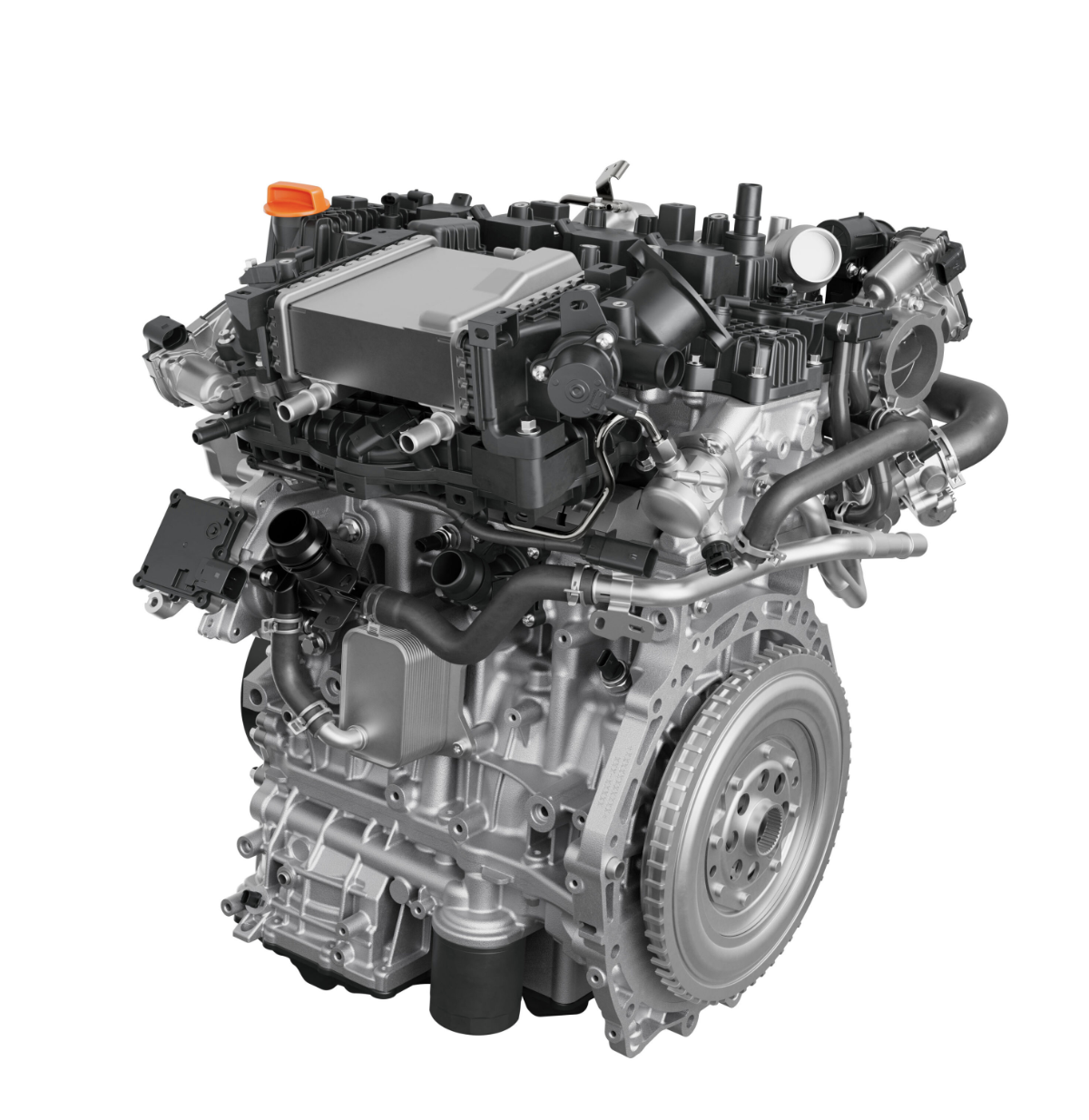
Horse Powertrain went the other direction. On September 8 the London-based supplier revealed the HORSE B20, a 2.0-liter turbocharged four rated to IPX8 and specified to keep operating at depths up to 1.1 meters. That’s 43 inches of water, measured at the engine.
The basics: 130 kg, direct injection, 140-185 kW (188-248 hp) and 300-380 Nm (221-280 lb-ft) depending on calibration, built for HEV, PHEV and REEV applications in SUVs and pickups. Horse also claims continuous stable output at 100% grade, which is a 45-degree slope, not a 45% one.
What IPX8 actually promises, and what it doesn’t
Here’s the part worth understanding before anyone starts quoting the rating as gospel. IPX8 comes from IEC 60529, the ingress protection code maintained by the IEC. The X means dust protection wasn’t tested or wasn’t relevant. The 8 covers continuous immersion.
Related Articles
- Ford Super Duty Production Hits Best Month Since 2006 as Aluminum Supply Returns
- Rolls-Royce Stolen in Transit Turns Up in Illinois: The Law Behind the Arrest
Unlike almost every other digit in the code, IPX8 has no fixed test parameters written into the standard. The only hard requirement is that conditions be more demanding than IPX7, which is one meter for 30 minutes. Depth, duration and pressure are agreed between the manufacturer and the customer. Two products both wearing an IPX8 badge can have been tested to wildly different conditions.
Which is exactly why Horse publishing “1.1 meters” matters more than the four characters in front of it. The number is the specification. The rating is just the test category.
The engine’s rating is not the vehicle’s rating
Do not read 1.1 meters and assume a truck built around this engine will ford 43 inches. Vehicle wading depth is set by whichever component drowns first, and historically that has almost never been the block.
The list of usual suspects: air intake snorkel or airbox inlet height, ECU and body-module mounting locations, connector sealing, axle and transfer-case breather routing, transmission vent height, door and floorpan sealing, and on any electrified vehicle, the high-voltage battery enclosure, inverter, DC-DC converter and charge port. For reference, Land Rover’s own newsroom puts Defender’s maximum wading at 900mm, and that figure comes from the whole vehicle, not one subsystem.
There’s also the failure mode that sealing doesn’t address at all. Hydrolock happens when water goes down the intake tract and into a cylinder, and liquid doesn’t compress. A perfectly sealed engine exterior does nothing to stop that. The intake path is a separate engineering problem, which is why snorkels exist and why Horse’s own claim is carefully worded around operation and sealing rather than immunity.
What Horse says it did is genuinely useful, though. The engine uses a fully sealed structure with torsional vibration dampers and dedicated engine-to-transmission sealing, IPX8-rated electrical components and sensors, and a control strategy that reads those sensors and automatically pulls power or softens throttle response when it detects submersion. That last item is the interesting one. A wading engine that limits its own output is managing thermal shock and load while the cooling system is dumped into cold water, and it’s doing it without waiting for the driver to notice.
The thermal and lubrication engineering hiding in the spec sheet
Two details in Horse’s release do more work than they look like they do.
The gantry-type aluminum block with integrated exhaust manifold matters for wading specifically. An integrated exhaust manifold casts the runners into the cylinder head where coolant surrounds them, instead of hanging a red-hot cast-iron log off the side of the engine. Plunge a conventional manifold and turbine housing into a river and you’re inviting thermal shock cracking. Water-jacketed exhaust runners cut that exposure and also shorten warm-up time and lower peak exhaust gas temperature, which protects the catalyst.
The variable displacement oil pump and the fully active dual-cooling system address the other extreme. At a sustained 45-degree climb, oil pickup geometry gets ugly, coolant circulation fights gravity, and a fixed-displacement pump burns parasitic power making pressure the engine doesn’t need. Horse specifically calls out continuous slope climbing and long-duration high-temperature operation as design targets for the cooling system, which tells you where the validation hours went.
The Miller cycle claim deserves a note too. Miller closes the intake valve late, shortening the effective compression stroke while keeping the full expansion stroke, which cuts pumping losses and knock tendency and lets you run a higher geometric compression ratio. Horse quotes 48.4% brake thermal efficiency, and that’s a serious number for a gasoline passenger-car engine. It’s achievable in part because a dedicated hybrid engine doesn’t have to be good at everything. The electric motors handle transients and low-load creep, so the engine can be tuned to live in a narrow, efficient band instead of compromising for driveability.
Where you can actually find one
The B20 debuted at the Beijing Auto Show and has since gone into a PHEV powertrain in the Geely Galaxy Cruiser 700, a China-only off-roader, paired with Horse’s 3DHT230 three-speed hybrid transmission.
That’s not an accident of geography. Horse Powertrain was created by Renault Group and Geely, each holding 45%, with Aramco buying 10% at a €7.4 billion enterprise valuation in December 2024. The company runs 18 plants and five R&D centers with over 19,000 employees, and its customer list includes Renault, Geely, Volvo Cars, Nissan, Mitsubishi and Proton.
The timing of the reveal is the part nobody should skip. One day after announcing the B20, Horse opened a North America office in Southfield, Michigan, with 32 roles and a stated aim of selling combustion and hybrid powertrains directly to American automakers. Announcing a waterproof off-road hybrid engine on Tuesday and cutting a ribbon in metro Detroit on Wednesday is not a coincidence. It’s a sales pitch aimed at every domestic product planner who quietly walked back an EV-only truck program.
What this means if you actually wheel your truck
A few things, none of them “buy a snorkel and send it.”
Sealed engines are harder to service, and seals are consumables. Every dedicated sealing interface on this engine is a surface that has to be cleaned, inspected and torqued correctly during any teardown. A shop that reassembles a wading-rated engine with the wrong sealant or an out-of-spec bolt sequence hasn’t just made a leak. It’s silently deleted the capability the vehicle was sold on. If a truck with hardware like this ever reaches your driveway, dealer-level service documentation stops being a nice-to-have.
Related Articles
- Watch: Ford Bronco Driver Rams Parked Car Into Yard, Then She Refuses DUI Test
- Mazda’s Hiroshima Museum Just Hit Two Million Visitors — And the Pace Says Something Interesting
Post-wading maintenance doesn’t disappear either. Differential, transfer case and transmission fluids still need checking for the milky look that means water got past a breather or seal. Wheel bearings and brake hardware still need drying and inspection. The engine being rated to swim doesn’t extend that rating to everything bolted behind it.
Then there’s the money side, and this is where owners get hurt most often. Water damage in the US is typically a comprehensive claim, not collision, and comprehensive is built around accidental loss. Deliberately driving into water deeper than the manufacturer’s stated limit is a fight you may not win with an adjuster. Manufacturers know it, which is why Jeep prints it directly on its own capability page: traversing water can cause damage that may not be covered by the new vehicle warranty.
Flood-damaged vehicles also carry branded titles in most states, and a water-drowned hybrid with a compromised high-voltage pack is one of the fastest paths to a total loss in the entire off-road world. The B20’s real contribution isn’t permission to go deeper. It’s removing one more expensive failure point from a segment where the recovery bill routinely exceeds the fun.
Images Via: Horse Powertrain
About the Author