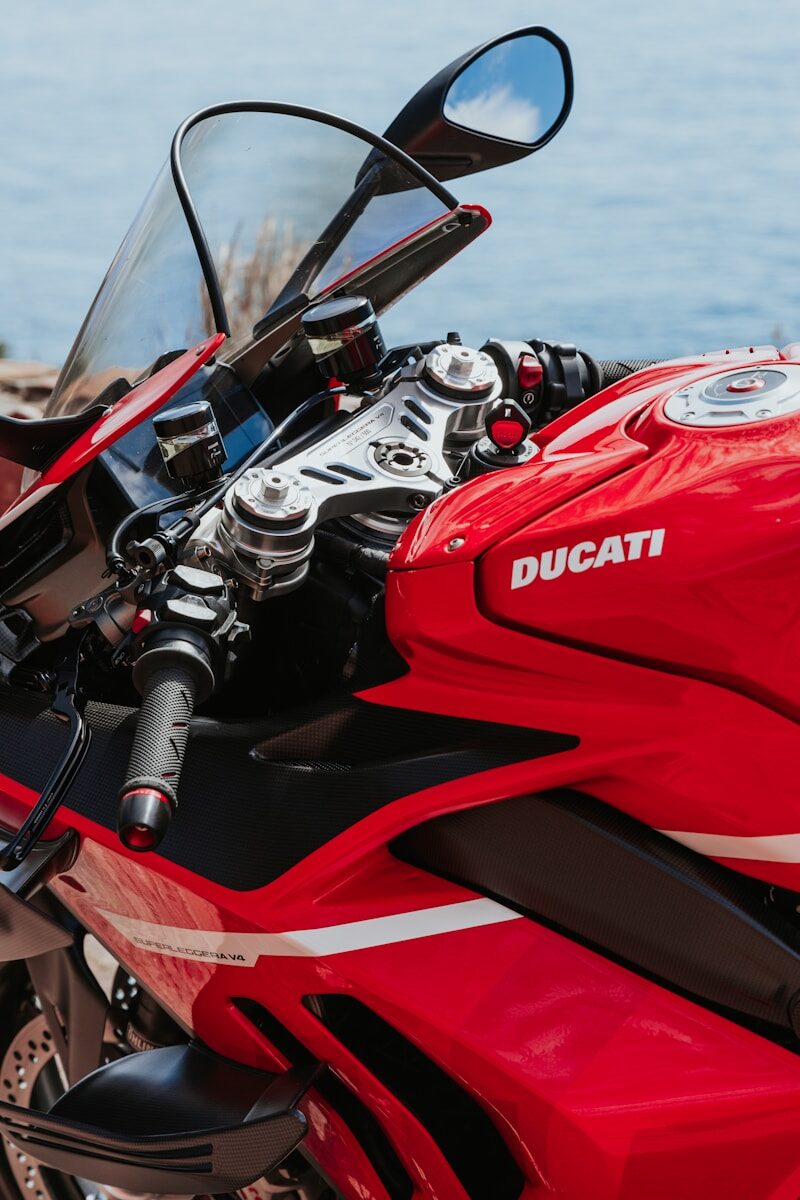
Photo: Stephan Louis / Unsplash
Audi CEO Gernot Döllner confirmed in a Bloomberg interview that Ducati is one of roughly 600 businesses Volkswagen Group is currently evaluating, out of about 2,000 it owns. His phrasing was careful: “we’ll also talk about Ducati, but nothing has been decided.” Nobody has hired a banker. Nobody has taken a bid. But the framework that put Ducati’s name on a list is not a rumor, and it’s worth reading, because Volkswagen published it five days earlier.
The number 600 isn’t random
On September 3, VW’s supervisory board unanimously signed off on Future Plan 2030, a twelve-initiative restructuring package. One of those initiatives covers the shareholding portfolio, and the language is unusually blunt for a German corporate document: holdings will be assessed to keep only those making a clear strategic and financial contribution to the core business, with the portfolio to be cut by around one-third. Non-strategic activities get divested or realigned.
One-third of 2,000 companies is roughly 667. Döllner’s 600 figure is that mandate expressed as a work queue. The same document sets a nine percent group operating margin target by 2030 and commits VW to cutting around 50,000 positions.
Related Articles
- Watch: A Bugatti Tourbillon Prototype Just Got Rear-Ended By The Cheapest Car
- RealTruck Quietly Files to Close Rugged Liner’s Michigan Plant, Cutting 90 Jobs by Spring 2027
VW has already shown what execution looks like here. In June the group agreed to sell 51 percent of Everllence, the large-engine and turbomachinery business formerly known as MAN Energy Solutions, to Bain Capital in a leveraged buyout generating about €7.4 billion. That deal was announced under the headline “streamlining investment portfolio.” Ducati would be a rounding error by comparison.
What Ducati actually earns
Here’s where it gets uncomfortable for Bologna. Ducati’s 2025 results, published in March, show 50,895 motorcycles delivered against 54,495 the year before, revenue of €925 million against €1.003 billion, and operating profit of €52 million against €91 million. Operating margin fell from 9.1 percent to 5.6 percent.
Read that against the nine percent group target and you can see the problem an accountant sees. In 2024, Ducati cleared the bar. In 2025 it didn’t. But margin isn’t really the trigger. The Future Plan criterion is contribution to the core business, and the core business is building cars. A motorcycle brand under the Audi umbrella has always been an odd fit on an org chart, no matter how good the bikes are.
CFO Henning Jens made the counterargument in the same release: Ducati grew market share while its core market contracted by double digits. That’s a real defense. It’s also not the metric the portfolio review is using.
Why the numbers fell, and what it teaches you about your next bike
Ducati named three culprits, and one of them is genuinely instructive.
The first is tariffs. Ducati identifies the United States as its primary market, and US duties hit landed cost directly. The second is currency, specifically the dollar and the yen, which squeezes an exporter selling from a euro cost base.
The third is Euro 5+, and this is the part most coverage skips. Ducati says the transition pulled the Monster, Hypermotard, and DesertX out of the range until they returned in early 2026 with the new V2 engine. Losing three volume models from a lineup that only ships 50,000 units a year is not a rounding error.
Euro 5+ isn’t a new emissions ceiling. The limits didn’t move. What moved was verification, under Regulation 2019/129 amending the EU’s L-category framework. From January 1, 2025, all new motorcycles sold in the EU need full OBD stage II, including catalyst monitoring, which means the bike has to detect a degrading catalytic converter and report it. At the same time, the “mathematical durability procedure” expired on December 31, 2024. Manufacturers used to run a bike 2,500 or 3,500 kilometers, apply a deterioration factor, and call it durability. That shortcut is gone. Engines now have to demonstrate compliance the hard way.
Catalyst monitoring is why several older Ducati twins couldn’t be carried over. Desmodromic valve actuation, with its mechanical closing rockers, gives spectacular high-rpm control and terrible low-rpm combustion consistency, which is exactly what wrecks the stable exhaust signature an OBD II catalyst monitor needs to read.
Ducati’s answer was the new V2: 890cc, 120 hp at 10,750 rpm, and no desmo. It uses spring-closed valves with DLC-coated finger followers and intake variable timing. Ducati’s own release states the payoff plainly, that the spring system delivers low-rev regularity and easier maintenance, with valve clearance checks every 18,000 miles.
For owners, that’s the headline. Ducati’s maintenance guidance puts standard service intervals at 24,000 km (15,000 miles), with some models stretching the Desmo Service to 30,000 km (18,000 miles). A spring-valve top end doesn’t require measuring and shimming both an opening and a closing rocker per valve. On a middleweight twin, that difference shows up as hundreds of dollars per major service. The brand’s reputation for punishing shop bills is already being engineered away, independent of who signs the checks.
The 2012 comparison nobody runs
Audi’s April 2012 acquisition announcement never stated a purchase price. What was disclosed, by seller Investindustrial, was Ducati’s baseline: 42,200 units and €480 million in revenue for 2011.
Run the fourteen-year math. Units are up about 21 percent. Revenue is up 93 percent. Ducati under Volkswagen didn’t chase volume, it raised average transaction price and moved upmarket, which is exactly the strategy Domenicali describes as prioritizing value and exclusivity. Anyone valuing the business today is buying a brand that nearly doubled revenue on flat-ish volume, six consecutive MotoGP constructors’ titles, and a centenary year with a fully renewed lineup.
Who buys a motorcycle brand in 2026
The premium European motorcycle sector already ran this experiment. KTM’s Austrian parent went through insolvency restructuring, and Bajaj Auto took control in November 2025, renaming Pierer Mobility to Bajaj Mobility. Group revenue for 2025 came in at €1.009 billion after a 46 percent decline, followed by a rightsizing program cutting around 500 jobs.
That’s the market Ducati would be sold into. Strategic buyers with volume manufacturing scale, or private equity. The Everllence deal shows VW is comfortable with the leveraged-buyout structure and with keeping a minority stake.
There’s also a political dimension. Any Italian industrial asset changing hands invites scrutiny from Rome, and German labor representation sits on VW’s supervisory board with real leverage. The Future Plan explicitly commits to working with employee representatives on implementation. That’s the same friction that killed the 2017 attempt.
What this actually means if you own one
Not much, in the near term, and less than the internet will tell you.
Warranty and parts obligations belong to Ducati Motor Holding S.p.A. and its national distributors, not to Volkswagen AG. A share sale transfers ownership of the entity; the entity’s contractual obligations ride along unchanged. Your warranty doesn’t evaporate because a different name appears on the shareholder register.
EU type-approval law also requires manufacturers to provide independent repairers with access to repair and maintenance information, including OBD data. That obligation attaches to the type-approval holder, so your local independent shop keeps its access regardless of who owns the company.
Related Articles
- GM Denies L87 V8 Employee Discount as NHTSA Probes Nearly 1 Million Trucks
- Formula 1’s Apple TV Reach Is Sliding, and Apple Just Raised the Price Anyway
Insurance won’t move either. Motorcycle rating is driven by model, displacement, theft and claim history, rider profile, and garaging location. Corporate parentage isn’t a rating factor. The second-order effect is real but slow: if parts pricing rises under a cost-focused owner, repair estimates rise, more crashed bikes get totaled, and comprehensive and collision premiums drift upward over several years. That’s a 2030 problem, not a 2026 one.
The thing worth actually watching is the dealer network. Ownership changes bite hardest three to five years out, when a new owner rationalizes distribution and decides which markets deserve investment. If you’re buying a 2026 centenary model and you live somewhere with exactly one Ducati dealer within 200 miles, that dealer’s health matters more to your ownership experience than anything decided in Wolfsburg.
For now, Ducati is a name on a list of 600, in a review that has produced exactly one confirmed sentence: nothing has been decided.
Lead image: Stephan Louis on Unsplash
About the Author