Photo: Mecum Auctions
Most 1995 Mustangs are worth about as much as a nice used lawn tractor. This one is different because of what happened to it over one February weekend in Florida, and because of what Roush chose not to do to it afterward.
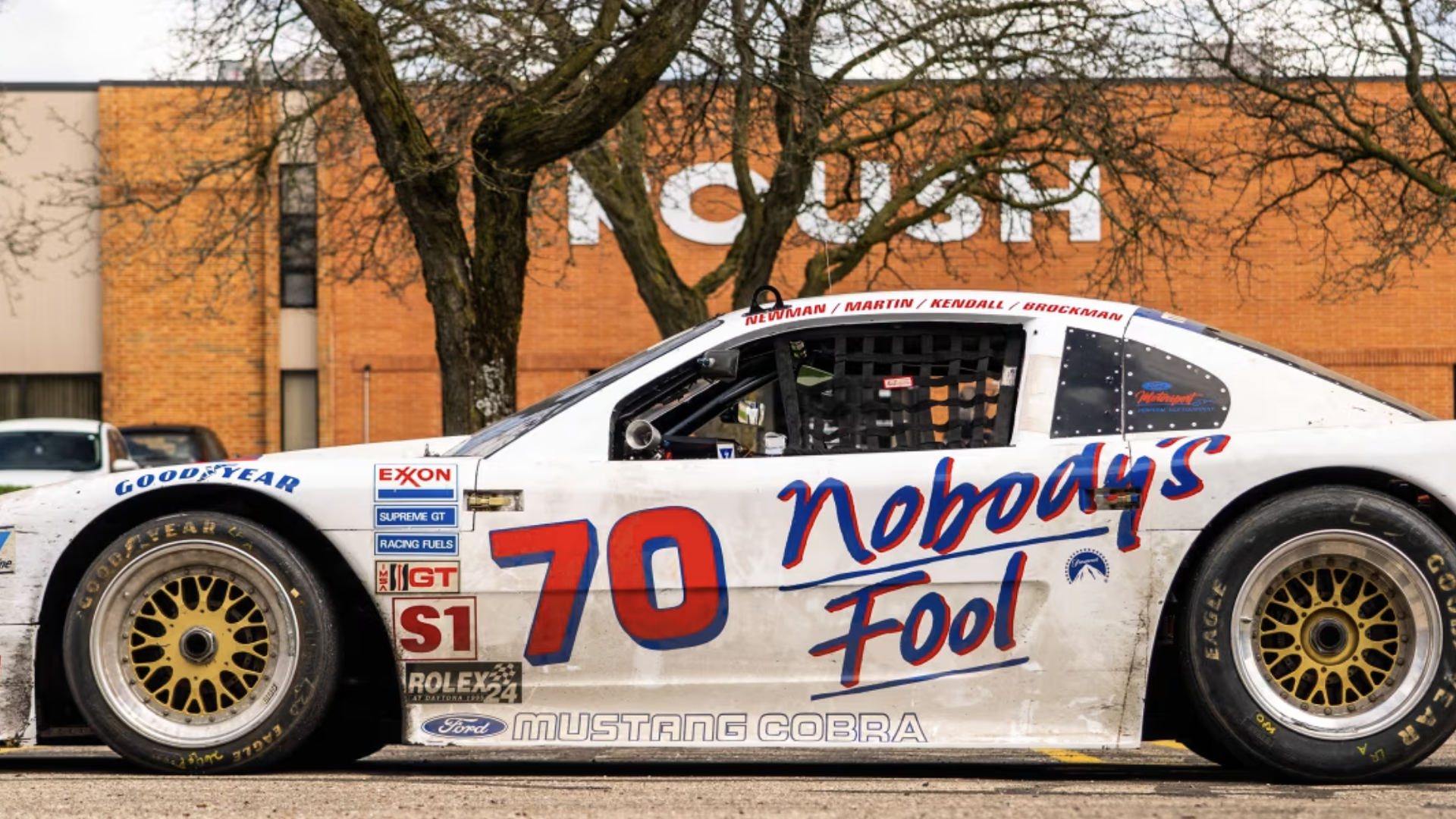
The car is the “Nobody’s Fool” Ford Mustang Cobra that Paul Newman helped drive at the 1995 Rolex 24 at Daytona. It sold as Lot S140 at Mecum’s first-ever Nashville auction, held Sept. 22–26 at Nashville Superspeedway in Lebanon, Tennessee. The final price was $935,000.
A movie ad that won its class
The car’s story starts as a marketing experiment. According to Mecum’s consignment announcement, Paramount Pictures sponsored the car with leftover marketing money from Newman’s film Nobody’s Fool. The No. 70 on the doors marked Newman’s 70th birthday.
Related Articles
- This Electric 1970 International Scout Still Makes You Work a Clutch
- Today in Automotive History: F1’s First Night Race Was Won by a Crash on Purpose
Studios have burned leftover budgets on far worse ideas. This one won.
Roush Racing built it as chassis No. 23. The car took a GTS-1 class victory and third place overall at the 1995 Rolex 24, with a driver lineup that included:
- Paul Newman
- Tommy Kendall
- Mark Martin
A car wearing a Mustang Cobra badge finished on the overall podium of a 24-hour race behind two purpose-built prototypes. And one of the men sharing the wheel was 70 years old.
What’s actually under the bodywork
Forget the Cobra badge. Mecum’s lot description calls it an IMSA road race car, and Mecum describes it as “the culmination of Jack Roush’s road racing experience.” The listing includes:
- A Roush-built 6.0-liter Ford V8.
- A five-speed manual transmission.
- Goodyear Eagle radial race tires.
- Race-worn bodywork in the white No. 70 “Nobody’s Fool” Paramount livery.
Cars in IMSA’s GTS-1 class were race-bred machines that wore production-shaped bodies. The resemblance to a showroom Mustang was mostly a matter of silhouette and marketing. The buyer is getting a Roush endurance car that happens to be shaped like a Mustang, not a hot-rodded street car. That distinction matters for how the car should be valued, maintained, and eventually used.
Why the dirt is worth money
This is the detail that makes the car unusual among retired race cars. After Daytona, the Mustang was fitted with unused spare body panels and put on display at Daytona USA, now the Motorsports Hall of Fame. The panels that actually ran the race were loaded onto the truck, sent back to Michigan, and kept ever since.
For the sale, those race-worn panels went back on the car. The clean “show” panels came along with it.
Race cars usually lose this kind of evidence. They get crashed, reskinned, updated for the next season, or restored until they look better than they ever did on the grid. The panels that carried the scuffs, rubber marks, and 24 hours of Daytona grime are normally the first thing thrown away. Here, a team deliberately kept them for three decades, which is exactly why the buyer is paying for a dirty car. Wash it and you’d be scrubbing away the most irreplaceable part of what was bought.
The two sets of bodywork also give the new owner a practical option. The car could run in vintage events wearing the show panels, while the race-worn set stays safely in climate control. That’s the rare case where a fresh set of fenders protects value rather than erasing it.
Why Roush let it go
The car came from the Roush Automotive Collection, which Mecum says has been built over 38 years and holds more than 150 vehicles. Selected cars were offered publicly for the first time to mark Roush Industries’ 50th anniversary.
Newman’s Mustang wasn’t the only headline Roush lot. Also in the group:
- A 1997 Mustang Cobra Trans-Am car that Tommy Kendall drove to a record 11 wins and the 1997 SCCA championship.
- A 1969 Boss 429 fitted with a Pro Stock engine that Jack Roush built himself.
In other words, Roush was selling its greatest hits, not clearing out the back of the shop.
What the price says about the market
$935,000 for a mid-’90s Mustang sounds absurd until you split the value into parts.
The Daytona result is solid, verifiable history. The Roush chassis-number provenance keeps the car’s identity clean. The Newman connection is the multiplier. He was a genuine, competitive racer, not a celebrity turning a few ceremonial laps, and collectors pay a premium for exactly that difference.
What the buyer didn’t pay for is originality in the concours sense. Nothing here is factory-correct, because nothing here ever came from a factory. Period race cars are valued by a different yardstick: documented history, continuity of ownership, and how much of the car is still the car that raced. This one scores unusually well on the last point, thanks to those dirty panels.
Related Articles
- Police Say a Naked Man Took a Ford Taurus the Wrong Way Down a Colorado Springs Boulevard. Cops Backed Off, and It Crashed Anyway
- Rival Crew Swung at NASCAR’s Corey Heim by Virginia’s Martinsville Hot Dog Stand, Then He Posted ‘At Least Make It Count Next Time’
When a single well-documented ’90s race car commands blue-chip muscle money, every owner of a documented IMSA or Trans-Am car from the era just got a new comp. Auction houses just got a new headliner idea.
If you’re the new owner
A few practical realities come with a car like this:
- It’s a race car, and it isn’t street legal. Purpose-built competition cars generally can’t be registered for road use. Plan on a trailer, not a license plate.
- Insurance is its own world. Standard collector-car policies typically exclude track use. Anyone planning vintage racing will need separate on-track coverage, and an agreed-value policy that reflects a near-$1 million price.
- Safety gear has expiration dates. Anything that sat on display for three decades needs a full teardown before it turns a wheel in anger. In sanctioned racing that includes the fuel cell, belts, fire suppression, hoses, and brake hydraulics, and most vintage racing groups enforce equipment rules.
- Documentation is part of the asset. The chassis number, race records, the show panels, and the chain of custody from Roush should all stay with the car. Separating them costs money later.
The smartest move may be the least exciting one: keep it exactly as it is, dirt included. You’ve just paid $935,000 for 30-year-old Daytona grime, so would you ever put a hose to it?
Images Via: Mecum
About the Author