Photo: Michal Vrba / Unsplash
Mazda’s corporate museum in Hiroshima quietly crossed a number most tourist attractions would kill for: two million lifetime visitors. The company confirmed the milestone on September 1, and the honor of being visitor number 2,000,000 didn’t go to some rotary-obsessed pilgrim who flew in from overseas. It went to 71 fifth graders from Ohkou Elementary School in Hiroshima, who showed up on a routine social studies field trip and left as a footnote in company history.
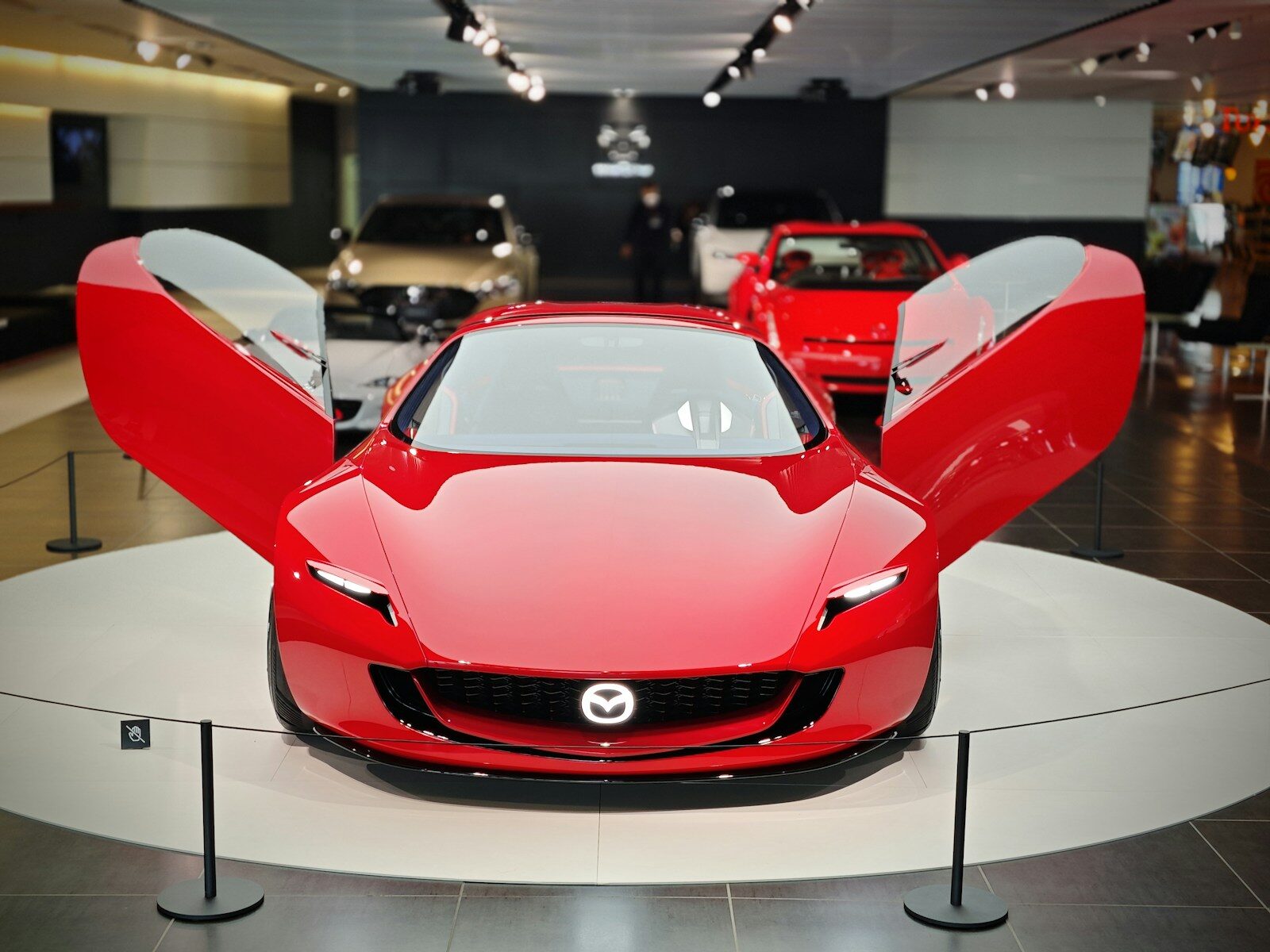
At the ceremony marking the moment, Mazda President and CEO Masahiro Moro presented the kids with a commemorative gift: a 1:18 scale model of the Mazda Iconic SP, the two-rotor hybrid concept the brand unveiled in 2024 as a hint at what a future Mazda sports car could look like if the rotary engine gets a second career as a compact range extender. Moro told the group he hoped the visit left them thinking, in his words, “Cars are cool.”
Fourteen Years for the First Million, Eighteen for the Second
The museum has sat on the grounds of Mazda’s Fuchu-cho headquarters in Hiroshima Prefecture since it opened in May 1994, and it’s been renovated twice since, once in 2005 and again in 2022. That second overhaul reorganized the exhibits into a single chronological walk, starting with the company’s founding and ending with Mazda’s current design and technology direction. It’s a layout choice a lot of corporate museums eventually land on, because letting visitors wander a disconnected pile of old cars rarely tells much of a story on its own.
Here’s the detail worth sitting with: this is only the second time Mazda has marked a millionth-visitor milestone at this museum. The first million took roughly 14 years, from the May 1994 opening to the one millionth visitor in October 2008. This second million took about 18 years. That’s a noticeably slower pace for hitting an identical number, and the most obvious explanation doesn’t require much digging: a global pandemic that shut down international travel and in-person museum tours for the better part of two years, combined with a 2022 renovation that almost certainly took the building offline for a stretch. A small museum in Hiroshima isn’t immune to the same forces that gutted attendance at car museums everywhere between 2020 and 2022.
A Museum That Doubles as a Recruiting Pitch
None of this is charity work on Mazda’s part. Nearly every major Japanese and German automaker runs some version of a heritage center tied to its home turf, and they all serve the same three jobs at once: tourism revenue, brand storytelling on the company’s own terms, and a pipeline for getting kids interested in manufacturing before they’ve picked a career path. Mazda’s museum leans hard into that last piece, with casting workshops and other hands-on programs aimed squarely at school groups rather than diehard enthusiasts.
That community angle isn’t incidental, either. Mazda’s identity has been wrapped up in Hiroshima’s manufacturing recovery since long before the museum existed, and the company has said explicitly that part of the museum’s job is passing the region’s industrial heritage on to the next generation, not just its own. A field trip full of ten-year-olds fits that mission better than a busload of tourists ever could.
Mazda’s Collector Market Isn’t Waiting Around
While Mazda polishes its official history, the unofficial version keeps writing itself in driveways and classifieds. We’ve covered a Miata built to pass for an Aston Martin, a VeilSide-bodied RX-7 replica bound for a Mecum auction stage, and a genuinely rare Autozam AZ-1 that popped up for sale despite never being sold new in the U.S. None of that happens by accident. Mazda spent decades making genuinely strange engineering bets, rotary engines chief among them, and that willingness to zig when everyone else zagged left behind a used market that’s still more interesting to dig through than most of its competitors.
For enthusiasts who might find themselves in Hiroshima, the appeal isn’t just nostalgia bait. It’s one of the only places anywhere that frames Mazda’s contrarian streak, the rotary engines, the kei cars, the eventual pivot toward hybrid rotary concepts like the Iconic SP, as a single continuous idea instead of a scattered list of gambles. Two million visitors in, plenty of people have apparently found that worth the trip.
Lead image: Michal Vrba on Unsplash
About the Author