Video: Daytona Beach Police Department
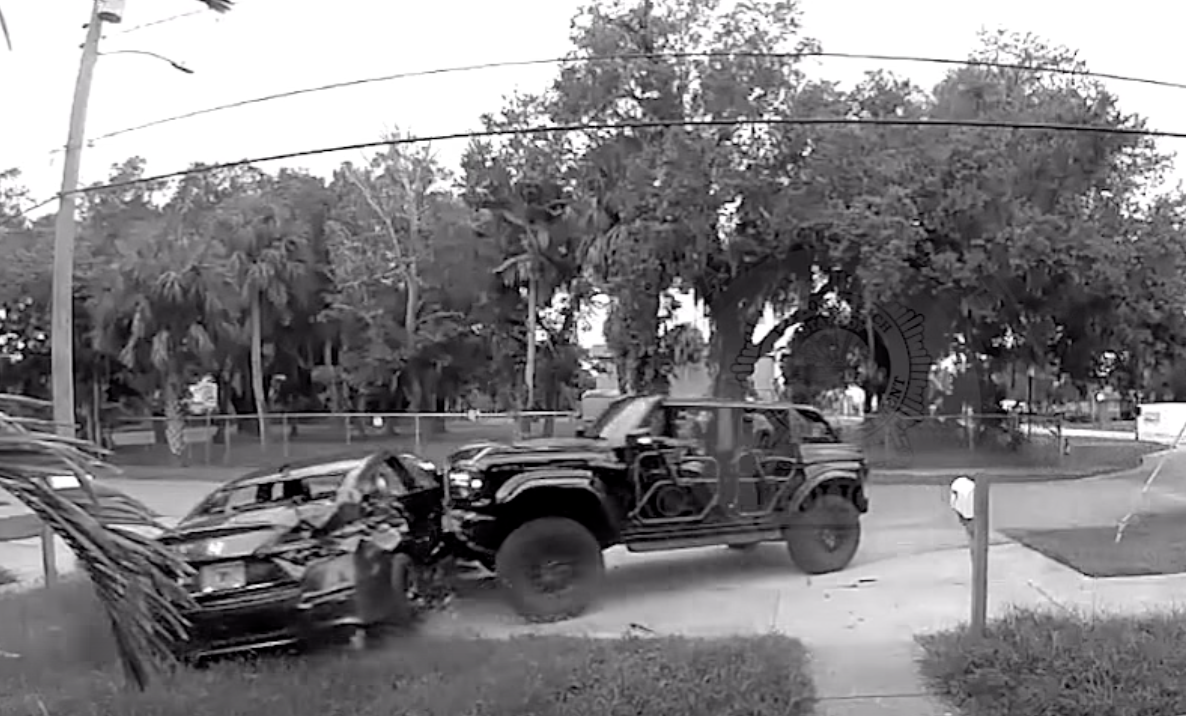
Ford engineered the modern Bronco to leave pavement behind. Daytona Beach police say one driver managed that trick in the least adventurous way possible: by crossing a residential street, hitting a parked sedan, and pushing it out of a driveway.
The video released by the Daytona Beach Police Department begins with home-security footage of a dark Ford Bronco approaching from across the road. The SUV strikes the front corner of a parked car and keeps moving long enough to shove the car sideways into the grass. Nobody needs a crash-reconstruction degree to see that this was more than a parking-lot kiss.
A Bronco Went Off-Road In The Worst Possible Place
Police identified the alleged driver as 24-year-old Elizabeth Pearl Boucher. In the department’s edited video, Boucher tells officers she hit the car’s front light. An officer answers that she did considerably more than that. The conversation then moves from crash damage to a DUI investigation, with Boucher shown declining roadside sobriety exercises and attempting to leave the officers.
At one point, while officers are putting her in handcuffs, Boucher says, “I thought we were all friends.” That is not how traffic investigations work, obviously, but it may be the fastest summary ever offered of a night taking a very expensive turn.
The Volusia County Criminal Justice Information System’s August 31 booking report records Boucher’s arrest by Daytona Beach police at 3:29 a.m. under case number 2026 105683 CFDB. The report lists alleged offenses of resisting an officer without violence, possession of a controlled substance without a prescription, touch or strike, refusal to submit to DUI testing, DUI involving alcohol or drugs, and DUI damage to another person’s property or person.
The police department’s own post lists DUI, possession of a controlled substance, resisting an officer, and DUI-related damage among the charges. It also correctly notes that every suspect is presumed innocent unless proven guilty. The booking report documents allegations, not convictions, and it does not establish what substance police allegedly recovered or whether any of the listed charges will survive review by prosecutors.
Refusing A Test Is Not An Off Switch
Roadside sobriety exercises and a chemical DUI test are different things, even though viral arrest videos tend to blend them into one long argument beside a patrol car. Police footage shows Boucher declining the exercises, while the county record separately lists refusal to submit to DUI testing as a charge.
Florida law does not require a published breath-alcohol number for prosecutors to pursue a DUI case. Under Florida Statute 316.193, the state can proceed on evidence that alcohol, a chemical substance, or a controlled substance impaired a driver’s normal faculties. A blood- or breath-alcohol level of 0.08 or higher is another route, not the only route.
The property damage matters too. The same statute classifies DUI that causes or contributes to damage to another person’s property as a first-degree misdemeanor. Florida’s separate refusal statute can make a qualifying first refusal a second-degree misdemeanor and calls for a one-year driving-privilege suspension; later refusals carry steeper consequences. Refusing a test may deprive investigators of one convenient number, but it does not erase video, officer observations, physical evidence, or the crash itself.
That distinction is worth remembering when watching police footage. In a recent California Porsche DUI arrest covered by Backfire News, authorities released an unusually dramatic blood-alcohol result. Here, the official materials reviewed for this story provide no test result, so there is no responsible number to guess.
The Repair Bill May Reach Far Beyond A Headlight
A parked car pushed sideways off a driveway can hide damage well beyond the visible bodywork. A wheel struck at an angle may transfer force into a tie rod, control arm, hub, strut, steering rack, or subframe. Even when the sheet metal looks survivable, an alignment check and a measurement of the mounting points are sensible. The Bronco may need its own inspection of the bumper structure, cooling pack, crash sensors, and driver-assistance hardware.
The fact that the striking vehicle was a Bronco adds irony, not magic. Its body-on-frame construction and off-road hardware do not repeal momentum, nor do they make a driveway impact harmless. Ford is reportedly preparing to expand the Bronco family with a pickup rival to the Jeep Gladiator, but “can move another car into the lawn” remains a feature nobody should test.
For the owner of the parked car, the practical move is to preserve the original security footage, photograph the vehicle before it is moved or repaired, obtain the police report number, and let the insurer arrange a thorough inspection. Visible lamp damage is only the opening estimate. Alignment, suspension, structural measurements, calibration, towing, rental transportation, and diminished value can turn a seemingly simple corner hit into a much larger claim.
Boucher’s case now belongs to the courts, where evidence and charging decisions matter more than a memorable line in a police video. The driveway footage already delivers the automotive lesson: when an impact moves an entire parked car, the damage story starts underneath, not at the broken light.
Lead image: Daytona Beach Police Department video
About the Author