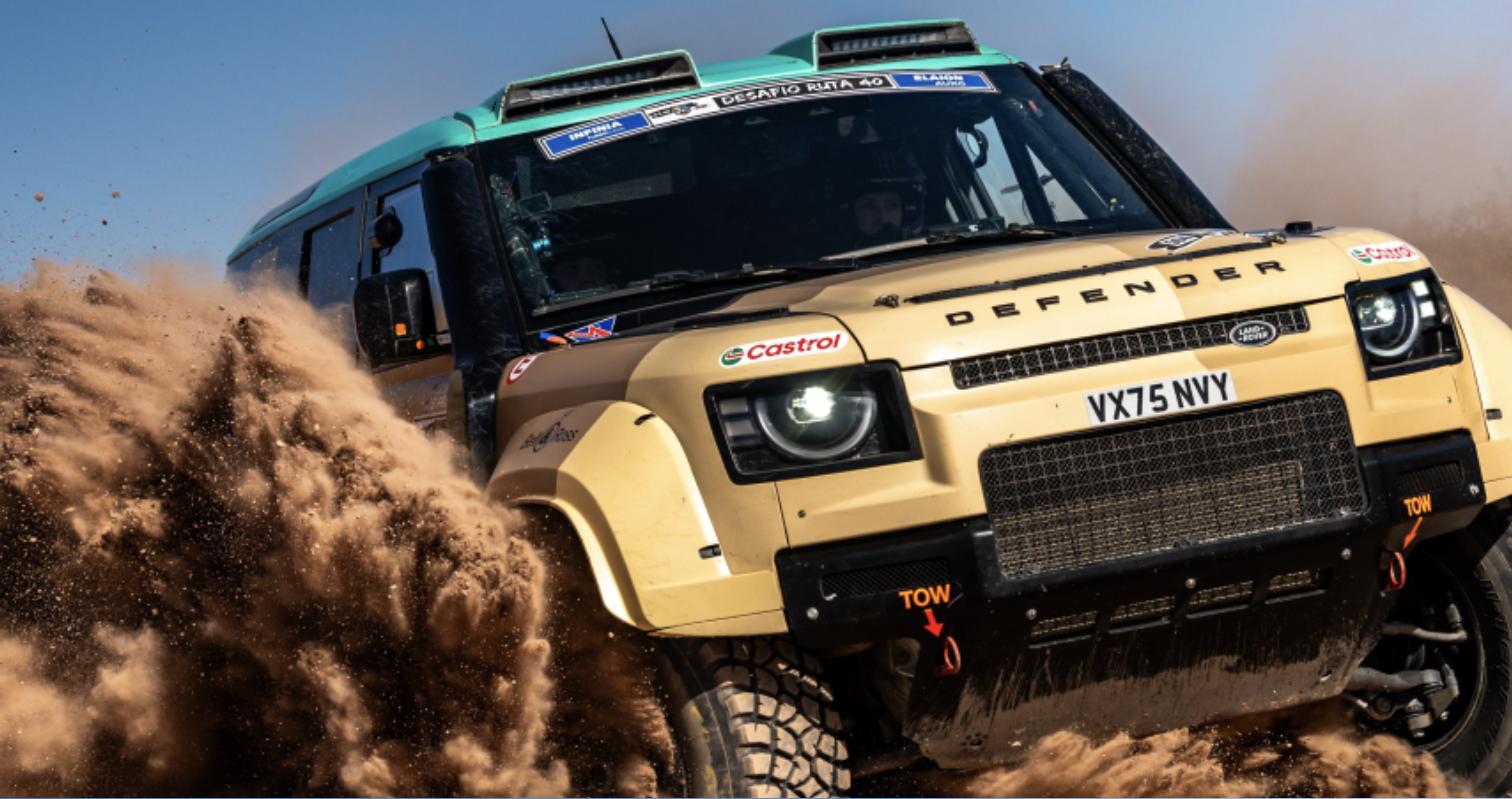
Defender Rally is finally racing in Africa. The team has entered three Defender D7X-Rs in the Rallye OLA Energy du Maroc, running 26 September through 3 October, which puts the fourth round of the FIA World Rally-Raid Championship in the Moroccan desert and puts a production-derived race truck on the continent that invented this entire genre of motorsport.
The driver list is the one that has been quietly taking the Stock class apart all season. Rokas Bačiuška and Oriol Vidal arrive leading the standings on 199 points. Stéphane Peterhansel and Mika Metge sit second on 170. Sara Price is on 164 and gets Sean Berriman back alongside her, the navigator she ran with at Dakar and in Portugal.
“Stock” is a dull name for the most interesting class in rally-raid
Worth clearing up, because the class name does the category no favors: Stock is not some new marketing invention. It is what the FIA started calling Group T2 in 2024, when it renamed the cross-country categories in plain English — T1 became Ultimate, T3 became Challenger, T4 became SSV. T2 has existed for decades as the home of series-production cross-country cars, and for most of that history it was where privateer Land Cruisers finished a very long way behind the prototypes.
What changed is that a manufacturer decided to take it seriously, and the rulebook is the entire point. The D7X-R keeps the Defender OCTA’s transmission, driveline and D7x body architecture — a bonded-and-riveted aluminium monocoque, not the tubular spaceframe an Ultimate car is built around. The bodyshells come off the same line in Nitra, Slovakia that builds the Defender in your local dealer’s lot. The 4.4-liter twin-turbo V8 is the OCTA’s engine, burning the sustainable fuel FIA regulations mandate. What the engineers are allowed to change is the survival equipment: bespoke suspension, a wider track, and considerably more cooling.
That constraint is why the class is interesting. An Ultimate car is a bespoke prototype wearing a manufacturer’s grille. A Stock car has to drag a production gearbox architecture across a desert and still be running at the end of the week. Rivals are arriving at the same conclusion from different directions — Toyota is building its 2027 Dakar Hilux around a hydrogen fuel cell — but nobody else is currently trying to sell you the road version of the thing that just finished.
Morocco breaks different parts than Dakar does
The route covers 2,838 kilometers, of which 1,656 are against the clock. It starts in Agadir and works its way to Zagora through the foothills of the Atlas and the Drâa valley, mixing rocky mountain tracks, fast sand pistes and proper Saharan dunes. Roughly 58 percent of the total distance is timed, which is a savage ratio by rally-raid standards and leaves almost no liaison mileage to nurse a wounded car.
That is the real difference from Dakar. Two weeks in Saudi Arabia gives a crew a rest day and time to rebuild. A week in Morocco gives them neither. Damage taken on day two is damage carried to the finish, and the organizers have made 2026 harder still: car and bike routes are being split so FIA crews get extra kilometers of Dakar preparation, and the cars now get a WRC-style public shakedown rather than the traditional prologue.
Dune running is also the specific enemy of anything derived from a road car. Soft sand means sustained high engine load at low road speed, which is the worst possible combination for a cooling pack — maximum heat generation, minimum ram air, and fine dust steadily packing the radiator cores while transmission and differential temperatures climb with nowhere to dump them. Lower tire pressures for flotation add rolling resistance and sidewall heat on top. This is precisely why Defender’s permitted modifications are mostly cooling and suspension, and precisely why Morocco is a more honest engineering test than a headline stage win.
We head into this next round with some strong results behind us and a clear understanding of what we need to deliver next. Every kilometre of racing is a valuable lesson for the Defender Rally team, especially in our debut season.
Ian James, Team Principal, Defender Rally
The result worth watching is not the class win
Defender has won Stock at every round it has entered this year: the class on debut at Dakar in January with Bačiuška and Vidal heading a 1-2-4, a class sweep in Portugal, and another 1-2-3 in Argentina. Taken alone that means less than it sounds, because a thin class field flatters anyone.
The column that actually matters is the overall order. In Portugal, Peterhansel and Bačiuška finished 16th and 17th overall among cars. In Argentina, all three crews landed 18th, 19th and 20th overall across 1,523 kilometers of timed stages. Those are prototype neighborhoods. The Ultimate machinery still wins outright — Ford’s Raptors took second and third overall at Dakar in January — but a truck sharing a monocoque and a gearbox with a showroom SUV parking itself inside the top 20 is the claim Defender is really making, and Morocco is where it either holds up in sand or doesn’t.
What this means if you are actually shopping for one
None of this would matter commercially except that Defender is about to sell the homework. A Design Preview Model of the road-legal Defender Dakar appeared at The Quail in August with 626 horsepower and 553 lb-ft, 35-inch tires on forged 20-inch wheels, and reservations opening in early 2027. We have already pointed out that its headline power figure is the number the OCTA was making anyway, and the rest of what Land Rover put on the lawn at Monterey made the strategy obvious.
The useful owner takeaway is which upgrades are genuine and which are jewelry. Cooling capacity, damper quality, track width and underbody protection are the parts doing the work in Morocco, and they are the expensive-to-retrofit items that determine whether a heavy SUV survives repeated hard off-road use or cooks a transmission on a hot trail. Thirty-five-inch tires are the part buyers fixate on, and they are also the part that quietly re-gears the truck, adds unsprung mass and lengthens stopping distances on pavement. If you want the capability without the limited-run premium, the argument for the overlooked supercharged Defender 110 is still a good one, and it is worth knowing what JLR has actually committed to building before signing up for anything long-dated.
One more rehearsal before the real thing
Morocco has always been the Dakar dress rehearsal, which is exactly why it exists on the calendar in late September. Defender is in year one of a three-year W2RC program, the season ends in Abu Dhabi from 22 to 27 November, and every kilometer of Moroccan sand between now and January feeds directly into the 2027 Dakar car.
A championship lead of 29 points with two rounds left is comfortable, not safe. And the fastest way to lose it is to ask a production driveline to do something in a dune field that it was never asked to do in a dealer demo.
Your Turn: Would you trust a showroom-based truck on a rally like this? Tell us what you think.
About the Author