Most brands bring one hero car to a concours lawn and call it a day. Land Rover showed up to The Quail this week with a rare ’90s survivor, a 626-horsepower flagship, an actual Dakar Rally race truck, and a locked box nobody’s allowed to open until noon. That’s not a display, that’s a full-on identity crisis staged on purpose, and once you look at what’s actually parked on that grass, it makes a weird kind of sense.
The Quail, A Motorsports Gathering, kicks off Monterey Car Week down on the Monterey Peninsula, and it’s traditionally the domain of six-figure restorations and one-off coachbuilt exotics. Land Rover used its spot on the lawn differently this year, building a timeline out of real hardware instead of a single showpiece, and pairing it with an actual motorsport program rather than just a livery-wrapped mockup.
The Original Blueprint Is Still Sitting On The Grass
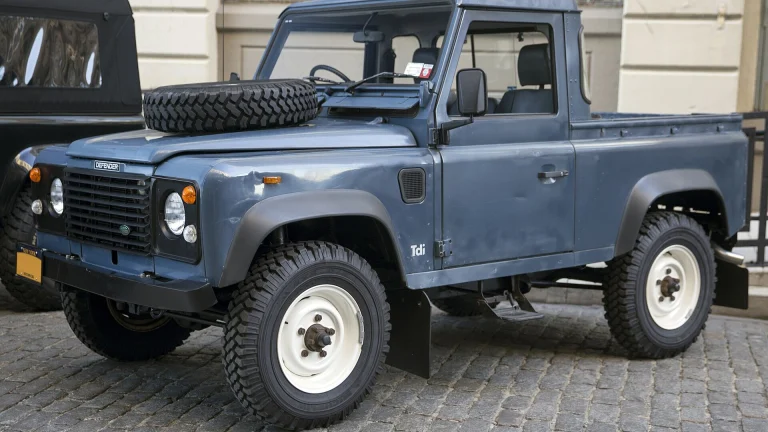
Anchoring the display is a North American Spec Defender, one of the trucks Land Rover built specifically for the U.S. market between 1993 and 1997 in genuinely small numbers before regulatory and business pressures pulled the model off American shores entirely. NAS Defenders have quietly become some of the most sought-after Land Rovers on the collector market, and the appeal isn’t nostalgia alone. These trucks were mechanically simple by design: leaf springs, low-tech but durable drivetrains, and a body-on-frame layout that made field repairs realistic instead of theoretical. That simplicity is exactly why so many are still running three decades later, and why clean examples now regularly trade well into six figures at auction.
626 Horsepower And A Suspension That Skips The Anti-Roll Bars
Standing in for the modern side of the family is Defender OCTA, the range-topping model built around a twin-turbo V8 rated at 626 horsepower and Land Rover’s 6D Dynamics suspension. Instead of relying on conventional anti-roll bars, 6D Dynamics links the dampers hydraulically across the vehicle, letting the truck manage body roll, pitch, and warp independently at each corner. The practical result is a Defender that can stay flat through a paved corner and still let a wheel droop deep into a rut off-road, without the compromises a fixed anti-roll bar forces on both jobs. It’s the same basic engineering logic Land Rover already put on sale with the New Defender OCTA, just now the brand’s using The Quail to argue it belongs next to a 30-year-old truck built on leaf springs.
Same Bones, Built To Survive The Dunes Instead Of The Driveway
The truck actually doing the identity-crisis heavy lifting is the Defender Dakar D7X-R, making its U.S. debut at The Quail after competing in the FIA World Rally-Raid Championship and the Dakar Rally. What makes the D7X-R worth paying attention to, mechanically, is that it’s built to FIA stock-class rules rather than the fully bespoke prototype regulations that govern the fastest Dakar entries. That means every D7X-R starts life on the same production line as a customer Defender OCTA, keeping the aluminum D7x body architecture, the driveline layout, and the 4.4-liter twin-turbo V8 essentially intact. From there, Land Rover raises the ride height, widens the track, upgrades the cooling system, and fits motorsport-tuned suspension to survive thousands of miles of dunes and rock-strewn stages. Stock-class rules exist to keep a rally-raid program tethered to the showroom truck instead of turning into a silhouette racer wearing a Defender badge, and that tether is the whole point of parking it next to a production OCTA. If you’re the type who already appreciates gear built to take a beating, it’s the same mindset that shows up in the aftermarket off-road world, like the armored trailers we’ve covered that treat overlanding as a genuine survival exercise rather than a weekend hashtag.
The Driver Behind The Wheel
Sara Price is on hand representing the Defender Rally team, and she’s not a hired spokesperson bolted onto the display for the weekend. Price built her name in motocross before moving into desert racing and rally-raid competition, and she’s part of the driver lineup behind Defender Rally’s winning Dakar program. Putting her at the booth instead of just showing footage matters for the same reason the stock-class regulations matter: Land Rover is betting that buyers care whether the racing program is real, not just a marketing overlay on a lifestyle SUV.
Whatever’s Under That Cover, Nobody’s Confirming Yet
Land Rover also confirmed a press conference at the Defender booth at noon PST on August 10 for what it’s calling a global preview of an all-new derivative with unique features. The company hasn’t detailed what that means, and we’re not going to guess on its behalf. What we do know is that JLR chose a concours event over a traditional auto show for the reveal, which tells you something about who Land Rover thinks its actual audience is right now: collectors and enthusiasts standing on a lawn in Monterey, not a convention center crowd.
Guests who wander over to the Land Rover Experience Center at The Quail Lodge can also book guided off-road runs for the length of the event, turning the static display into something you can actually feel from the driver’s seat, body control and all.
Why This Matters Beyond A Pretty Lawn Display
Concours events used to be about judging paint depth and matching numbers, not brand strategy. Automakers increasingly treat them as the setting for reveals and halo-car storytelling because the audience already self-selects for people who care about provenance and engineering, not just horsepower figures on a spec sheet. For Defender specifically, the timing carries extra weight: the brand’s still working to rebuild trust after a stop-sale earlier this year covering the Defender, Discovery, and Range Rover lineups over an airbag issue, and there’s no better counter-programming than showing up with your racing program’s actual winning driver and a race truck that shares its bones with the truck in your showroom. Whether that global preview turns out to be a new body style, a special edition, or something else entirely, Land Rover made its point at The Quail before the cover even came off: heritage, horsepower, and motorsport pedigree all trace back to the same aluminum architecture, and none of it is for show.
About the Author