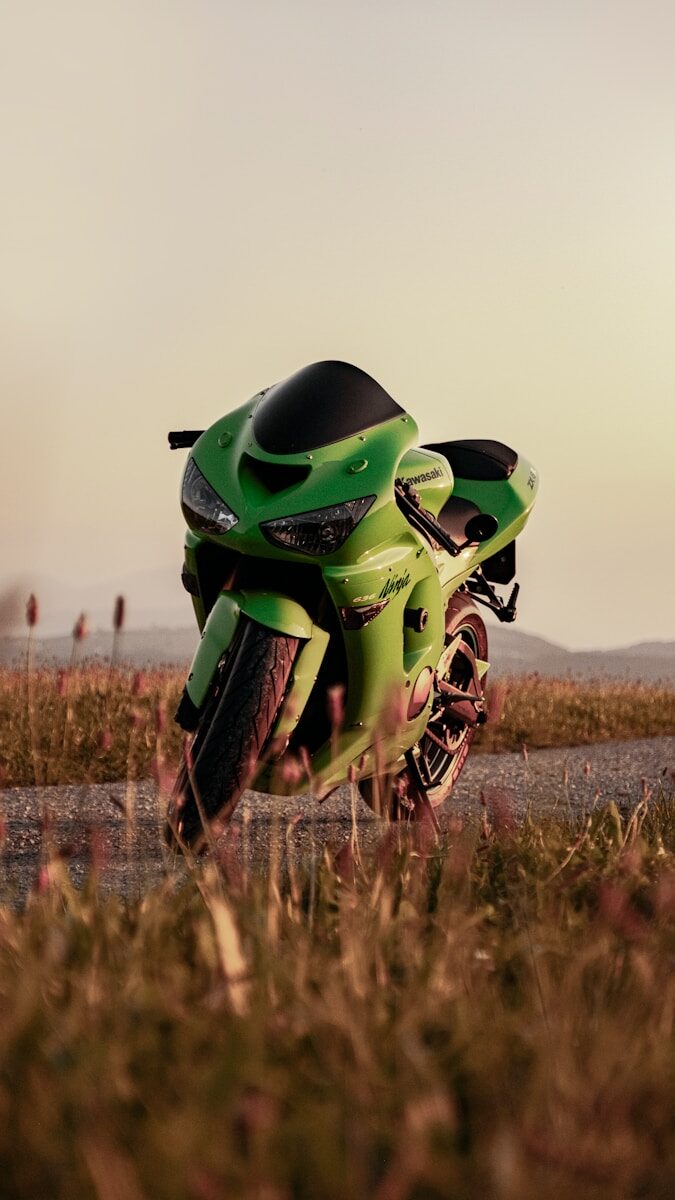
Kawasaki has quietly re-upped one of the last true 600-class inline-fours you can still buy with a license plate on it. The Ninja ZX-6R and ZX-6R ABS are back for 2027, and if you were hoping for a ground-up redesign, sharpen your expectations: this is a carryover, right down to the decimal point.
What actually changed: the paint
Put Kawasaki’s 2027 spec sheet next to the 2026 one and every meaningful number is identical. Same 636cc DOHC 16-valve inline-four. Same 67.0 x 45.1mm bore and stroke, same 12.9:1 squeeze, same 127.0 horsepower at 13,000 rpm and 52.1 lb-ft at 10,800 rpm. Same 38mm Keihin throttle bodies with oval sub-throttles, same six-speed, same sealed chain. Chassis is untouched too: aluminum perimeter frame, 23.5 degrees of rake, 4.0 inches of trail, a 55.1-inch wheelbase and a 32.7-inch seat.
What’s new is the color palette. Kawasaki lists Lime Green, Metallic Spark Black/Metallic Flat Spark Black, Metallic Matte Twilight Blue and Galaxy Silver for 2027 — the gray-and-white schemes from 2026 are gone.
Pricing sits still as well. Kawasaki’s site shows $11,599 for the non-ABS bike and $12,599 with ABS, matching 2026 dollar for dollar. In a year where almost nothing on a showroom floor costs what it did twelve months ago, a flat sticker is arguably the most interesting thing in the announcement.
Read that horsepower figure carefully
The 127.0 hp number carries an asterisk most spec-sheet skimmers blow past. Kawasaki measures it to ISO standard 4106, and the company says outright that ISO tallies horsepower differently than the SAE standard used for most car figures — which means the published number may read higher than an SAE result would. That’s not Kawasaki fudging; it’s a disclosed methodology difference. It does mean cross-shopping a Ninja’s claimed output against a rival’s SAE-rated number is apples to oranges, and that dyno charts from your local shop will land wherever they land.
Related Articles
- O’Reilly Auto Parts Is Paying $18.8 Million Because Its Texts Wouldn’t Take No for an Answer
- A Real-Life Lightning McQueen Got Towed After an Elk Grove Car Meet Turned Into a Brawl
The other number worth chewing on is the stroke. At 45.1mm against a 67.0mm bore, the 636 is noticeably less oversquare than the 599cc fours the class was built around. Kawasaki has been explicit for years that the extra 37cc buys low- and mid-range torque, which is the whole argument for the bike on a public road. The tradeoff is theoretical top-end and a rev ceiling that a shorter-stroke 599 could chase harder. On a canyon run at 6,000 rpm, you’ll take the torque.
The ABS question is a $1,000 question
Here’s the part that deserves real thought, because it’s a permanent decision. The ABS model doesn’t just add a pump — it adds KIBS, which Kawasaki built specifically for supersports and which ties the ABS ECU to the engine ECU. Beyond wheel speed, KIBS watches front caliper hydraulic pressure, throttle position, engine rpm, clutch actuation and gear position, then modulates front pressure in far finer increments than a generic system. It’s designed to limit rear-wheel lift under hard braking and to account for downshifts while you’re on the lever.
That is not a retrofit. You cannot bolt KIBS onto a non-ABS ZX-6R in your garage; the plumbing, the sensors and the ECU handshake all have to be there from the factory. Choose the cheaper bike and you’ve chosen for the life of the motorcycle.
Worth weighing against that $1,000: IIHS research puts fatal crash rates for bikes with optional ABS 22 percent below identical models without it, with affiliated loss data showing collision claim rates 21 to 24 percent lower. The U.S. still doesn’t mandate motorcycle ABS the way the EU, UK, Japan and India do — which is exactly why Kawasaki can keep selling you the option. Call your insurer before you sign; some carriers price ABS bikes differently, and a discount plus the safety math can close a chunk of that gap over a few years of premiums.
What the competition looks like now
The middleweight aisle has thinned to the point of absurdity. Yamaha’s supersport lineup runs R3, R7, R9, R1 and R1M — no street R6 anywhere on it. Honda lists the CBR600RR at $11,499 without ABS and $12,499 with it, undercutting the Kawasaki by exactly $100 on both trims. Suzuki’s 2026 announcement put the GSX-R600 at $12,199 — $600 above the base Ninja, with no ABS, no traction control and no TFT dash on offer at any price.
Related Articles
- Ram’s 2027 Rumble Bee Muscle Trucks Ditch eTorque and Stop-Start, But Keep the One Hybrid-Era Trick Worth Having
- Florida Deputies Clock a Pink Porsche at 96 MPH in a 45 Zone — One MPH From a Simple Ticket, Instead a Criminal Charge
Frame it that way and the ZX-6R’s flat pricing looks less like inertia and more like positioning. For a hundred bucks over the Honda you get traction control with three settings, selectable power modes, an upshift-only quickshifter, a 4.3-inch color TFT and phone connectivity. Kawasaki isn’t winning this segment on horsepower. It’s winning on the electronics package.
The racing footnote that keeps the 636 alive
There’s a structural reason this engine still exists. MotoAmerica’s Supersport class caps four-cylinder entries at “over 400cc up to 636cc” — a ceiling that is, transparently, the ZX-6R’s displacement. Kawasaki’s oddball 636 didn’t get grandfathered into the rulebook by accident; the rulebook moved to accommodate it after the 599cc field collapsed. As long as that number stays in print, there’s a competition case for keeping the bike homologated, and homologation is often what keeps a slow-selling model in the catalog.
Practical takeaways
Buy the 2027 for the color you want, not for the spec sheet — a leftover 2026 at a discount is mechanically the same motorcycle, and dealers clearing floor space at model-year changeover is where the actual money is saved. Get the ABS unless you’re building a dedicated track bike, because it’s the one box you can’t tick later. And budget realistically: chain-and-sprocket wear, Diablo Rosso IV replacement rubber and shim-adjust valve service on a 13,000-rpm four are the costs that define ownership here, not the sticker.
About the Author